Nuro Autonomous Delivery Startup has become one of the most important names in the future of last-mile logistics. The company was founded in 2016 by Dave Ferguson and Jiajun Zhu, both former engineers from Google’s self-driving car project. From the beginning, Nuro focused on a different part of autonomy than many other self-driving startups. Instead of building robotaxis for passengers, Nuro designed autonomous vehicles for goods delivery.
This focus made Nuro stand out in the autonomous vehicle industry. While many companies tried to solve the difficult challenge of carrying people safely through cities, Nuro focused on smaller, low-speed, zero-occupant vehicles built to transport groceries, meals, medicines, packages, and local retail orders. The idea was simple but powerful: last-mile delivery is costly, repetitive, local, and highly important to modern commerce.
Last-mile logistics refers to the final step of delivery, when goods move from a local store, restaurant, warehouse, or distribution center to the customer’s door. It is often the most expensive and complex part of the supply chain. Traffic, labor costs, route planning, fuel, delivery windows, and customer expectations all make last-mile logistics difficult. Nuro’s autonomous delivery model aims to reduce some of these challenges by using self-driving technology built specifically for local goods movement.
Nuro Autonomous Delivery Startup and Its Founding Vision
Nuro Autonomous Delivery Startup was built on the belief that autonomous vehicles could first become useful by moving goods instead of people. A zero-occupant delivery vehicle does not need seats, airbags, steering wheels, pedals, or passenger comfort features in the same way a traditional car does. This allows the vehicle to be designed around cargo, safety, local movement, and efficiency.
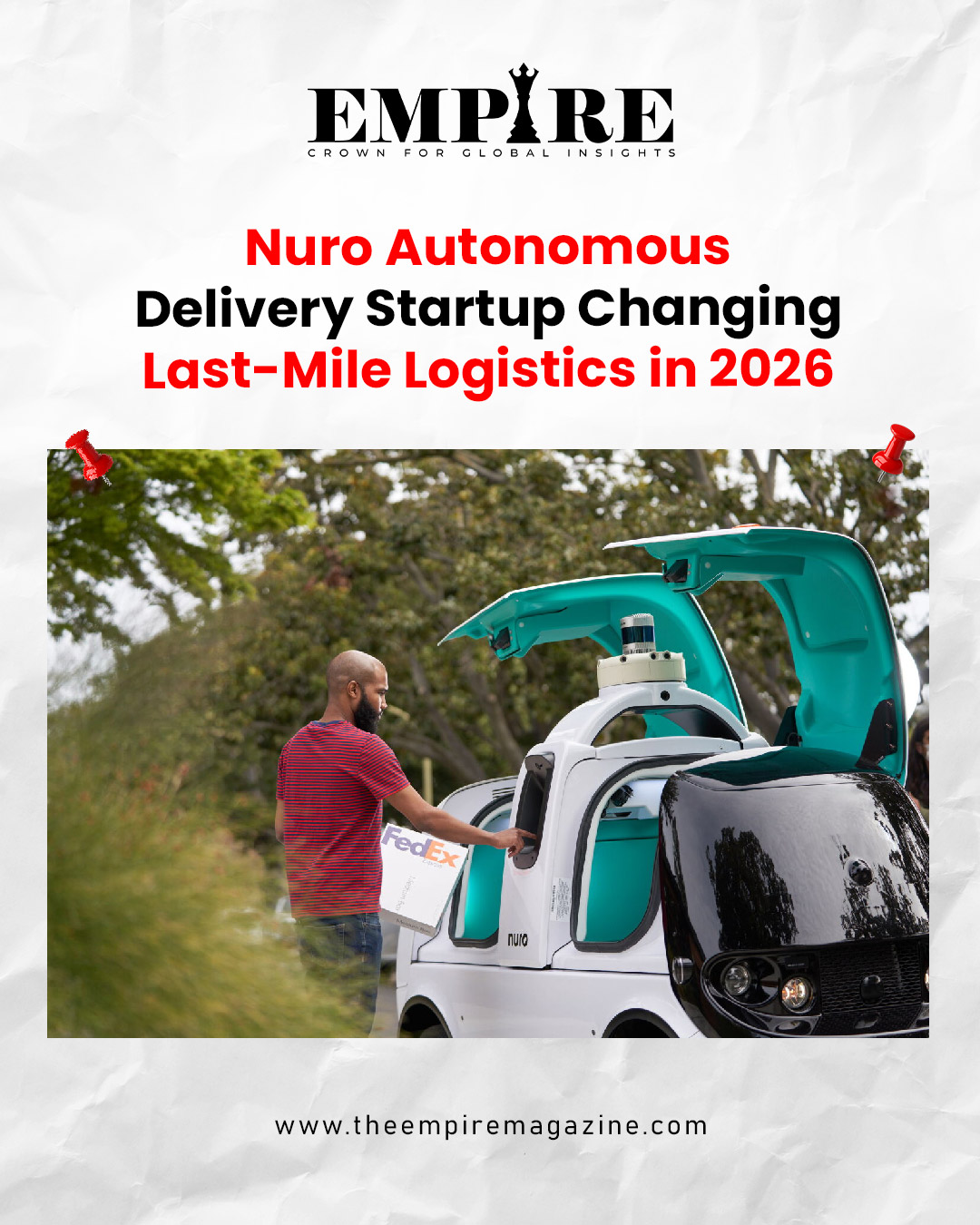
Nuro’s early vehicles were created specifically for delivery. The company developed small autonomous vehicles that could operate at low speeds and carry products in storage compartments. Customers could unlock the vehicle when it arrived and collect their order.
This model had practical advantages. Delivery routes are often repeatable. Grocery stores, restaurants, pharmacies, and retailers already send orders to nearby customers. Autonomous delivery can fit into this structure if the technology is safe, reliable, and approved by regulators.
Nuro Autonomous Delivery Startup and Zero-Occupant Vehicles
Nuro Autonomous Delivery Startup became known for zero-occupant vehicles. This means the vehicle is not designed to carry a driver or passengers. Instead, it is built only to carry goods.
This design changes the safety and business logic of autonomy. A smaller, lighter delivery vehicle can reduce certain risks compared with a full-size passenger car. It can also be optimized for neighborhood delivery instead of highway travel or long-distance trips.
Nuro’s R2 vehicle became especially important because it represented one of the clearest examples of a purpose-built autonomous delivery robot for public roads. In 2020, the U.S. National Highway Traffic Safety Administration granted Nuro a temporary exemption for its R2 low-speed, occupantless electric delivery vehicle. This was a major regulatory milestone because U.S. vehicle rules were traditionally built around human-driven cars.
Nuro Autonomous Delivery Startup and Regulatory Progress
Nuro Autonomous Delivery Startup made history when its R2 vehicle received federal approval for a temporary exemption from certain low-speed vehicle standards. The exemption allowed Nuro to deploy a vehicle without traditional human-driver features such as mirrors and windshield requirements tied to human operation.
This was important because autonomous delivery vehicles do not fit neatly into old vehicle categories. Regulations were created for cars with drivers, passengers, steering wheels, pedals, and driver visibility needs. Nuro’s R2 challenged that structure by showing that a vehicle could be designed only for goods and automated driving.
Nuro also received permission in California for autonomous vehicle deployment, becoming one of the first companies allowed to operate driverless delivery services in the state. These regulatory steps helped validate the company’s technology and opened the door for pilot programs with major commercial partners.
Nuro Autonomous Delivery Startup and Safety Standards
Nuro Autonomous Delivery Startup has always had to address safety as a central issue. Autonomous vehicles must detect pedestrians, cyclists, cars, signals, road signs, driveways, construction zones, and unexpected events. For delivery vehicles, safety is especially important because they operate close to homes, stores, sidewalks, and neighborhoods.
Nuro’s vehicles use sensors, software, mapping, perception systems, prediction tools, and autonomous driving algorithms. The goal is to understand the surrounding environment and move safely through local streets.
Safety is also important for public trust. Customers, city officials, regulators, and partners need confidence that autonomous delivery vehicles can operate without creating new risks. This is why testing, permits, controlled deployment, and transparent safety processes are essential for companies like Nuro.
Nuro Autonomous Delivery Startup and Delivery Partnerships
Nuro Autonomous Delivery Startup built credibility through partnerships with major brands. The company worked with Kroger for grocery delivery, Domino’s for pizza delivery, FedEx for parcel logistics testing, and Uber Eats for food delivery pilots. These partnerships helped show how autonomous delivery could work in different real-world categories.
With Kroger, Nuro tested grocery delivery services. Grocery delivery is a strong use case because orders are local, repeatable, and often time-sensitive. Customers want fresh food delivered efficiently, and retailers want to reduce delivery costs.
With Domino’s, Nuro launched autonomous pizza delivery in Houston using its R2 vehicle. This pilot showed how restaurant delivery could work with autonomous vehicles. Customers received notifications and could collect their order from the vehicle.
FedEx tested Nuro’s autonomous vehicles for package delivery, exploring how self-driving technology could support parcel logistics. This connected Nuro to the wider e-commerce supply chain, where last-mile delivery has become a major cost challenge.
Nuro Autonomous Delivery Startup and Uber Eats
Nuro Autonomous Delivery Startup also partnered with Uber Eats. In 2022, Nuro and Uber announced a 10-year partnership for autonomous food delivery using Nuro’s vehicles through the Uber Eats platform. The partnership focused on markets including California and Texas.
This was important because Uber Eats already had a large restaurant and customer network. By connecting with Uber’s platform, Nuro could potentially reach more merchants and consumers without building a delivery marketplace from scratch.
For Uber, the partnership offered a way to explore autonomous delivery without owning the entire self-driving technology stack. For Nuro, it created access to a large food delivery ecosystem and a real-world route to commercialization.
Nuro Autonomous Delivery Startup and the Business of Last-Mile Delivery
Nuro Autonomous Delivery Startup is trying to solve one of the hardest problems in logistics: the cost and complexity of the final mile. Last-mile delivery often requires human drivers, flexible routing, customer communication, vehicle availability, and fast response times.
Labor is a major cost in delivery. Fuel and vehicle maintenance also add pressure. In dense cities, traffic makes delivery slower. In suburbs, long distances between stops can reduce efficiency. Autonomous delivery could help reduce some costs if vehicles can operate safely, reliably, and at scale.
The business opportunity is large because e-commerce, grocery delivery, restaurant delivery, pharmacy delivery, and same-day retail delivery have all grown. Consumers increasingly expect fast, convenient delivery. Retailers and logistics companies need better tools to meet that demand without destroying margins.
Nuro Autonomous Delivery Startup and Local Commerce
Nuro Autonomous Delivery Startup can support local commerce by helping stores deliver products to nearby customers. A small retailer, pharmacy, or restaurant may not want to operate a full delivery fleet. Autonomous vehicles could become part of a shared delivery network that helps businesses compete with large online platforms.
This is especially important for grocery and food delivery, where margins can be thin. If delivery costs are too high, the service becomes difficult to sustain. Autonomous delivery could help reduce costs over time, although the technology still requires major investment and careful operations.
Nuro’s delivery model also fits with the rise of on-demand commerce. Customers want speed, tracking, convenience, and flexible delivery windows. Autonomous vehicles can become part of that digital delivery experience if integrated with apps and merchant platforms.
Nuro Autonomous Delivery Startup and Technology Strategy
Nuro Autonomous Delivery Startup originally focused on custom delivery robots, but the company has expanded its strategy. In recent years, Nuro has shifted toward licensing its autonomous driving technology, known as the Nuro Driver, to other companies, original equipment manufacturers, and mobility providers.
This shift matters because building and operating a full delivery fleet is expensive. Vehicle manufacturing, operations, customer support, maintenance, mapping, insurance, and regulatory approvals all require large resources. Licensing autonomous technology can create a broader business model.
The Nuro Driver is designed as a Level 4 autonomous driving system. Level 4 means the vehicle can drive itself under specific conditions without human intervention. This is different from driver assistance systems, where a human driver must stay ready to take control.
Nuro Autonomous Delivery Startup and the Move Beyond Delivery
Nuro Autonomous Delivery Startup is now connected to a broader mobility future. The company announced a global robotaxi program with Uber and Lucid, using Nuro’s autonomous driving system in Lucid vehicles on the Uber platform. This shows that Nuro’s technology is moving beyond small delivery robots into passenger mobility.
This does not erase Nuro’s delivery roots. Instead, it shows how autonomous driving technology developed for goods movement can be applied to other vehicle categories. If Nuro can license its system successfully, it may become more of an autonomy platform company than only a delivery vehicle operator.
The move also reflects changes in the autonomous vehicle market. Many startups have struggled with high costs, long timelines, and difficult commercialization. Licensing technology to automakers and mobility platforms may offer a more scalable path.
Nuro Autonomous Delivery Startup and Funding
Nuro Autonomous Delivery Startup has raised large amounts of capital over its lifetime. In 2021, the company raised a major Series D round and reached a valuation of $8.6 billion. In 2025, Nuro raised $203 million in late-stage funding at a $6 billion valuation, with investment from companies including Uber and Nvidia.
The change in valuation shows how the autonomous vehicle market has become more disciplined. Investors are still interested in autonomy, especially as artificial intelligence becomes more important, but they are also focused on practical commercialization and sustainable business models.
Nuro’s ability to raise funding shows continued confidence in its technology. However, it also shows that autonomous vehicles remain capital-intensive. Building safe self-driving systems requires talent, testing, simulation, hardware, data, regulatory work, and long development timelines.
Nuro Autonomous Delivery Startup and Investor Expectations
Nuro Autonomous Delivery Startup must prove that its technology can create real revenue. Investors are no longer satisfied with ambitious promises alone. They want to see commercial partnerships, scalable licensing, regulatory progress, and clear unit economics.
Autonomous delivery can be powerful, but it must work financially. Vehicles need to be affordable to build and operate. Maintenance must be manageable. Delivery routes must be efficient. Customers and merchants must accept the experience.
Nuro’s shift toward licensing may help answer some of these concerns. If the company can provide autonomous driving technology to multiple partners, it may reduce the need to own every part of the delivery or mobility network.
Nuro Autonomous Delivery Startup and Competition
Nuro Autonomous Delivery Startup operates in a competitive space. Last-mile logistics is being transformed by drones, sidewalk robots, electric vans, delivery apps, warehouse automation, route optimization software, and autonomous vehicles.
Companies are exploring many ways to reduce delivery costs. Some focus on human driver efficiency. Others use warehouse micro-fulfillment centers. Some use sidewalk robots for small orders. Others test drones for certain routes. Nuro’s road-based autonomous vehicle approach is one part of this larger logistics innovation wave.
Its advantage is that it has built real autonomous vehicle technology and gained regulatory experience. Its challenge is to scale that technology into a profitable business while competing with other delivery and mobility models.
Nuro Autonomous Delivery Startup and Public Adoption
Nuro Autonomous Delivery Startup also depends on customer adoption. People must feel comfortable receiving goods from a driverless vehicle. They must understand how to unlock the compartment, collect the order, and complete the delivery.
For many customers, the first experience may feel new. But if the service is reliable, safe, and convenient, adoption can grow. Delivery is a practical use case because customers care mainly about whether the order arrives correctly, safely, and on time.
Public acceptance will also depend on how cities manage autonomous vehicles. Regulators must balance innovation with road safety, accessibility, traffic rules, and community concerns.
Nuro Autonomous Delivery Startup and the Future of Logistics
Nuro Autonomous Delivery Startup shows how last-mile logistics is becoming more automated, electric, and software-driven. The company’s early focus on zero-occupant delivery vehicles helped define a new category in autonomous transportation.
The future of Nuro may look different from its original delivery-only model. Its autonomous technology is now positioned for broader use across delivery, robotaxis, fleet operators, and possibly personal vehicles. This makes Nuro an important company to watch in both logistics and mobility.
Last-mile logistics will continue to face pressure from rising delivery demand, labor shortages, customer expectations, and cost challenges. Autonomous systems may not replace all human delivery workers soon, but they can become part of a mixed delivery network.
For Nuro, the next stage depends on technology reliability, partner adoption, regulatory approvals, funding discipline, and commercial execution. Its journey shows that autonomous delivery is not just a futuristic idea. It is a real business challenge at the center of modern logistics.
For more startup and logistics technology insights, read more on The Empire Magazine.
Follow The Empire Magazine on Facebook and Instagram.
– The Empire Magazine
Crown For Global Insights