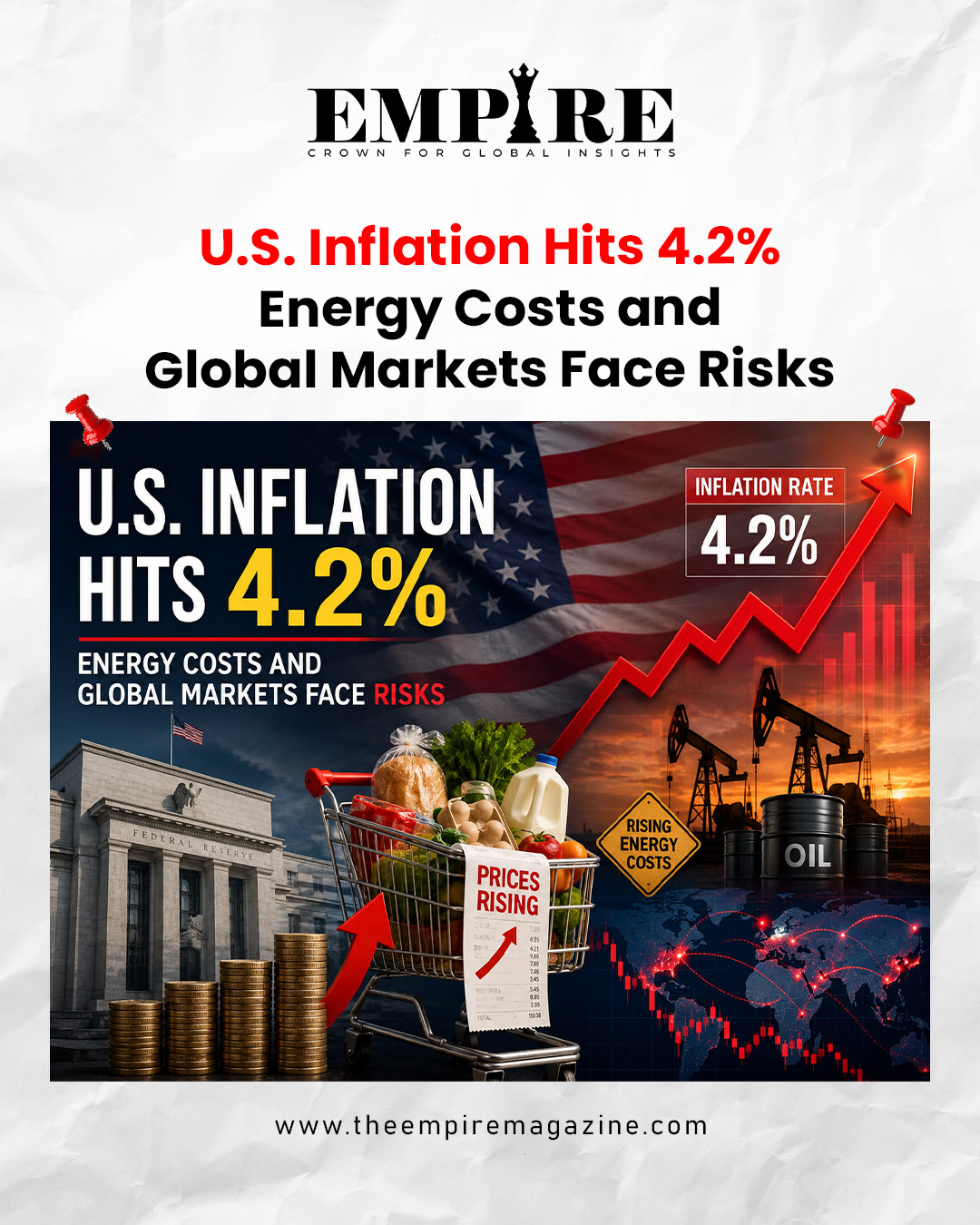
U.S. Inflation Hits 4.2% at a time when global markets are already dealing with energy uncertainty, geopolitical risk, and cautious investor sentiment. The latest inflation reading shows that price pressure has not disappeared from the world’s largest economy. Instead, higher energy costs are again becoming a major force behind household expenses, business costs, and financial market expectations.
The U.S. Consumer Price Index rose 4.2% year-over-year in May 2026, marking a sharp acceleration from earlier levels. Energy played a major role in the move. The Bureau of Labor Statistics reported that the energy index increased 3.9% in May, while gasoline prices rose 7.0% during the month. For consumers, this means higher costs at the pump. For businesses, it means pressure on transport, logistics, manufacturing, aviation, retail, and supply chains.
Inflation is important because it affects almost every part of the economy. When prices rise quickly, consumers have less purchasing power. Businesses face higher input costs. Central banks become more cautious. Bond yields can move higher. Stock markets may become more volatile. Currencies can react as investors adjust expectations for interest rates and growth.
U.S. Inflation Hits 4.2% and Energy Becomes the Main Driver
U.S. Inflation Hits 4.2% largely because energy costs have moved higher. Energy is one of the most sensitive parts of inflation because it affects both direct consumer spending and business operations. Gasoline, electricity, fuel oil, natural gas, freight costs, airline fuel, and industrial energy use can all shape broader price trends.
When gasoline prices rise, households feel the impact quickly. Many people cannot easily reduce commuting, school travel, deliveries, or basic movement. This makes fuel inflation politically and economically important. Rising energy costs can also change consumer behavior. Families may reduce spending on restaurants, entertainment, shopping, travel, and discretionary goods to cover higher fuel and utility bills.
For businesses, energy costs are not limited to one line item. A retailer may pay more for delivery, warehousing, refrigeration, and store operations. A manufacturer may face higher production and transport costs. Airlines may see fuel expenses rise. Shipping companies may adjust freight rates. These increases can move through the economy and influence final prices for consumers.
U.S. Inflation Hits 4.2% and Gasoline Prices Matter
U.S. Inflation Hits 4.2% with gasoline acting as one of the clearest pressure points. Gasoline prices are highly visible to consumers because they are seen every day at fuel stations. Even when other categories are stable, rising gasoline prices can make people feel inflation more strongly.
Gasoline also affects market psychology. Investors watch fuel prices because they can influence consumer spending, company margins, inflation expectations, and central bank policy. If energy prices remain elevated for several months, markets may start to worry that temporary inflation could become more persistent.
This matters for global markets because the United States is a major consumer economy. If American households reduce spending because of higher fuel costs, the impact can be felt by global exporters, retailers, commodity producers, and financial markets.
U.S. Inflation Hits 4.2% and the Federal Reserve Faces Pressure
U.S. Inflation Hits 4.2% at a difficult time for the Federal Reserve. The central bank’s long-term inflation target is 2%, so a 4.2% inflation reading remains well above the desired level. When inflation rises, the Federal Reserve must decide whether to keep interest rates higher for longer or risk price pressure becoming more embedded.
Higher interest rates are used to slow demand and reduce inflation, but they can also make borrowing more expensive. This affects mortgages, car loans, credit cards, business loans, and investment activity. If rates stay high, consumers and companies may become more cautious.
The challenge is that energy-driven inflation is difficult for central banks to control. The Federal Reserve can influence demand, but it cannot directly produce more oil, open shipping lanes, or reduce geopolitical risk. This creates a policy dilemma. If inflation is driven mainly by energy, aggressive rate hikes could hurt growth without immediately solving the root cause.
U.S. Inflation Hits 4.2% and Rate Expectations Shift
U.S. Inflation Hits 4.2% and markets immediately begin watching rate expectations. Bond traders, equity investors, currency markets, and commodity investors all react to inflation data because it changes the outlook for monetary policy.
If investors believe inflation will remain high, bond yields may rise. Higher yields can pressure stock valuations, especially for technology and growth companies. A stronger dollar may also emerge if markets expect U.S. interest rates to stay elevated compared with other major economies.
However, if core inflation remains more controlled, markets may expect the Federal Reserve to wait before making any aggressive move. That is why investors look beyond the headline number. They study energy prices, food prices, services inflation, wages, shelter costs, and core inflation to understand whether the pressure is broad or concentrated.
U.S. Inflation Hits 4.2% and Global Markets React
U.S. Inflation Hits 4.2% with global markets watching closely because U.S. inflation affects the world. The dollar, Treasury yields, oil prices, gold, emerging-market currencies, global equities, and commodity markets can all respond to U.S. inflation data.
When U.S. inflation rises, investors often become more cautious. They may expect tighter financial conditions, slower consumer spending, and pressure on corporate earnings. This can affect stock markets in Asia, Europe, the Middle East, and emerging economies.
Global companies also watch U.S. inflation because America remains a key consumer market. If higher energy costs reduce American demand, exporters and multinational companies may feel the impact. Luxury brands, consumer goods companies, automakers, airlines, and retailers all depend in some way on U.S. consumer strength.
U.S. Inflation Hits 4.2% and Emerging Markets Feel the Impact
U.S. Inflation Hits 4.2% can create pressure for emerging markets. When U.S. rates are expected to stay higher, global capital may move toward dollar assets. This can weaken emerging-market currencies and make dollar-denominated debt more expensive.
Energy-importing countries may face a double challenge. They may pay more for oil and fuel while also dealing with a stronger dollar. This can raise import costs and worsen inflation at home. Countries that depend heavily on imported energy may feel the pressure most directly.
At the same time, energy-exporting countries may benefit from higher oil and gas prices. This means the global impact of energy inflation is uneven. Some economies gain revenue, while others face higher costs.
U.S. Inflation Hits 4.2% and Oil Market Risk
U.S. Inflation Hits 4.2% while oil markets remain sensitive to geopolitical tension and supply disruption. Energy prices often rise when traders fear that oil flows could be affected by conflict, sanctions, shipping disruptions, or production cuts.
Oil is not only a commodity. It is a core input for the global economy. It affects transport, petrochemicals, aviation, manufacturing, agriculture, and consumer goods. When oil prices rise quickly, the effects can spread across many sectors.
The connection between oil and inflation is especially important because energy shocks can happen suddenly. A conflict, shipping issue, refinery outage, or supply cut can push prices higher before companies and consumers have time to adjust.
U.S. Inflation Hits 4.2% and Supply Chains Face New Costs
U.S. Inflation Hits 4.2% and supply chains face renewed cost pressure. Higher fuel costs can increase freight rates, trucking expenses, air cargo costs, and shipping charges. This can affect imported goods, food distribution, e-commerce delivery, and manufacturing supply chains.
During earlier inflation cycles, supply chains were a major source of price pressure. While many disruptions have eased, energy shocks can bring back cost concerns. If companies cannot absorb higher transport and production costs, they may pass some of those costs to consumers.
This is why energy inflation can be more powerful than it first appears. It does not stay only in fuel markets. It can move into food, goods, travel, logistics, retail pricing, and corporate margins.
U.S. Inflation Hits 4.2% and Consumer Spending Slows
U.S. Inflation Hits 4.2% and consumers may become more careful with spending. Inflation reduces real income because wages often do not rise as fast as prices. When households spend more on fuel, electricity, rent, food, and insurance, they have less money left for optional purchases.
Retailers may see changes in customer behavior. Shoppers may buy fewer premium products, delay large purchases, look for discounts, or shift to lower-cost alternatives. Travel and leisure spending can also become more selective if fuel and airfare rise.
Consumer spending is important because it supports a large part of the U.S. economy. If inflation weakens spending, companies may see slower revenue growth. This can affect earnings, hiring, investment, and stock market confidence.
U.S. Inflation Hits 4.2% and Household Budgets Tighten
U.S. Inflation Hits 4.2% and household budgets become more stressed. Lower- and middle-income families are often hit hardest because energy and food take a larger share of their monthly income. Higher gasoline prices can be especially difficult for workers who commute long distances.
Inflation also affects confidence. Even if employment remains strong, rising prices can make consumers feel financially insecure. This can reduce spending on non-essential goods and services.
For businesses, weaker consumer confidence can create a difficult environment. They may face higher costs at the same time customers become more price-sensitive.
U.S. Inflation Hits 4.2% and Corporate Margins
U.S. Inflation Hits 4.2% and companies must manage cost pressure. Energy is a direct expense for transportation, logistics, airlines, industrial firms, restaurants, hotels, and retailers. It is also an indirect cost because suppliers may raise prices.
Companies with strong pricing power may pass costs to customers. However, if consumers are already under pressure, raising prices can reduce demand. This creates a margin squeeze. Businesses may need to cut costs, improve efficiency, renegotiate supplier contracts, or reduce discretionary spending.
Some sectors may be more exposed than others. Airlines, shipping, trucking, chemicals, manufacturing, and retail logistics are especially sensitive to energy. Technology companies may be less directly exposed, but data centers also require major electricity use.
U.S. Inflation Hits 4.2% and Earnings Expectations
U.S. Inflation Hits 4.2% and investors may adjust earnings expectations. If energy costs stay high, analysts may reduce margin forecasts for companies exposed to fuel, transport, and consumer weakness.
Stock markets often respond not only to current inflation but to what inflation means for future profits. If higher costs reduce earnings, valuations can come under pressure. If inflation leads to higher interest rates, the pressure can increase further.
This is why one inflation report can influence global market sentiment. It affects monetary policy, consumer behavior, corporate costs, and investor risk appetite at the same time.
U.S. Inflation Hits 4.2% and the Dollar’s Role
U.S. Inflation Hits 4.2% and the U.S. dollar becomes an important market signal. If investors expect the Federal Reserve to keep rates elevated, the dollar may strengthen. A stronger dollar can make imports cheaper for the U.S., but it can create pressure for other countries.
Many commodities, including oil, are priced in dollars. When the dollar strengthens, countries using other currencies may pay more in local-currency terms. This can worsen inflation abroad, especially in energy-importing economies.
A strong dollar can also pressure emerging-market debt. Countries and companies with dollar-denominated loans may face higher repayment costs when their local currencies weaken.
U.S. Inflation Hits 4.2% and Commodity Markets
U.S. Inflation Hits 4.2% and commodity markets become more active. Oil, natural gas, gold, industrial metals, and agricultural commodities can all react to inflation expectations and geopolitical risk.
Gold often attracts attention during inflation and uncertainty because investors may use it as a store of value. Oil prices can move higher when supply concerns rise. Industrial metals may react to growth expectations. Agricultural prices can be affected by fuel and fertilizer costs.
Commodity volatility can create another round of pressure for global businesses. Companies that depend on raw materials may face uncertain input costs, while commodity producers may benefit from higher prices.
U.S. Inflation Hits 4.2% and Global Central Banks
U.S. Inflation Hits 4.2% and global central banks must consider their own policy paths. If U.S. inflation remains high and the Federal Reserve stays cautious, other central banks may face pressure from currency movements, import costs, and capital flows.
Some countries may want to cut interest rates to support growth, but a strong dollar and high energy prices can make that harder. If they cut too quickly, their currencies may weaken and imported inflation may rise.
This creates a global policy challenge. Inflation may be driven by energy, but central banks must still manage expectations. If people and businesses believe inflation will stay high, they may adjust wages and prices in ways that make inflation more persistent.
U.S. Inflation Hits 4.2% and Investor Strategy
U.S. Inflation Hits 4.2% and investors may become more selective. During periods of inflation uncertainty, markets often favor companies with strong balance sheets, pricing power, stable cash flow, and lower debt sensitivity.
Energy companies may benefit from higher prices, while fuel-heavy sectors may face pressure. Banks may react to interest-rate expectations. Consumer discretionary companies may be watched closely because household spending could weaken.
Investors also pay attention to inflation-protected assets, dividend-paying companies, commodities, and defensive sectors. The key question is whether inflation remains energy-led or spreads into broader services and wages.
U.S. Inflation Hits 4.2% and the Global Market Outlook
U.S. Inflation Hits 4.2% and the global market outlook becomes more uncertain. The main issue is whether rising energy costs are temporary or the beginning of a longer inflation wave. If energy prices stabilize, inflation may ease over time. If energy prices continue rising, markets may price in tighter policy and slower growth.
The next data points will matter. Investors will watch gasoline prices, crude oil, core inflation, wage growth, consumer spending, retail sales, and Federal Reserve commentary. Businesses will watch whether higher energy costs affect demand and margins.
For global markets, the inflation shock is a reminder that energy remains central to economic stability. Even in a world focused on AI, digital platforms, and clean technology, oil and fuel prices still shape inflation, consumer behavior, corporate earnings, and central bank decisions.
For more business and global market insights, read more on The Empire Magazine.
Follow The Empire Magazine on Facebook and Instagram.
– The Empire Magazine
Crown For Global Insights