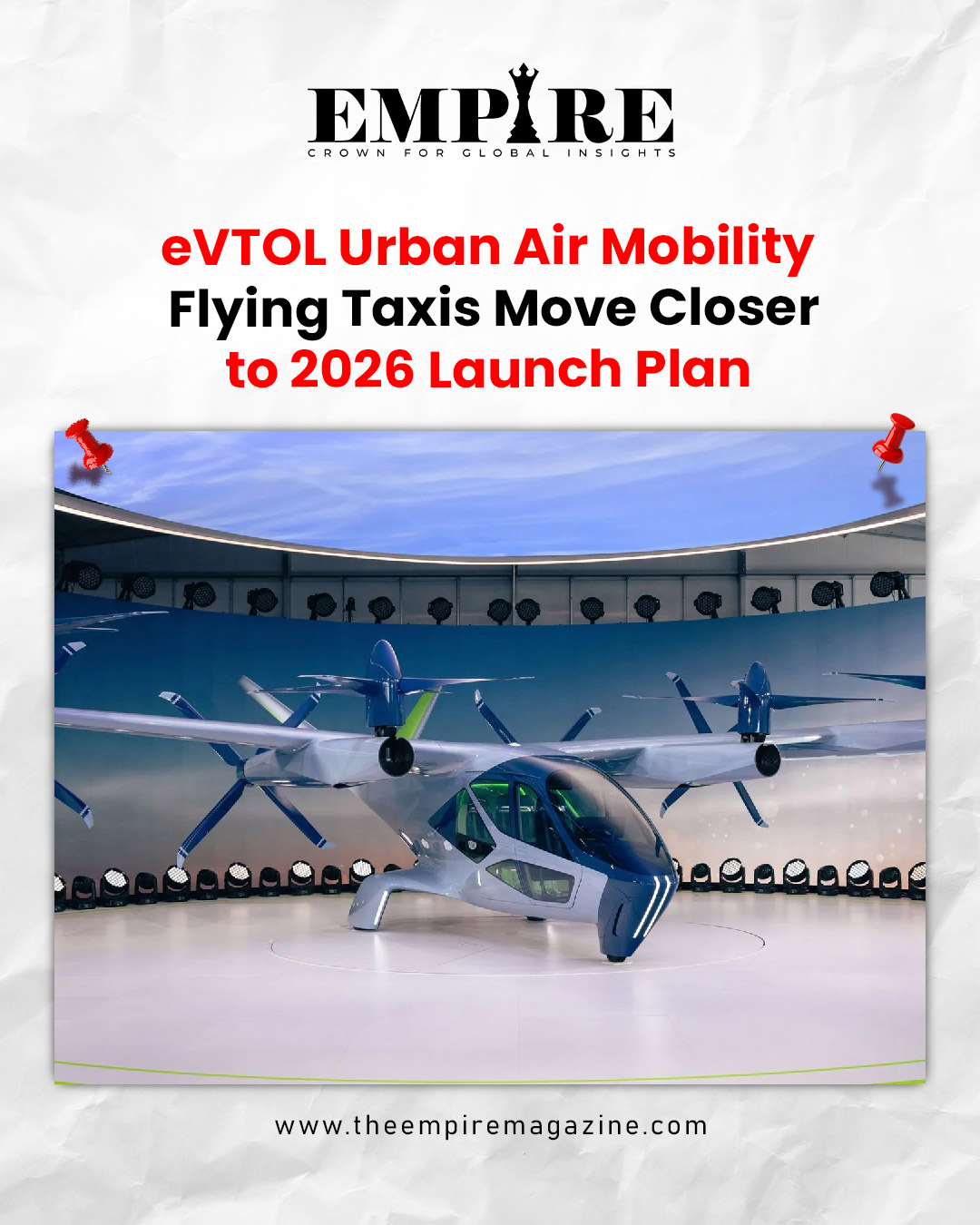
eVTOL Urban Air Mobility is becoming one of the most closely watched areas in transportation technology. For years, flying taxis sounded like a futuristic idea, but electric vertical take-off and landing aircraft are now moving through certification, test flights, infrastructure planning, and early commercial launch programs.
An eVTOL aircraft is designed to take off and land vertically, similar to a helicopter, but it uses electric propulsion. This gives it a different business case from traditional helicopters. The goal is to offer quieter, cleaner, and more efficient short-distance air travel across crowded urban areas.
Urban air mobility is the broader concept behind this movement. It imagines a network where passengers can travel between airports, business districts, residential areas, tourism zones, and transport hubs using electric air taxis. Instead of sitting in road traffic for long periods, passengers could take short point-to-point flights from vertiports.
The industry is still early, but progress is real. Companies such as Joby Aviation, Archer Aviation, Lilium, Vertical Aerospace, and Eve Air Mobility have worked on electric aircraft, regulatory approvals, and commercial partnerships. Cities such as Dubai, New York, Los Angeles, Miami, and Abu Dhabi have been discussed as future air taxi markets, while aviation regulators in the United States and Europe are building rules for safe operations.
eVTOL Urban Air Mobility and How Flying Taxis Work
eVTOL Urban Air Mobility depends on aircraft that can rise vertically, transition into forward flight, and land vertically again. This makes them suitable for city environments where long runways are not available. The aircraft can operate from vertiports, which are dedicated take-off and landing locations designed for electric air taxis.
Most passenger eVTOL aircraft are designed for short routes. They are not intended to replace long-distance airplanes. Instead, they are focused on airport transfers, cross-city trips, premium commuting, tourism routes, medical transport, and regional mobility.
Electric propulsion is one of the key differences. eVTOL aircraft use battery-powered motors instead of traditional jet or turbine engines. This can reduce direct emissions during flight and lower noise compared with helicopters. However, battery range, charging speed, weight, and certification remain major technical challenges.
eVTOL Urban Air Mobility and the Role of Vertiports
eVTOL Urban Air Mobility cannot work without vertiports. A vertiport is a landing and take-off facility for vertical aircraft. It may include passenger waiting areas, charging systems, safety zones, maintenance access, and connections to ground transport.
Vertiports are important because flying taxis need to connect with real city movement. A flight is only useful if passengers can reach the vertiport easily and continue their journey after landing. This is why many early air taxi plans focus on airports, downtown districts, tourist areas, business centers, and major transport hubs.
Dubai is one of the clearest examples of this infrastructure strategy. The city has worked with partners to develop vertiport locations connected to key destinations such as Dubai International Airport, Downtown Dubai, Dubai Marina, and Palm Jumeirah. This shows how urban air mobility is being planned as part of a wider transport network, not as a standalone novelty.
eVTOL Urban Air Mobility and Joby Aviation
eVTOL Urban Air Mobility has gained strong momentum through Joby Aviation. Joby is developing an all-electric air taxi designed to carry a pilot and passengers on short urban and regional trips. The company has spent years testing aircraft, working with regulators, and preparing for commercial operations.
In March 2026, Joby announced that its first FAA-conforming aircraft had taken flight. This was an important milestone because FAA-conforming aircraft are built for the final stages of certification testing. It showed that Joby was moving closer to formal type inspection and regulatory review.
Joby has also been active in Dubai. The company has announced progress with Dubai’s air taxi network and completed a point-to-point electric air taxi flight in the United Arab Emirates. Dubai’s Roads and Transport Authority has supported air taxi plans as part of the city’s future mobility vision.
eVTOL Urban Air Mobility and Dubai’s Early Launch Plans
eVTOL Urban Air Mobility could see one of its earliest large public examples in Dubai. Dubai has positioned itself as a city willing to test future transport systems, including autonomous mobility, smart infrastructure, and air taxi services.
Joby’s partnership with Dubai gives the company a strong international launch opportunity. The city’s high tourism traffic, airport connectivity, luxury travel market, and investment in futuristic infrastructure make it a suitable early market for flying taxis.
Dubai’s model also shows why urban air mobility may begin as a premium service. Early air taxi trips are likely to be more expensive than regular taxis or metro travel. The first users may include business travelers, high-income residents, tourists, airport passengers, and premium mobility customers.
eVTOL Urban Air Mobility and Archer Aviation
eVTOL Urban Air Mobility is also being advanced by Archer Aviation. Archer is developing its Midnight aircraft, an electric air taxi designed for short urban trips. The company has been working through FAA certification steps and has announced plans linked to initial U.S. operations.
Archer has focused on routes that could connect airports and city centers. This makes business sense because airport transfers are a common pain point in major cities. A trip that takes a long time by road during traffic could be shortened by air.
The company has also built partnerships across aviation, automotive, and mobility sectors. These partnerships matter because air taxi services require more than aircraft. They need pilots, maintenance systems, charging, vertiports, booking platforms, safety operations, and regulatory approval.
eVTOL Urban Air Mobility and U.S. Certification
eVTOL Urban Air Mobility in the United States depends heavily on FAA certification. Aircraft must meet strict safety standards before they can carry passengers commercially. This process includes aircraft design approval, testing, production certification, pilot training, maintenance procedures, operational rules, and airspace integration.
Certification is one of the biggest reasons flying taxis have taken longer than early projections. Aviation safety standards are intentionally demanding. A company cannot simply launch a new aircraft because the technology works in test flights. It must prove the aircraft is reliable, safe, maintainable, and suitable for passenger operations.
The progress by Joby and Archer shows that the industry is moving forward, but commercial air taxi services will still depend on regulatory milestones and operational readiness.
eVTOL Urban Air Mobility and Europe’s Regulatory Path
eVTOL Urban Air Mobility is also developing in Europe under the European Union Aviation Safety Agency. EASA has worked on rules for vertical take-off and landing aircraft, urban air mobility, and new air mobility operations.
Europe’s approach is important because air taxis will need strong public trust. Cities must understand noise, safety, landing locations, air traffic management, emergency procedures, and environmental impact before allowing regular services.
EASA has said urban air mobility is expected to become a reality in Europe within the coming years. However, Europe’s path has also shown that certification and business models are difficult. Some European eVTOL companies have faced funding challenges, delays, restructuring, or changing launch expectations.
eVTOL Urban Air Mobility and Safety Rules
eVTOL Urban Air Mobility must meet high safety expectations because these aircraft will operate near people, buildings, roads, airports, and other aircraft. Safety is not only about the aircraft itself. It also includes flight paths, pilots, weather limits, maintenance, ground operations, passenger handling, and emergency planning.
Regulators must decide how eVTOL aircraft fit into existing airspace. They must also manage traffic if many air taxis operate in the future. Early services may be limited and carefully controlled before larger networks become possible.
This is why commercial launch timelines should be viewed carefully. The technology is progressing, but the industry cannot skip aviation safety requirements.
eVTOL Urban Air Mobility and the Business Model
eVTOL Urban Air Mobility has a business model based on time savings, premium travel, and city connectivity. The strongest early use case is airport transfer. Airports are often far from city centers, and road congestion can make trips unpredictable. A flying taxi could offer a faster and more reliable route for travelers who are willing to pay more.
Another use case is connecting business districts. In large cities, executives and professionals may value faster travel between financial centers, conference locations, and airports. Tourism is another opportunity, especially in cities with strong luxury travel demand.
However, pricing remains a challenge. Early services are likely to be expensive because aircraft production, certification, vertiports, insurance, pilots, maintenance, and charging infrastructure all require major investment. Over time, companies hope higher production volumes and better operations can reduce costs.
eVTOL Urban Air Mobility and Fleet Operations
eVTOL Urban Air Mobility companies are not only building aircraft. Many are trying to build full transportation networks. This includes booking apps, fleet management, maintenance systems, vertiport partnerships, charging infrastructure, and customer service.
This makes the business complex. A successful air taxi company must perform like an aircraft manufacturer, airline, technology company, and mobility platform at the same time. That is difficult and capital-intensive.
The companies that succeed will likely be those that can combine safe aircraft, strong funding, regulatory progress, infrastructure partnerships, and real customer demand.
eVTOL Urban Air Mobility and Environmental Impact
eVTOL Urban Air Mobility is often promoted as a cleaner alternative to helicopters and some road trips. Because eVTOL aircraft use electric propulsion, they produce no direct emissions during flight. If charged with clean electricity, their environmental profile can improve further.
Noise is another key issue. eVTOL aircraft are expected to be quieter than helicopters, which could make them more acceptable in cities. However, public acceptance will depend on real-world noise levels, flight frequency, routes, and community impact.
The environmental benefit also depends on how services are used. If air taxis mainly replace public transport or short efficient trips, the benefit may be limited. If they replace long traffic-heavy journeys, emergency transport, or helicopter services, the value may be stronger.
eVTOL Urban Air Mobility and Battery Challenges
eVTOL Urban Air Mobility depends on battery technology. Batteries must deliver enough power for vertical take-off, safe cruising, landing, reserve energy, and repeated daily operations. They must also be reliable, safe, and lightweight.
Battery limitations affect range and payload. A heavier battery can reduce passenger capacity or flight distance. Charging time also matters because aircraft must fly multiple trips per day to make the business model work.
This is why eVTOL aircraft are usually designed for shorter routes first. Long-range electric flight is much harder with current battery technology.
eVTOL Urban Air Mobility and Public Acceptance
eVTOL Urban Air Mobility will need public acceptance to scale. People must believe that flying taxis are safe, useful, quiet, and fairly integrated into city life. If residents see them as noisy luxury vehicles for the wealthy, cities may face resistance.
Public acceptance will depend on clear benefits. Air taxis may be easier to justify for airport links, emergency services, medical transport, and routes where they reduce congestion pressure. They may face more criticism if they only serve premium travelers without broader public value.
Cities will also need rules around noise, landing sites, safety zones, pricing, and integration with public transport. The best urban air mobility systems will not replace buses, trains, metros, or road transport. They will add a new layer for specific high-value routes.
eVTOL Urban Air Mobility and Infrastructure Investment
eVTOL Urban Air Mobility requires investment from airports, real estate owners, city governments, aviation companies, and private infrastructure partners. Vertiports must be located carefully, approved by regulators, and connected to ground mobility.
Infrastructure may become one of the biggest bottlenecks. Even if aircraft are certified, air taxi networks cannot grow without enough safe landing sites. Cities must decide where vertiports can be built and how they affect neighborhoods.
This is why early networks are likely to be small. A few high-demand routes may launch first before broader city coverage becomes possible.
eVTOL Urban Air Mobility and the Future of Flying Taxis
eVTOL Urban Air Mobility has moved from concept to serious aviation development. Test flights, certification progress, vertiport planning, and city partnerships show that flying taxis are no longer only science fiction. The industry is now entering the difficult phase of proving safety, reliability, commercial demand, and operational scale.
The next stage will depend on certification approvals, pilot training, aircraft production, battery performance, infrastructure readiness, and customer adoption. Dubai, the United States, and parts of Europe may become early proving grounds for this new form of mobility.
Flying taxis are unlikely to replace everyday road transport for most people soon. They are more likely to begin as premium airport transfers, business travel services, tourism experiences, and selected city routes. Over time, if costs fall and infrastructure expands, urban air mobility could become a larger part of the transport mix.
For more technology and mobility insights, read more on The Empire Magazine.
Follow The Empire Magazine on Facebook and Instagram.
– The Empire Magazine
Crown For Global Insights