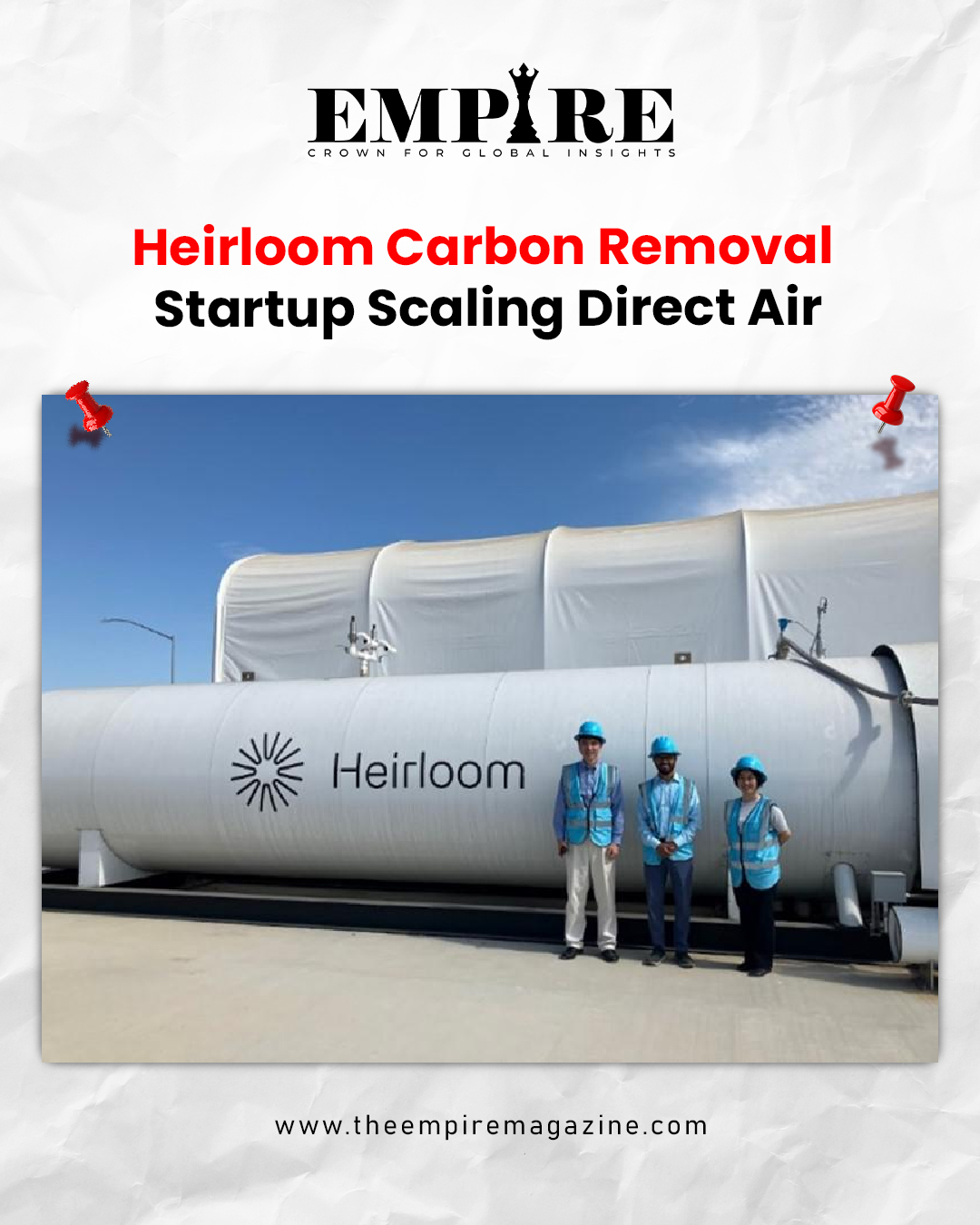
Heirloom Carbon Removal is one of the most closely watched startups in the direct air capture sector. The company is working on a climate technology model that removes carbon dioxide directly from the atmosphere and stores it permanently. At a time when governments, companies, and investors are searching for practical carbon removal solutions, Heirloom has built its identity around a simple but ambitious idea: use the natural properties of limestone to capture carbon from air at industrial scale.
Founded in 2020, Heirloom is based in the United States and operates in the growing carbon dioxide removal market. Direct air capture, often called DAC, is different from traditional carbon capture because it does not only capture emissions from factory smokestacks or industrial sites. Instead, it pulls already-emitted carbon dioxide from ambient air. This makes DAC important for addressing emissions that are difficult to avoid and for removing legacy carbon already present in the atmosphere.
Heirloom’s approach is built around limestone, one of the world’s most abundant minerals. The company uses a process that accelerates limestone’s natural ability to absorb carbon dioxide. By combining carbon mineralization with engineered direct air capture systems, Heirloom aims to create a scalable and lower-cost pathway for permanent carbon removal.
Heirloom Carbon Removal Technology Uses Limestone
Heirloom Carbon Removal technology is based on the chemistry of limestone. Limestone naturally absorbs carbon dioxide over time, but the natural process is slow. Heirloom’s system speeds up this reaction so that carbon dioxide can be captured from the air more efficiently.
The process begins with limestone, which is heated to separate carbon dioxide and create calcium oxide. When water is added, the material becomes calcium hydroxide. This material is then exposed to air, where it absorbs carbon dioxide and turns back into limestone. The captured carbon dioxide can then be stored permanently underground.
This cycle is important because it uses a naturally occurring mineral process instead of depending only on complex synthetic materials. Heirloom’s model focuses on repeatability, modular plant design, and measurable carbon removal. For buyers of carbon removal credits, measurement and durability are key because companies need confidence that the carbon dioxide has actually been removed and stored for the long term.
Heirloom Carbon Removal and Direct Air Capture Explained
Direct air capture is still a developing industry, but it has become more important as global companies set net-zero and carbon-negative targets. Renewable energy, electrification, and efficiency can reduce future emissions, but some sectors are difficult to decarbonize fully. Aviation, shipping, heavy industry, and parts of agriculture are examples where emissions may remain challenging for years.
This is where carbon removal startups like Heirloom become relevant. Their work is not a replacement for reducing emissions, but it can support climate strategies by removing carbon dioxide that is already in the atmosphere. The strongest climate plans usually combine emissions reduction with permanent carbon removal.
Heirloom’s limestone-based approach also reflects a larger trend in climate technology: using simple natural chemistry with advanced engineering. The company is trying to make direct air capture more affordable and scalable by improving plant design, energy use, and deployment speed.
Heirloom Carbon Removal First Commercial Facility
Heirloom opened what it described as America’s first commercial direct air capture facility in Tracy, California, in November 2023. The facility was designed to demonstrate that Heirloom’s limestone-based technology could move from laboratory testing to commercial operation.
The Tracy facility marked an important step for the company because direct air capture startups need real-world plants to prove that their systems can operate reliably. Climate technology is often judged not only by ideas or patents, but by deployment. Facilities like Tracy help show how equipment performs, how operations scale, and how carbon removal can be verified.
The company has stated that the facility can capture up to 1,000 tons of carbon dioxide per year. While this is small compared with global emissions, it is meaningful for an emerging industry where commercial direct air capture is still at an early stage. For Heirloom, the facility acts as both a carbon removal plant and a learning platform for future larger projects.
Heirloom Carbon Removal Facility Shows Commercial Progress
The Tracy facility also helped position Heirloom as one of the leading names in the U.S. direct air capture market. Carbon removal is moving from pilot projects toward infrastructure-style development. That shift requires facilities, customers, financing, regulatory support, and long-term storage partnerships.
Heirloom’s commercial progress matters because many climate startups face a difficult gap between promising technology and large-scale deployment. A startup may prove that its science works, but the real challenge is building plants, lowering costs, securing customers, and operating at scale. Heirloom is trying to cross that gap with commercial facilities and long-term removal agreements.
Heirloom Carbon Removal Deals and Market Demand
Heirloom Carbon Removal has attracted attention from major corporate buyers. In 2023, Microsoft signed a long-term agreement to purchase up to 315,000 metric tons of carbon dioxide removal from Heirloom over multiple years. The agreement was significant because large corporate buyers can help create demand for permanent carbon removal.
Long-term purchase agreements are important for startups because direct air capture facilities require major capital investment. When a company has a credible buyer committed to purchasing future removals, it can support project financing and expansion. This is similar to how renewable energy projects used long-term power purchase agreements to grow.
Heirloom has also been connected to corporate demand through carbon removal marketplaces and buyers focused on durable carbon removal. These agreements reflect a larger business trend: companies are no longer only buying traditional carbon offsets. Many are looking for high-quality removal credits that are measurable, permanent, and scientifically credible.
Heirloom Carbon Removal and Corporate Climate Goals
Corporate climate goals have created a market for carbon removal startups. Technology companies, aviation businesses, financial groups, and global industrial companies are all exploring how permanent carbon removal fits into their long-term sustainability plans.
For Heirloom, corporate demand helps validate the business model. Carbon removal is expensive today, but early buyers can help fund the first commercial plants. Over time, the industry hopes that more deployment will reduce costs, improve efficiency, and create stronger supply chains.
Heirloom Carbon Removal Funding and Expansion
Heirloom raised $150 million in Series B funding in 2024 to support the scaling of its commercial direct air capture technology. The round included climate-focused investors and strategic partners from industries such as aviation, shipping, manufacturing, and industrial technology.
This funding is important because direct air capture is capital intensive. Building facilities, improving equipment, hiring technical teams, and securing energy and storage infrastructure require significant investment. Startups in this sector cannot scale only through software-style growth. They need physical infrastructure, engineering talent, and long-term project development.
Heirloom’s funding also shows that investors continue to see opportunity in carbon removal, even as the sector faces questions about cost, energy demand, and speed of deployment. The startup’s focus on limestone gives it a differentiated story in a market that includes several competing direct air capture methods.
Heirloom Carbon Removal and Project Cypress
Heirloom is also involved in Project Cypress, a major direct air capture hub in Louisiana. Project Cypress is supported by the U.S. Department of Energy’s Regional Direct Air Capture Hubs program. The project includes Battelle as the prime recipient, with Heirloom and other partners involved in the development.
Project Cypress is designed to become a large-scale direct air capture hub that could remove up to 1 million tons of carbon dioxide per year when fully operational. The project received an initial award of $50 million from the U.S. Department of Energy’s Office of Clean Energy Demonstrations, along with private investment support for the initial phase.
This type of hub model is important because direct air capture needs more than capture equipment. It also needs clean energy, transportation, storage, permitting, community engagement, and skilled labor. A regional hub can bring these elements together in one location and support multiple facilities.
Heirloom Carbon Removal in Louisiana
Heirloom has also announced plans connected to Louisiana, including investment in a new direct air capture facility. Louisiana is significant because the region has energy infrastructure, industrial experience, and geology that may support carbon storage. For direct air capture companies, location matters because permanent storage and energy access can affect cost and scalability.
The Louisiana expansion shows that Heirloom is not only testing technology in California. The company is moving toward larger industrial projects that require partnerships with public agencies, private investors, and local communities.
Heirloom Carbon Removal Business Model
Heirloom Carbon Removal operates in a market where the product is not a physical consumer good, but verified removal of carbon dioxide. Customers buy carbon removal credits or long-term removal agreements. The value comes from proving that carbon dioxide was removed from the air and stored permanently.
This model requires strong measurement, reporting, and verification. Buyers want to know how much carbon was removed, where it was stored, and how long it will remain out of the atmosphere. For carbon removal to become a trusted market, transparency is essential.
Heirloom’s business model also depends on lowering costs over time. Today, direct air capture remains expensive compared with many other climate solutions. However, supporters believe costs can fall as facilities scale, supply chains mature, and technology improves. The renewable energy industry followed a similar cost-reduction path over decades, though direct air capture has its own technical and economic challenges.
Heirloom Carbon Removal Challenges
Heirloom Carbon Removal still faces several challenges. Direct air capture requires energy, land, equipment, and capital. The industry must prove that it can scale from thousands of tons to millions of tons without creating new environmental or community problems.
Cost is another major issue. Carbon removal buyers are currently limited, and many purchases come from companies with strong climate commitments. To become a broader market, direct air capture must become more affordable and more widely available.
There is also the challenge of public trust. Carbon removal should not be used as an excuse for companies to delay emissions reductions. The strongest role for direct air capture is to support deep decarbonization, not replace it. Heirloom and other startups must continue proving that their carbon removal is additional, durable, and responsibly deployed.
Heirloom Carbon Removal and the Future of Climate Technology
Heirloom Carbon Removal represents a new generation of climate startups focused on physical infrastructure. Unlike software startups, companies in direct air capture must build plants, manage materials, work with energy systems, and coordinate with storage partners. This makes the path harder, but the potential impact larger.
The company’s growth shows how climate technology is becoming an industrial investment category. Governments are funding direct air capture hubs. Corporations are signing long-term carbon removal deals. Investors are backing startups that can turn climate science into commercial infrastructure.
Heirloom’s progress is still early compared with the scale of the climate challenge. However, its commercial facility, funding, Microsoft agreement, and Project Cypress role show that the startup has moved beyond concept stage. The next test is whether it can scale carbon removal safely, affordably, and permanently.
For more business and startup insights, read more on The Empire Magazine.
Follow The Empire Magazine on Facebook and Instagram.
– The Empire Magazine
Crown For Global Insights