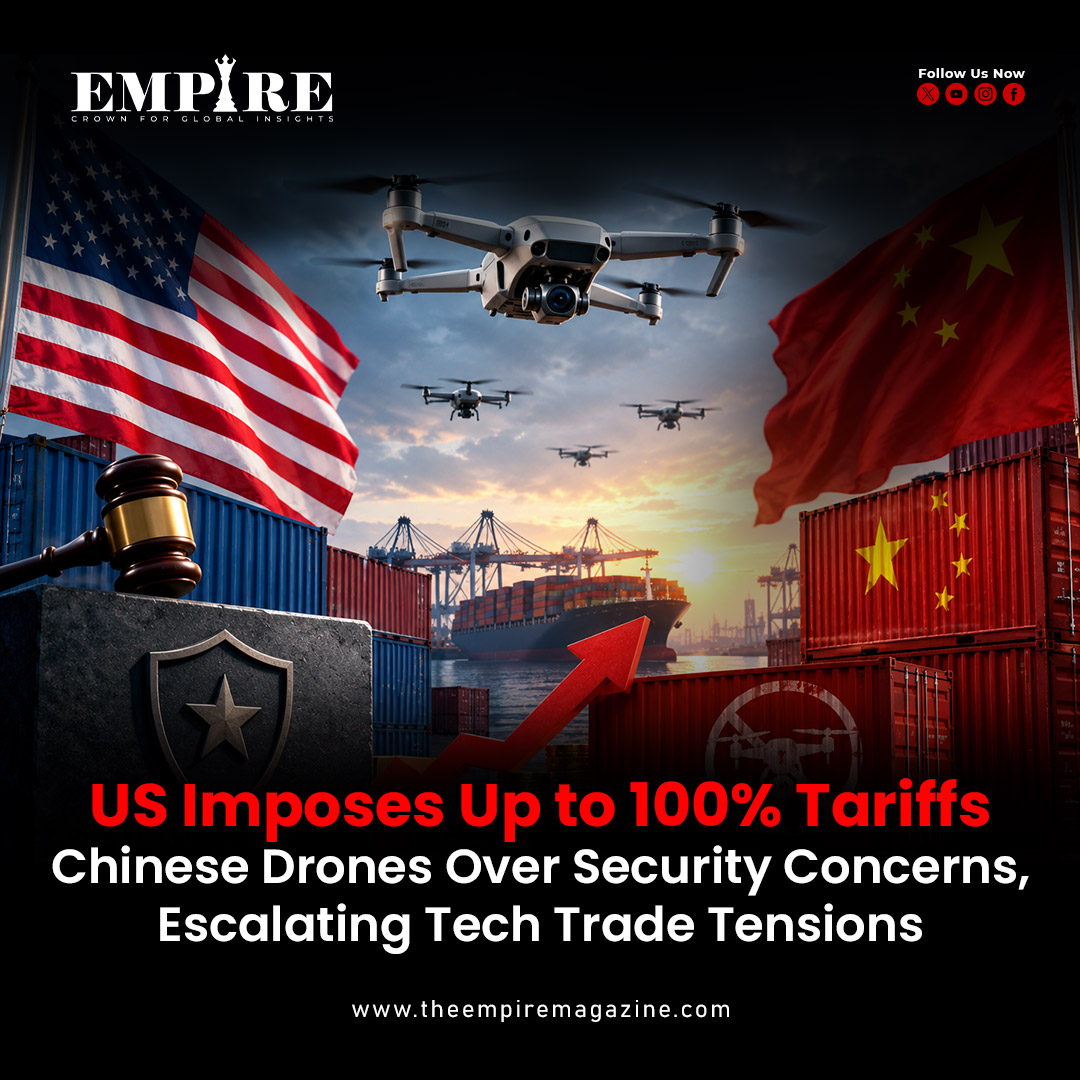
US Imposes Up to 100% Tariffs on Chinese Drones Over Security Concerns as the United States takes a major step to reduce dependence on foreign unmanned aircraft systems and strengthen domestic drone manufacturing. The new tariff measures target specific categories of drones and drone components, with Washington citing national security concerns, supply chain vulnerabilities, and risks associated with foreign-made technology.
The decision represents another escalation in technology-related tensions between the United States and China, where both countries have increasingly focused on controlling critical technologies, protecting supply chains, and strengthening domestic innovation capabilities.
Drones have become important tools across multiple sectors, including defense, infrastructure inspection, agriculture, logistics, emergency response, and commercial operations. Because of their growing importance, governments around the world are increasingly treating unmanned aircraft technology as a strategic industry.
US Imposes Up to 100% Tariffs on Chinese Drones as Security Concerns Increase
The United States government introduced new tariffs on certain imported unmanned aircraft systems (UAS) and related components under national security measures. According to the official proclamation, the decision followed a Commerce Department assessment that concluded heavy reliance on foreign drone production and components could create strategic vulnerabilities.
The tariffs include a 100% ad valorem duty on specific drones and components considered more sensitive from a security perspective. These include drones above certain weight thresholds, drones with thermal imaging capabilities, docking stations, and selected critical components.
The administration stated that dependence on foreign suppliers creates concerns related to:
- Supply chain security
- Data protection
- Technology dependence
- Domestic manufacturing capacity
The move reflects a broader U.S. strategy of increasing control over technologies considered important for national security.
US Imposes Up to 100% Tariffs on Chinese Drones Targeting Key Technology Categories
The new tariff structure does not apply equally to all drone products.
According to the U.S. announcement, certain advanced drones face the highest tariff levels, while smaller and less sensitive drone categories face lower duties.
100% Tariffs on Sensitive Drone Systems
The highest tariff category applies to drones that meet specific conditions, including:
- Maximum takeoff weight above 25 kilograms
- Integration of thermal imaging technology
- Certain drone docking systems
- Selected critical components
These systems are considered more sensitive because they may be used for surveillance, infrastructure monitoring, or defense-related applications.
Additional Tariffs on Smaller Drone Products
The policy also introduces a 25% tariff category for certain smaller drones and components that do not fall into the most sensitive category.
This approach creates different tariff levels depending on the capability and strategic importance of the technology.
US Imposes Up to 100% Tariffs on Chinese Drones Amid China Technology Competition
The drone industry has become one of the latest areas affected by broader U.S.-China technology competition.
China has become a major force in global drone manufacturing, with companies such as DJI achieving significant market presence worldwide. Chinese drone manufacturers have supplied products for commercial users, businesses, and government-related applications across different countries.
The United States has raised concerns about potential cybersecurity risks connected with foreign-made drone systems, particularly regarding data collection and technology control.
The new tariffs are part of a wider effort by Washington to encourage domestic production of strategically important technologies.
US Imposes Up to 100% Tariffs on Chinese Drones to Strengthen Domestic Manufacturing
A major objective behind the tariff decision is increasing U.S. drone manufacturing capacity.
The U.S. government stated that domestic production currently does not meet the country’s expected needs for drone systems and components. Officials highlighted concerns that reliance on international supply chains could create challenges during geopolitical disruptions or emergencies.
The policy aims to encourage companies to invest in:
Domestic Drone Production
The government wants manufacturers to expand production facilities inside the United States.
Secure Supply Chains
Reducing dependence on foreign suppliers is viewed as important for protecting critical technology infrastructure.
Innovation and Competition
The tariff policy is designed to provide more opportunities for American drone companies to compete in the growing unmanned aircraft market.
US Imposes Up to 100% Tariffs on Chinese Drones and Raises Global Trade Questions
The tariff decision has increased concerns about the future direction of global technology trade.
Technology industries have increasingly become connected with national security discussions. Governments are now evaluating products not only based on economic value but also on factors such as data security, manufacturing dependency, and strategic importance.
China has criticized the U.S. drone tariffs, arguing that the measures unfairly target Chinese companies and could negatively affect trade relations between the two countries.
The development adds another layer to ongoing disputes involving advanced technology sectors, including semiconductors, artificial intelligence, electric vehicles, and telecommunications equipment.
US Imposes Up to 100% Tariffs on Chinese Drones Affecting Global Drone Markets
The new tariffs could influence manufacturers, suppliers, and customers across the global drone industry.
Companies that rely on imported drone systems may face higher costs, while manufacturers outside China could find new opportunities in the U.S. market.
The policy also encourages businesses to examine their supply chains and consider alternative sources for drone hardware and components.
Drone technology continues to expand into industries such as:
- Agriculture monitoring
- Construction
- Energy infrastructure
- Public safety
- Transportation
- Industrial inspections
As adoption increases, governments and businesses are paying closer attention to where these technologies are manufactured and how their data systems operate.
US Imposes Up to 100% Tariffs on Chinese Drones and the Future of Technology Competition
The drone tariff decision highlights the growing connection between technology policy and national security.
The United States and China are competing not only in manufacturing but also in developing leadership across advanced technologies. Drone systems represent one part of a larger competition involving innovation, supply chains, and strategic industries.
The introduction of these tariffs shows how governments are increasingly using trade policies to influence technology development and reduce dependence on foreign suppliers.
Read more technology and global business insights on The Empire Magazine:
https://theempiremagazine.com/?p=8290&preview=true
Follow The Empire Magazine for global business, technology, and leadership stories:
Facebook: https://www.facebook.com/profile.php?id=61573749076160
Instagram: https://www.instagram.com/the_empire_magazine/
The Empire Magazine | Crown For Global Insights