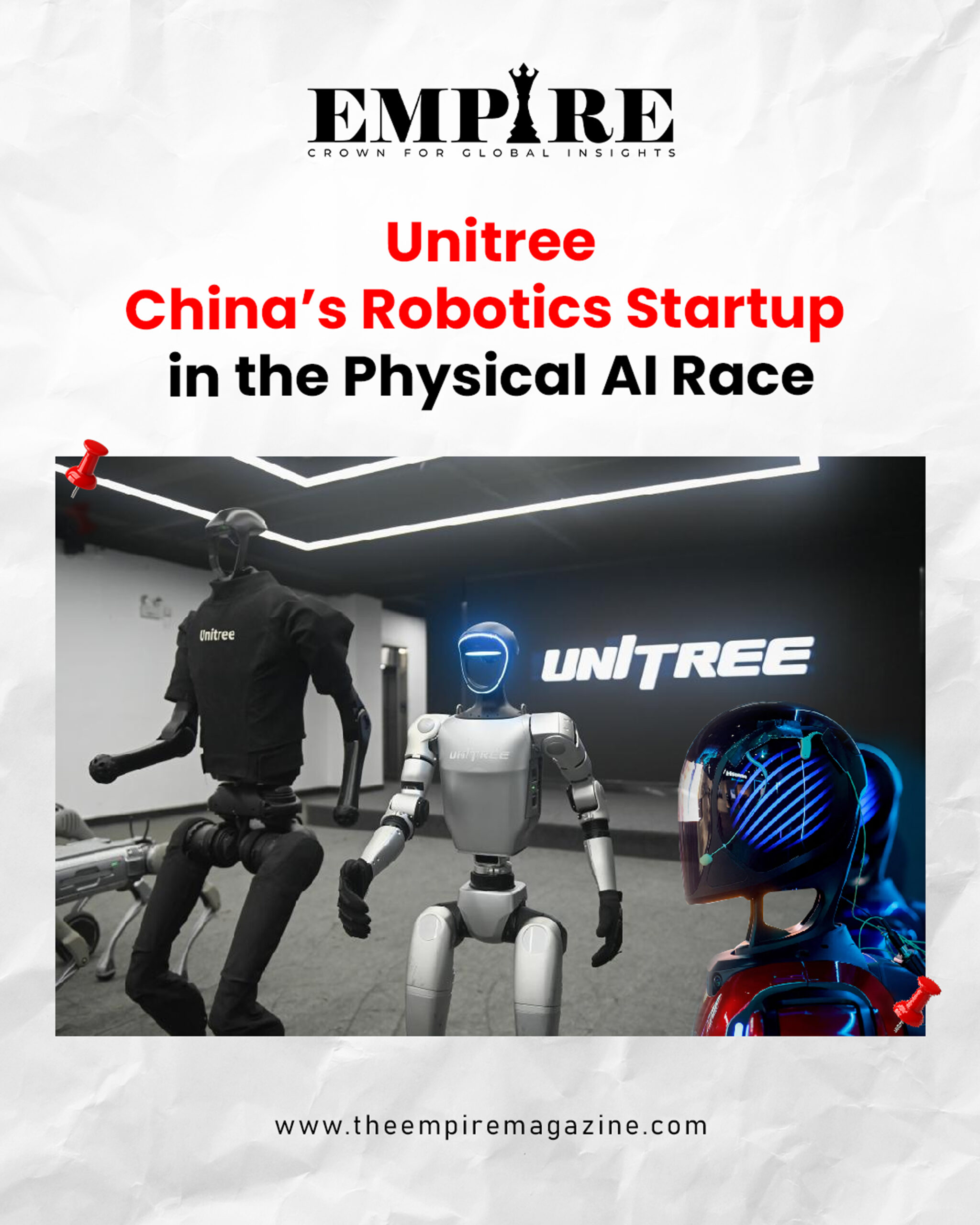
Unitree is one of China’s most visible robotics startups and a growing player in the global physical AI race. The company, officially known as Hangzhou Yushu Technology Co., Ltd., is based in Hangzhou, China, and was founded in 2016 by Wang Xingxing. Unitree first became known for its quadruped robots and later expanded into humanoid robots, placing it directly inside one of the fastest-moving areas of artificial intelligence and robotics.
Physical AI refers to artificial intelligence systems that do not only process text, images, or data but also act in the real world through robots, machines, vehicles, sensors, and physical movement. This field is becoming important because AI companies, chipmakers, automakers, factories, logistics firms, and research labs are looking for machines that can perform real tasks in human environments.
Unitree’s rise shows how China’s robotics industry is moving from industrial automation into consumer, research, education, entertainment, and humanoid robotics markets.
What Unitree Does
Unitree develops legged robots, including quadruped robots and humanoid robots. Its product lineup includes consumer and education robots such as Go2, industrial robots such as B2, and humanoid robots such as H1, G1, R1, and H2. The company describes itself as a pioneer in the global high-performance quadruped robot industry and a leader in quadruped robot applications.
From Robot Dogs to Humanoids
Unitree first gained attention through its four-legged robots, often compared with robotic dogs. These machines are used for education, research, demonstrations, inspection, and development projects. Quadruped robots are useful because they can move across uneven terrain, climb steps, and operate in environments where wheeled robots may struggle.
The company later entered humanoid robotics. Its H1 humanoid is described by Unitree as a full-size general-purpose humanoid robot capable of running in China, with stable gait and flexible movement.
Why Physical AI Is Becoming Important
Physical AI is attracting global interest because many industries need machines that can work in real-world environments. Traditional AI works mainly in digital spaces, such as chatbots, search engines, image generation, coding tools, and data analysis. Physical AI connects intelligence with motion, perception, and action.
Humanoid robots and quadruped robots can support areas such as manufacturing, logistics, inspection, disaster response, research, security, elderly care, and education. The opportunity is large because labor shortages, automation demand, and AI progress are all pushing companies to explore robotics.
Robots Need AI, Hardware, and Control Systems
A robot is not only a mechanical body. It needs sensors, motors, batteries, control software, cameras, computing power, balance systems, and AI models. Physical AI becomes useful when a robot can understand its environment, move safely, follow instructions, and complete tasks.
Unitree’s position is important because it focuses on making legged robots more accessible and commercially available. Lower-cost robotics can help universities, developers, startups, and companies test real-world AI systems more easily.
Unitree’s Product Strategy
Unitree’s strategy has been shaped by affordability, mobility, and mass-market visibility. The company’s robots have appeared in demonstrations, research projects, public events, and online videos. This visibility has helped Unitree become one of the better-known Chinese robotics brands internationally.
Go2 and Quadruped Robotics
The Unitree Go2 is part of the company’s consumer and education robot lineup. Robots in this category are often used by developers, schools, universities, hobbyists, and researchers to experiment with robotics applications.
Quadruped robots can be used for mapping, inspection, autonomous navigation, and AI research. Because they can move through more complex environments than simple wheeled platforms, they are useful for physical AI experimentation.
B2 and Industrial Applications
Unitree also offers industrial quadruped robots such as B2. Industrial robot dogs can be used in inspection, security patrol, warehouse research, and infrastructure monitoring. These environments require stronger mobility, endurance, and durability than consumer robots.
Industrial applications are important because they create real business value. A robot that can inspect a factory, power facility, tunnel, warehouse, or construction site can reduce risk and improve operational visibility.
Unitree’s Humanoid Robots
Unitree’s humanoid robot lineup has attracted major attention because humanoids are now a central part of the physical AI race. Humanoid robots are designed to operate in environments built for people. They can use stairs, doors, tools, shelves, and workspaces designed around human movement.
The Unitree R1 product page describes the humanoid robot as having a complex structure and powerful output, while also warning users to keep safe distance because of the robot’s power and complexity.
Why Humanoid Design Matters
Humanoid robots are difficult to build because they require balance, arm control, hand movement, perception, navigation, and safety systems. However, their form is valuable because most workplaces and homes are built for the human body.
A humanoid robot could theoretically perform many different tasks without requiring companies to redesign entire buildings or workstations. This is why companies such as Tesla, Figure AI, Apptronik, Agility Robotics, Boston Dynamics, and Unitree are investing in humanoid development.
Nvidia and Unitree in the Robotics Ecosystem
Nvidia has become one of the most important companies in the physical AI market because robots need powerful computing platforms, simulation tools, AI models, and developer software. Reuters reported in June 2026 that Nvidia is working with humanoid robot makers in the United States, Europe, and South Korea, in addition to China’s Unitree. The report said Nvidia’s work with Unitree includes standardized research robots, with Unitree providing the robot body and Nvidia contributing computing technology.
Why Nvidia’s Role Matters
Nvidia’s role matters because robotics requires advanced AI computing. A robot needs to process camera feeds, sensor data, language instructions, motion planning, and control decisions in real time. Nvidia’s Jetson, Isaac, and robotics software platforms are designed to support these workloads.
Collaboration with Nvidia also shows how robotics is becoming connected to the broader AI infrastructure market. Chips, software, simulation, and robot bodies are all part of the same ecosystem.
Unitree and China’s Robotics Ambition
China has become one of the world’s most important robotics markets. The country has strong manufacturing capacity, supply chains, electronics production, battery technology, and government support for advanced manufacturing. This gives Chinese robotics companies advantages in cost, production speed, and hardware iteration.
Unitree benefits from this environment because robotics hardware depends on motors, sensors, batteries, mechanical parts, and manufacturing expertise. China’s industrial ecosystem can help robotics startups move from prototypes to commercial products more quickly.
Manufacturing Scale as an Advantage
Robotics startups often struggle to move from demonstrations to mass production. Building one robot is different from building thousands of reliable robots. Manufacturing quality, supply chain control, testing, and cost reduction are critical.
Unitree’s ability to offer relatively accessible robots has helped it stand out. Lower prices can expand the number of developers and institutions able to work with physical AI hardware.
IPO Activity and Market Attention
Unitree has also attracted attention because of reported plans to list on Shanghai’s STAR Market. Recent market reporting said Unitree’s IPO application was accepted for the STAR Market and that the company was targeting a valuation of about $6.2 billion.
Why Public Market Interest Matters
A public listing would show investor interest in China’s robotics sector and the physical AI opportunity. Robotics companies require large investment because hardware development, manufacturing, talent, safety testing, and customer deployment are expensive.
Public market funding could help companies like Unitree scale production, improve research and development, and expand internationally.
Competition in the Physical AI Race
Unitree competes in a crowded and fast-moving robotics market. In quadruped robots, competitors include Boston Dynamics, Deep Robotics, Ghost Robotics, and other legged-robot companies. In humanoids, competitors include Tesla Optimus, Figure AI, Apptronik, Agility Robotics, UBTech, Fourier Intelligence, 1X, Sanctuary AI, and others.
China’s Competitive Robotics Landscape
China’s robotics ecosystem includes many companies working on humanoids, industrial robots, service robots, robot hands, sensors, and AI control systems. This creates strong competition but also a supply chain advantage.
Chinese robotics firms can often move quickly because they operate near component suppliers, electronics manufacturers, and industrial customers. However, they must also prove quality, safety, cybersecurity, and reliability to win global trust.
Safety, Security, and Trust
As robots become more capable, safety and cybersecurity become more important. Physical AI systems can move, collect data, record video, connect to networks, and interact with people. This creates concerns around privacy, control, and misuse.
Reuters reported that Nvidia emphasized cybersecurity in its work involving Unitree, including secure software updates through Nvidia chips. The report also noted that U.S. lawmakers had raised concerns about Unitree and proposed restrictions on federally funded research using the company’s robots.
Why Trust Is Essential
For robots to enter schools, factories, research labs, homes, and public spaces, buyers need confidence in security and safety. Companies must address data protection, software updates, access control, and physical safety.
This is especially important for international expansion because robotics is now connected to national security, critical infrastructure, and AI governance.
Why Unitree Matters in Startup Innovation
Unitree matters because it shows how robotics startups can become global players by combining hardware engineering, AI systems, manufacturing scale, and accessible pricing. The company helped make legged robots more visible and available to a wider group of developers and institutions.
As physical AI grows, robots will become important platforms for AI research and business applications. Unitree’s quadruped and humanoid robots place the company in the center of this trend.
For more technology and business insights, read this feature on The Empire Magazine.
Follow The Empire Magazine on Instagram and Facebook
– The Empire Magazine
Crown For Global Insights.