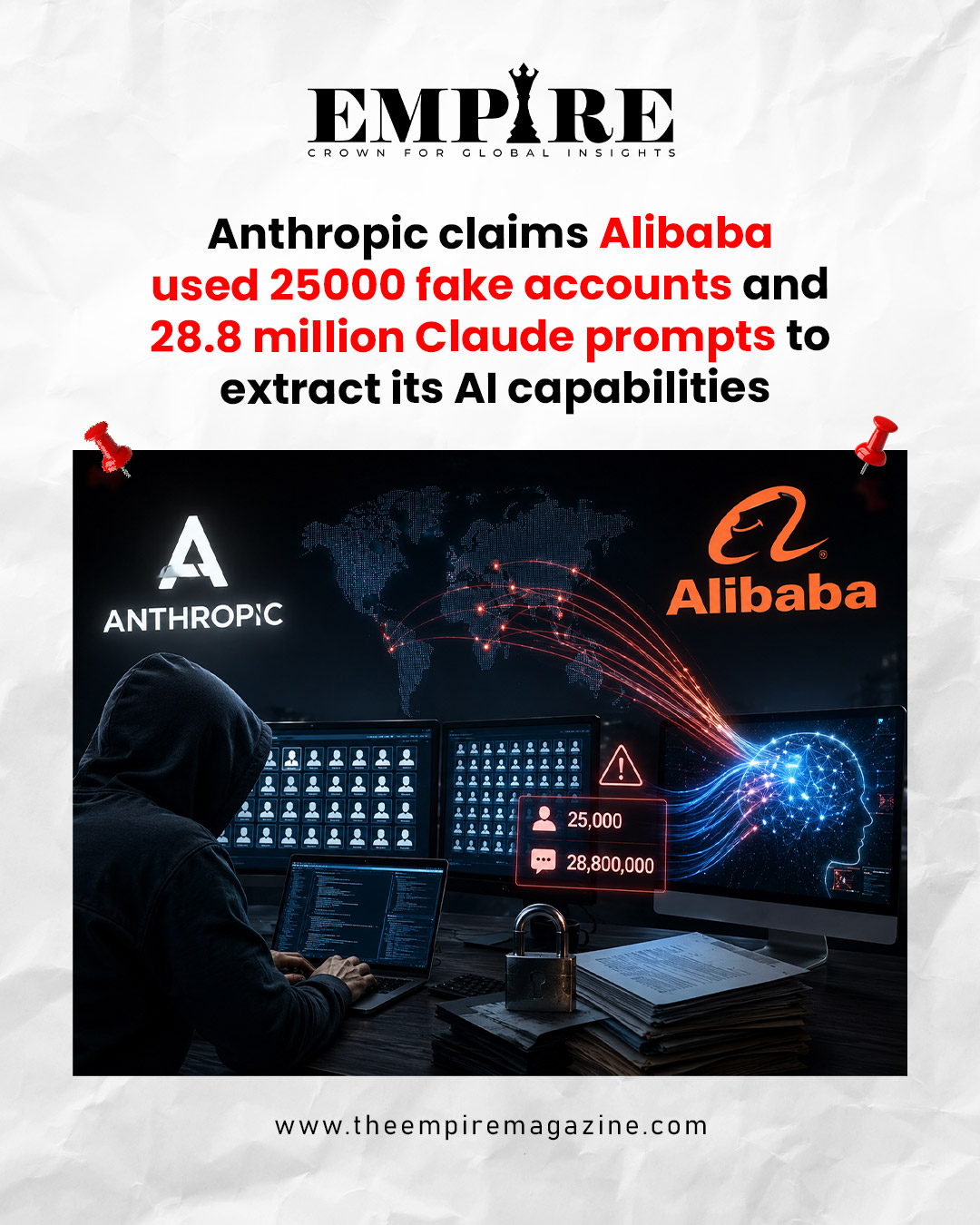
Anthropic alleges Alibaba used 25,000 fake accounts and 28.8 million Claude prompts in the largest AI model distillation attack. Here’s what it means for global AI. Anthropic has accused operators linked to Alibaba’s Qwen AI lab of using nearly 25,000 fake accounts and 28.8 million Claude interactions to extract its AI capabilities through alleged model distillation. The claims have intensified the global AI race while raising major questions around intellectual property, cybersecurity, and AI governance.
Anthropic Claims Alibaba Used 25,000 Fake Accounts to Extract Claude AI Capabilities
Artificial intelligence has rapidly become one of the world’s most valuable technological assets, making every breakthrough a strategic advantage for companies and governments alike. That competition has now taken another dramatic turn after Anthropic accused operators linked to Alibaba’s Qwen AI lab of orchestrating what it described as the largest known attempt to extract the capabilities of its Claude AI models. According to Anthropic, the alleged campaign relied on nearly 25,000 fraudulent accounts that collectively generated more than 28.8 million interactions with Claude over a period of several weeks, allowing the attackers to allegedly learn how the advanced AI system responds across complex reasoning, software engineering, and long-horizon tasks. The company has shared these allegations with U.S. lawmakers, arguing that such activities threaten not only commercial innovation but also national technological leadership. While Alibaba had not publicly responded to the allegations when multiple media reports were published, the claims have already sparked a wider global debate around AI security, intellectual property protection, and the increasingly competitive race between American and Chinese artificial intelligence developers.
Anthropic Alibaba Claude AI Allegations Shake the Industry
The allegations have quickly become one of the biggest talking points across the artificial intelligence industry because they go beyond a simple cybersecurity incident. Anthropic claims that the operators behind the campaign deliberately created thousands of fraudulent accounts to bypass normal usage restrictions and interact with Claude on a massive scale between April 22 and June 5, 2026. According to the company’s letter sent to members of the U.S. Senate Banking Committee and White House officials, these millions of exchanges were allegedly designed to extract Claude’s advanced reasoning patterns, coding abilities, and decision-making processes for use in competing AI systems. Anthropic described the campaign as a sophisticated “model distillation” effort rather than a traditional hacking attack, emphasizing that the alleged objective was not to steal source code but to reproduce the behaviour and intelligence of one of the world’s most capable AI models through repeated interactions. The allegations have significantly heightened concerns over how frontier AI systems can be protected as competition among global technology giants intensifies.
Anthropic Alibaba Claude AI and Model Distillation Explained
The Anthropic Alibaba Claude AI controversy has brought the concept of AI model distillation into the global spotlight, a practice that is both technically sophisticated and increasingly contentious within the artificial intelligence ecosystem. Unlike conventional cyberattacks that target confidential source code or internal infrastructure, model distillation focuses on learning the behaviour of an advanced AI system by interacting with it repeatedly through carefully designed prompts and analysing its responses. In its communication to U.S. lawmakers, Anthropic alleged that the operators behind the campaign generated nearly 28.8 million prompts using approximately 25,000 fake accounts to systematically observe Claude’s reasoning patterns, coding capabilities, writing style, mathematical accuracy, and problem-solving approach. According to the company, this process was intended to enable another AI model to replicate Claude’s performance without direct access to its underlying architecture or proprietary training data. Anthropic further argued that such activity goes beyond ordinary benchmarking or product evaluation because of its unprecedented scale and coordination, describing it as an organised attempt to extract commercially valuable intelligence from one of the industry’s leading frontier models. Security researchers note that while AI developers routinely compare the performance of competing systems, mass automated querying designed to reproduce a model’s capabilities raises significant ethical, commercial, and legal concerns. The case also highlights a growing challenge facing AI companies worldwide: protecting intellectual property that is no longer limited to software code but increasingly resides in the learned behaviour and reasoning capabilities of advanced foundation models.
Alibaba not responded to Anthropic allegations
As artificial intelligence continues to evolve into a strategic national asset, companies are investing heavily in stronger safeguards, usage monitoring, rate-limiting mechanisms, identity verification, and anomaly detection systems to identify suspicious patterns before they can compromise valuable AI innovations. Although Anthropic has publicly detailed its allegations, it is important to note that these claims have not been adjudicated in court, and Alibaba had not publicly responded to the allegations at the time of the reports. This distinction remains crucial as the broader technology industry closely watches how regulators, policymakers, and legal systems define the boundaries between legitimate AI research, competitive benchmarking, and the unlawful extraction of proprietary model capabilities.
Anthropic Alibaba Claude AI Raises Global AI Security Concerns
Beyond the immediate allegations, the Anthropic Alibaba Claude AI dispute has become a defining moment for the global artificial intelligence industry. As AI models become more powerful and commercially valuable, they are increasingly viewed as strategic assets rather than just software products. Companies are investing billions of dollars in developing advanced large language models, making the protection of their intellectual property a top priority. Anthropic argues that if frontier AI systems can be replicated through large-scale querying instead of years of research and billions in investment, it could fundamentally alter the competitive landscape of the AI industry. The allegations have therefore shifted attention from model performance alone to the growing importance of AI security and responsible access management.
Anthropic Alibaba Claude AI Shows Why Model Distillation Is Different
Unlike traditional cyberattacks that involve breaking into servers or stealing confidential source code, model distillation focuses on understanding how an AI model behaves. By asking carefully designed questions repeatedly, another model can gradually learn similar reasoning patterns, writing styles, coding capabilities, and decision-making approaches. While model distillation itself is a recognised machine learning technique when conducted on models that developers own or have permission to use, the controversy arises when companies allegedly attempt to reproduce the capabilities of proprietary commercial models without authorisation. Anthropic maintains that the alleged campaign crossed this boundary because of its enormous scale and the coordinated use of thousands of fake accounts.
Anthropic Alibaba Claude AI Highlights the AI Race
The dispute also reflects the rapidly intensifying global AI race between leading technology companies. Frontier AI developers such as Anthropic, OpenAI, Google, Meta, Microsoft, and Chinese AI companies are competing to build increasingly capable models that can power enterprise software, scientific research, healthcare, education, finance, and government applications. Every improvement in reasoning ability, coding performance, or multimodal understanding represents years of engineering effort and significant financial investment. As a result, AI capabilities have become valuable competitive advantages that companies are determined to protect from unauthorised replication.
Governments Are Paying Close Attention to AI Protection
The allegations have also attracted the attention of policymakers because artificial intelligence is increasingly regarded as a matter of economic competitiveness and national security. Anthropic reportedly shared its concerns with members of the U.S. Senate Banking Committee and officials within the White House, arguing that stronger protections are needed for frontier AI models. Governments around the world are simultaneously working on AI governance frameworks that balance innovation with safeguards against misuse. The outcome of discussions surrounding this case could influence future regulations governing AI access, commercial model usage, cybersecurity standards, and intellectual property rights.
The Future of Anthropic Alibaba Claude AI Could Shape the Industry
Regardless of how the allegations are ultimately resolved, the Anthropic Alibaba Claude AI controversy has already become a landmark moment in the evolution of artificial intelligence. It highlights that the next phase of AI competition will not depend solely on developing smarter models but also on securing them against increasingly sophisticated attempts to replicate their capabilities. As organisations continue investing billions into frontier AI research, protecting proprietary intelligence may become just as important as creating it. The case also underscores the need for greater international cooperation, clearer legal standards, and responsible AI development practices that encourage innovation while respecting intellectual property. For businesses, policymakers, and technology leaders alike, this episode serves as a reminder that in the era of artificial intelligence, trust, security, and ethical competition will be as critical to long-term success as technological breakthroughs themselves.
Anthropic Alibaba Claude AI Could Influence Future AI Regulations
The Anthropic Alibaba Claude AI dispute is expected to have implications far beyond the companies involved. Legal experts believe the case could accelerate discussions around how governments regulate access to frontier AI models and define acceptable competitive practices. Existing intellectual property laws were designed primarily for software code, patents, and copyrighted content, but advanced AI systems introduce an entirely new challenge. If an AI model can be replicated by observing millions of responses instead of copying its code, regulators may need to redefine what constitutes intellectual property infringement in the age of artificial intelligence. The outcome of this debate could influence how AI companies worldwide design their products, monitor user activity, and enforce terms of service.
AI Companies Are Strengthening Security Measures
The controversy has also highlighted the growing importance of AI security infrastructure. Frontier AI developers are increasingly deploying sophisticated safeguards to detect unusual patterns of activity, identify coordinated account creation, limit excessive automated queries, and prevent misuse of their models. Advanced monitoring systems can now analyse behavioural patterns, request frequency, geographic distribution, and account authenticity to identify potential threats in real time. As AI models become more capable, companies are expected to invest even more heavily in cybersecurity, authentication technologies, and risk management frameworks. These measures aim not only to protect commercial assets but also to maintain user trust in AI platforms used by businesses, governments, and millions of individuals worldwide.
Anthropic Alibaba Claude AI Reflects a New Era of Competition
The allegations also demonstrate how competition in artificial intelligence is evolving. The industry is no longer competing solely on who can launch the next chatbot or achieve the highest benchmark scores. Instead, companies are racing to develop increasingly sophisticated foundation models capable of powering entire digital ecosystems. This has transformed AI into a strategic business asset comparable to cloud infrastructure, semiconductor technology, and advanced manufacturing. As a result, disputes over AI capabilities are becoming as commercially significant as patent battles in the smartphone industry or intellectual property disputes in the pharmaceutical sector. The Anthropic Alibaba Claude AI controversy illustrates that protecting innovation is now as critical as creating it.
Allegations made by Anthropic against operators allegedly linked to Alibaba’s Qwen AI lab
Artificial intelligence has entered a phase where technological leadership is measured not only by innovation but also by resilience. The allegations made by Anthropic against operators allegedly linked to Alibaba’s Qwen AI lab underscore how valuable frontier AI models have become in an increasingly competitive global landscape. While these allegations remain unproven and Alibaba had not publicly responded at the time of reporting, the episode has already sparked an important conversation about ethics, intellectual property, cybersecurity, and responsible competition in AI.
For enterprises, investors, policymakers, and technology leaders, the controversy serves as a reminder that the future of artificial intelligence will be shaped by more than breakthrough algorithms. It will depend on transparent governance, robust security mechanisms, international cooperation, and a shared commitment to fair innovation. As AI continues to transform industries and economies, protecting the integrity of advanced models will be just as essential as building the next generation of intelligent technologies. Whether this case ultimately leads to legal action, regulatory reforms, or stronger industry standards, one thing is clear the race for AI supremacy has entered a new chapter, where trust, accountability, and ethical innovation will determine who leads the future of artificial intelligence.
For more business and retail insights, read more on The Empire Magazine
Previous article: https://theempiremagazine.com/openai-managing-director/
Magazine Feautures | Podcasts: Empire Global Talks
Follow The Empire Magazine on Facebook | Instagram | LinkedIn | YouTube
The Empire Magazine | Crown for Global Insights