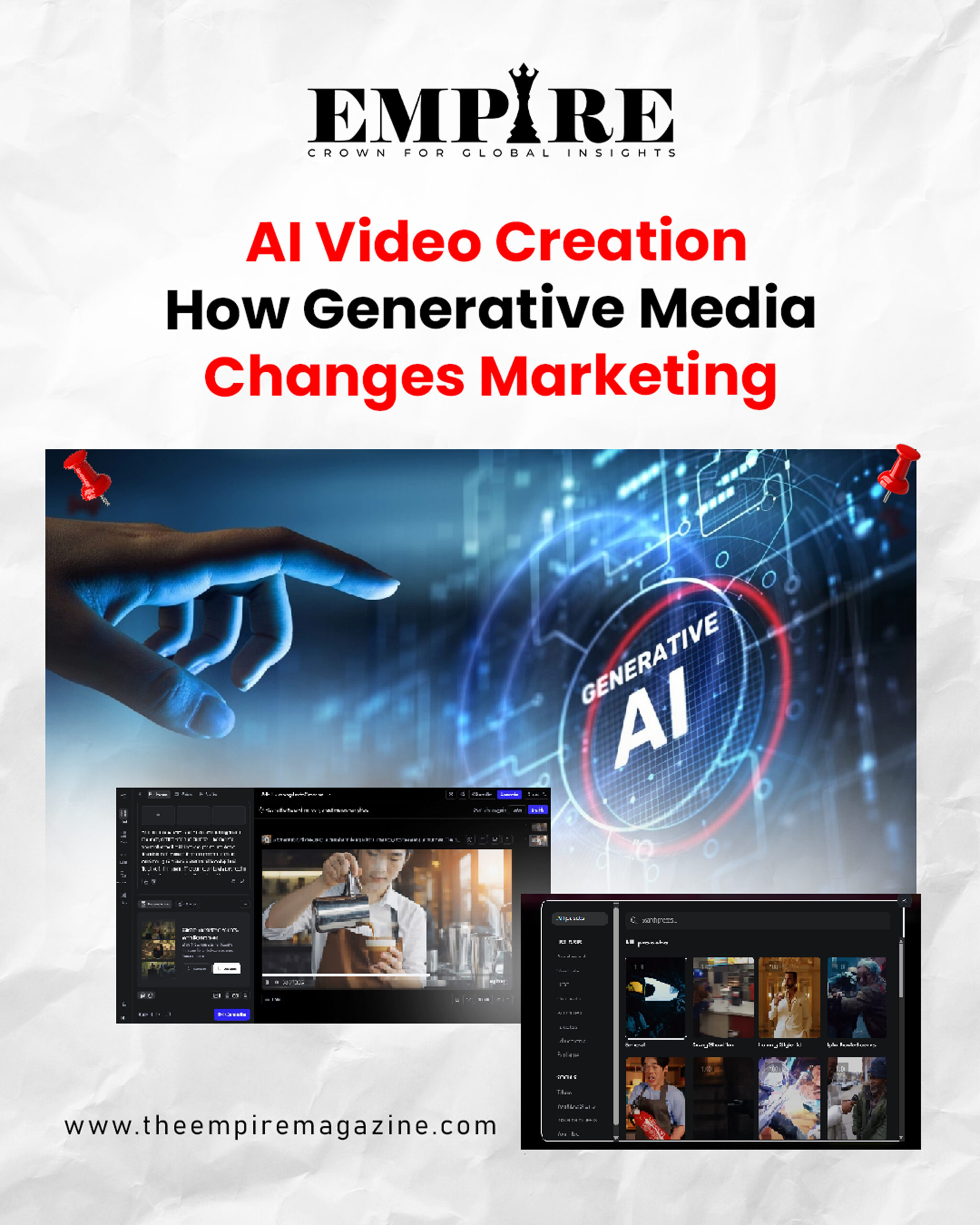
AI Video Creation is becoming one of the most important changes in digital marketing, advertising, and brand communication. Generative media tools now allow marketing teams to create videos from text prompts, images, scripts, product photos, and brand ideas. This is changing how companies produce social media ads, product videos, explainers, campaign concepts, short-form content, and personalized brand assets.
For years, video marketing required cameras, locations, production teams, editors, actors, lighting, animation tools, and long timelines. Those methods are still important for premium campaigns, but AI video tools are creating a faster production layer. Marketers can now test ideas, create drafts, generate visual concepts, produce multiple versions, and adapt campaigns for different platforms in less time.
Reuters reported in May 2026 that global firms are using AI at Indian hubs to bring more advertising work in-house. The report highlighted examples where companies use AI for product visuals, influencer selection, campaign optimization, and faster content production. Kimberly-Clark reduced content creation time from 24 days to two hours using an AI platform developed in India.
Why Generative Media Matters for Brands
Generative media refers to content created or assisted by artificial intelligence. This includes AI-generated videos, images, voiceovers, scripts, animations, music, captions, and visual effects. In marketing, generative media is useful because brands need more content than ever before.
Companies now create content for Instagram Reels, TikTok, YouTube Shorts, LinkedIn, Facebook, websites, email campaigns, e-commerce pages, streaming ads, and internal presentations. Each platform requires different video lengths, formats, hooks, captions, aspect ratios, and creative styles.
More Content, Faster Campaigns
Modern marketing depends on speed. A brand may need to respond to a trend, launch a product, test ad variations, localize content for different markets, or create personalized videos for different audience segments. Traditional production can be slow and expensive for this volume of work.
AI video creation helps marketers produce more variations quickly. A single product campaign can be turned into multiple short clips, background visuals, explainer scenes, social edits, and ad concepts. This allows marketing teams to test performance and improve creative decisions based on data.
How AI Video Tools Work
AI video tools use machine learning models trained on large amounts of visual and audio data. Users can enter a text prompt, upload an image, provide a script, or choose a template. The system then generates video clips, animations, avatars, b-roll, visual effects, subtitles, or edits.
Tools such as Adobe Firefly, Runway, Synthesia, HeyGen, Pika, Luma AI, Google Veo, and other platforms are part of this growing market. Adobe Firefly’s AI video generator allows users to create videos using text prompts and reference images, including b-roll, visual effects, product videos, social media clips, and animations.
Text-to-Video and Image-to-Video
Text-to-video tools generate video from written instructions. A marketer can describe a product scene, brand mood, background, camera movement, or visual style. Image-to-video tools animate still images, product shots, or campaign visuals.
These tools are useful for early-stage creative development. Brands can create mood boards, concept clips, motion graphics, product teasers, and visual prototypes before committing to full production.
AI Video Creation in Advertising
AI video is becoming important in advertising because video is one of the strongest formats for attention and engagement. Digital video advertising continues to grow across social platforms, connected TV, streaming, and mobile apps.
The Drum reported that U.S. digital video ad spending is on track to pass $80 billion in 2026, with 11% year-over-year growth. This shows why brands are investing in video formats and why AI tools are becoming attractive for content production.
Ad Variations and Testing
Marketing teams often test many versions of the same ad. They may change the opening hook, background, product angle, caption, voiceover, or call-to-action. AI video tools make this testing easier because they can generate variations quickly.
This supports performance marketing. Instead of creating one expensive video and waiting for results, brands can test multiple versions and use data to identify what works.
Personalization and Localized Marketing
AI video creation also supports personalization. Brands can create different videos for different audiences, regions, languages, seasons, or customer behaviors. This is important because consumers respond better to content that feels relevant.
A global brand may need one product campaign adapted for India, the UAE, Europe, Singapore, the U.S., and Africa. AI tools can help change language, visuals, models, backgrounds, captions, and product framing for different markets.
Local Campaigns at Scale
Localization is often expensive when done through traditional production. Every new market may require translation, voiceover, editing, cultural adaptation, and format changes. AI can reduce the time needed for these versions.
However, brands must still review localized content carefully. Cultural accuracy, legal compliance, and brand safety remain important.
Why Companies Are Bringing Creative Work In-House
AI tools are allowing more companies to bring parts of creative production in-house. Reuters reported that companies such as Kimberly-Clark, Catalyst Brands, and Target India are using AI to streamline advertising operations and reduce reliance on external agencies for certain tasks.
This does not mean agencies are disappearing. Strategic creativity, brand positioning, premium production, campaign planning, and high-level storytelling remain valuable. However, AI reduces the need to outsource every content variation or basic production task.
In-House Speed and Cost Control
In-house AI video workflows can reduce costs and improve speed. A marketing team can create drafts, experiment with formats, and prepare campaign assets before sending final work to agencies or production partners.
This helps companies control budgets while keeping creative development active throughout the year.
Brand Safety and Commercial Use
Brand safety is a major issue in AI video creation. Companies need to know whether generated content can be used commercially, whether training data is licensed, and whether the output creates copyright or likeness risks.
Adobe states that its Firefly commercial model is trained on licensed content, such as Adobe Stock, and public domain content where copyright has expired. This makes commercial safety an important part of its positioning for businesses.
Content Credentials and Transparency
Transparency is becoming more important as AI-generated media becomes realistic. Brands may need to disclose AI use, protect customer trust, and follow platform or government rules. Content credentials and watermarking can help show how content was created or edited.
This matters because AI-generated video can also raise concerns about deepfakes, misinformation, fake endorsements, and unauthorized use of people’s likenesses.
The Role of Human Creativity
AI video creation does not remove the need for human creativity. Marketing still depends on strategy, storytelling, audience understanding, brand identity, emotional connection, and cultural judgment.
AI can generate clips, drafts, edits, and variations, but humans decide what fits the brand, what message matters, and what should be published. Deloitte’s U.S. CMO Scott Mager said AI can streamline marketing operations and improve creative output, but also warned against over-reliance on AI-generated video when authenticity matters.
AI as a Creative Assistant
For many teams, AI works best as a creative assistant. It can help generate ideas, storyboard concepts, produce drafts, create b-roll, edit captions, resize videos, and explore styles. Final decisions still require marketers, designers, editors, brand managers, and legal reviewers.
This human-AI workflow is becoming the practical model for many marketing teams.
AI Video for Social Media Marketing
Social media is one of the biggest use cases for AI video. Brands need short videos, reels, product explainers, tutorials, trend-based posts, and quick edits. AI tools can help create these assets faster.
Runway describes its AI content creation tools as useful for YouTube, TikTok, Instagram, and marketing campaigns, including production-ready assets that may be expensive or difficult to shoot.
Short-Form Video Production
Short-form video rewards speed and consistency. Brands that post regularly often need many creative variations. AI helps by generating backgrounds, transitions, animations, and visual hooks.
This is especially useful for small teams, startups, e-commerce brands, and agencies managing multiple clients.
Market Growth and Business Opportunity
The AI video generator market is expanding quickly. Grand View Research estimated the AI video generator market at $788.5 million in 2025 and projected it to reach $3.44 billion by 2033, growing at a compound annual growth rate of 20.3% from 2026 to 2033.
This growth is being driven by marketing, entertainment, education, e-commerce, gaming, corporate training, and social media content creation. Businesses are investing because video has become a central format for communication.
Enterprise Adoption
Enterprise adoption is growing because large companies need scalable content systems. They need brand-safe templates, review workflows, asset libraries, legal controls, and performance measurement. AI video tools are increasingly being connected with content management, design platforms, and advertising systems.
This helps companies manage video creation across teams while keeping brand rules consistent.
Challenges in AI Video Marketing
AI video creation still has limitations. Generated videos can contain visual errors, unrealistic movement, inconsistent characters, distorted text, unclear hands, poor product accuracy, or unnatural scenes. For product advertising, accuracy is critical.
Brands must also manage legal risks, copyright concerns, platform policies, likeness rights, and consumer trust.
Quality Control Is Essential
AI-generated video should go through human review before publication. Teams must check product accuracy, messaging, brand guidelines, cultural sensitivity, legal claims, and visual quality.
For regulated industries such as finance, healthcare, insurance, and education, compliance review is especially important.
Why AI Video Creation Matters for Marketing
AI Video Creation matters because it changes the economics and speed of marketing production. Brands can create more content, test more ideas, personalize campaigns, localize messages, and reduce production bottlenecks.
For more business and marketing insights, read this feature on The Empire Magazine.
Follow The Empire Magazine on Instagram and Facebook.
– The Empire Magazine
Crown For Global Insights