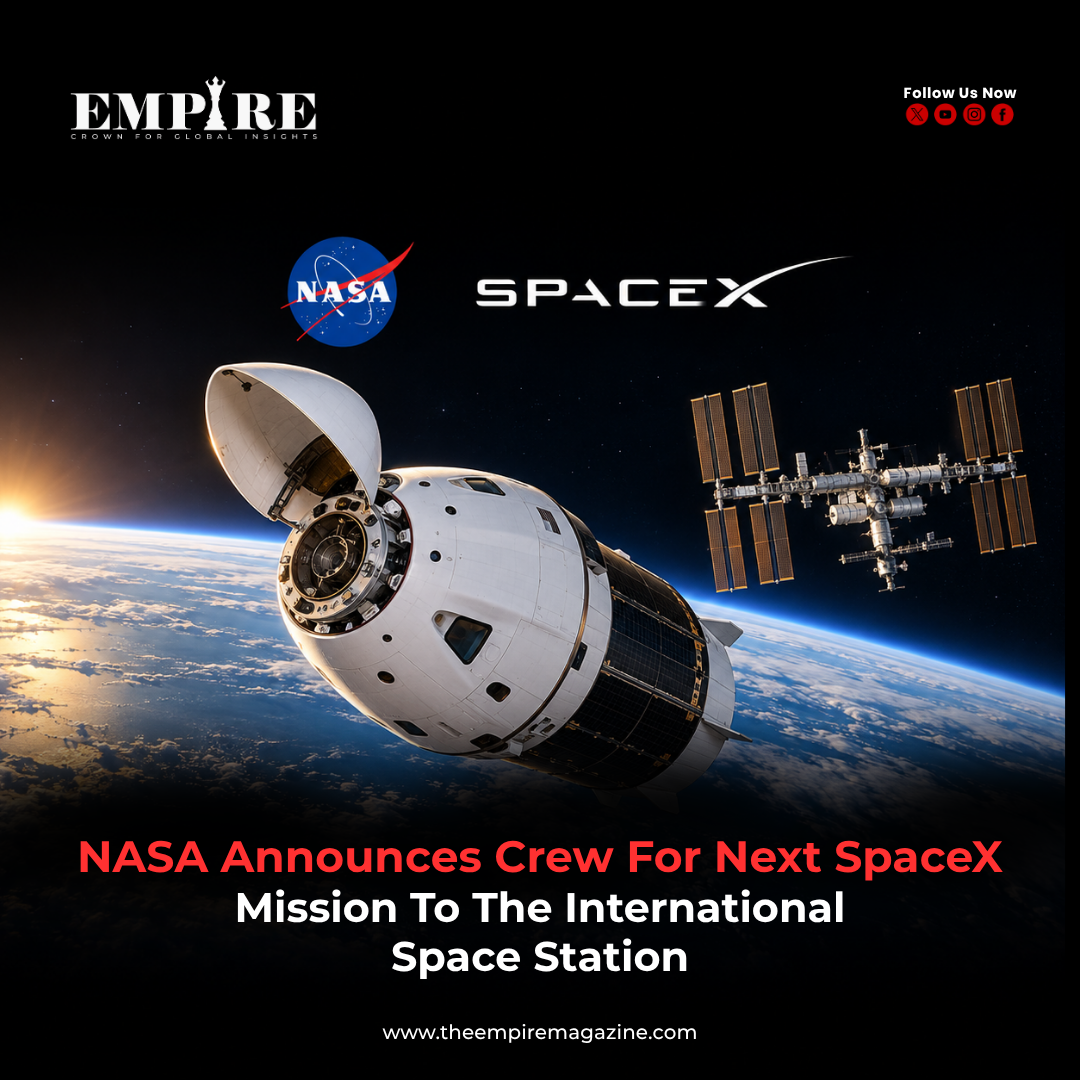
NASA has announced the four-person team for SpaceX Crew-14, a mission to the International Space Station scheduled to launch no earlier than spring 2027.
The September 24, 2026 announcement names representatives from NASA, JAXA and Roscosmos for a long-duration science expedition.
Information checked on 27 September 2026.
Table of Contents
- Who Is Flying on SpaceX Crew-14?
- When Will SpaceX Crew-14 Launch?
- Meet the Crew and Their Backgrounds
- Science Will Be Central to the Mission
- How SpaceX Supports Station Crew Rotations
- NASA Has Also Ordered Three Later SpaceX Missions
Who Is Flying on SpaceX Crew-14?
NASA assigned the following team.
| Crew member | Space agency | Mission role |
|---|---|---|
| Kayla Barron | NASA | Commander |
| Chris Birch | NASA | Pilot |
| Makoto Suwa | JAXA | Mission specialist |
| Arutyun Kiviryan | Roscosmos | Mission specialist |
When Will SpaceX Crew-14 Launch?
JAXA confirmed on September 25 that Suwa would fly aboard Crew Dragon on the Crew-14 mission. Its announcement gives a launch window of March 2027 or later, with the exact date to be announced once determined.
Crew-14 follows another mission already much closer to launch. NASA’s September 25 readiness update placed Crew-13’s earliest launch on October 1, 2026, at 11:10 a.m. EDT.
That flight is scheduled to carry Jessica Watkins, Luke Delaney, Joshua Kutryk and Sergey Teteryatnikov. NASA and its partners had completed the flight readiness review and agreed to continue preparations. This places the newly announced Crew-14 team in the following rotation.
Meet the Crew and Their Backgrounds
Kayla Barron: Returning Experience in Command
Barron brings experience from 177 days in orbit during the Crew-3 mission, which launched in November 2021 and returned in May 2022.
During that stay, she completed two spacewalks and served as lead robotics operator for another. She also helped operate the station’s robotic systems during the capture of a Cygnus cargo spacecraft.
Selected by NASA in 2017, Barron studied systems engineering at the U.S. Naval Academy and nuclear engineering at the University of Cambridge. Her earlier Navy career included service as a submarine warfare officer aboard the USS Maine.
Chris Birch: From Engineering and Elite Cycling to Spaceflight
Crew-14 will be Birch’s first spaceflight. NASA selected her for its astronaut candidate class in 2021, and she began training in January 2022.
She holds degrees in mathematics and biochemistry and molecular biophysics from the University of Arizona, together with a doctorate in biological engineering from MIT.
Birch taught bioengineering at the University of California, Riverside, and scientific writing and communication at Caltech. She later competed with the U.S. National Team as a track cyclist, winning eleven national championships.
Her career combines scientific research, teaching and high-performance sport, giving her a distinctive route into the astronaut corps.
Makoto Suwa: Geoscience and International Development
Suwa joined JAXA in July 2023 and qualified as an astronaut in October 2024.
He earned a doctorate in geosciences from Princeton University before working as a Japan Overseas Cooperation Volunteer in Rwanda. His career later took him to the World Meteorological Organization and the World Bank.
His preparation has also included the European Space Agency’s CAVES programme, which uses underground environments for teamwork training. JAXA nominated him for a long-duration ISS assignment in January 2026.
That background brings experience in Earth science and international cooperation to the crew.
Arutyun Kiviryan: A Background in Rocket Engineering
Kiviryan will make his first visit to the ISS. He trained as a rocket engineer at Baltic State Technical University and joined Russia’s cosmonaut corps in 2021, becoming a test cosmonaut in 2023.
Science Will Be Central to the Mission
NASA says the crew will conduct research and technology demonstrations supporting future Moon and Mars exploration, with benefits for Earth.
The ISS offers researchers a sustained microgravity environment, exposure to space and the ability to have crew members operate experiments directly. Its wider research programme spans biology, human health, physical science and technology testing.
NASA’s station research overview describes work on disease processes, diagnostic tools and the behaviour of living systems. Other investigations examine physical processes that behave differently in microgravity.
Technology demonstrations have included areas such as DNA sequencing and 3D printing. The station also provides a platform for observing Earth and collecting space science data. These examples show the breadth of the laboratory’s research programme.
For a long-duration crew, reaching orbit is the beginning of the assignment. The scientific value comes from the work carried out during the stay and the results researchers can analyse afterward.
How SpaceX Supports Station Crew Rotations
SpaceX’s crew transportation system combines the Crew Dragon spacecraft and Falcon 9 rocket. NASA’s programme overview identifies launch facilities at Kennedy Space Center and Cape Canaveral Space Force Station in Florida.
The commercial crew model allows NASA to purchase transportation services while private companies own and operate their spacecraft and supporting infrastructure. NASA engineers and specialists work with those providers on safety and technical requirements.
Reliable crew transportation supports the station’s research schedule by allowing teams to rotate through the laboratory. NASA describes the approach as a way to sustain access to low Earth orbit while concentrating other resources on deeper-space exploration.
NASA Has Also Ordered Three Later SpaceX Missions
The SpaceX Crew-14 announcement comes shortly after a separate commitment to future station flights.
On September 18, 2026, NASA announced a US$946 million contract modification covering Crew-15, Crew-16 and Crew-17, together with related mission services.
The award includes launch and ground operations, support in orbit, return and recovery, cargo transportation and an emergency return capability while the spacecraft is docked.
NASA said the modification brings SpaceX’s total contracted missions under the programme to 17 and the overall contract value to US$5.92 billion. The performance period runs through 2030, with mission readiness dates in 2027 and 2028.
Together, the crew assignment and later flight orders show how station operations are planned across successive missions. Crew-14’s preparation is one part of maintaining the people, transportation and research capability needed aboard the orbiting laboratory.
Explore more global business, technology and innovation coverage in The Empire Magazine’s article archive.
Read our related business coverage: Lila Sciences’ palladium catalysts for green hydrogen.
Follow The Empire Magazine for global business, technology, innovation, and leadership insights:
Facebook: The Empire Magazine
Instagram: @the_empire_magazine
The Empire Magazine | Crown For Global Insights