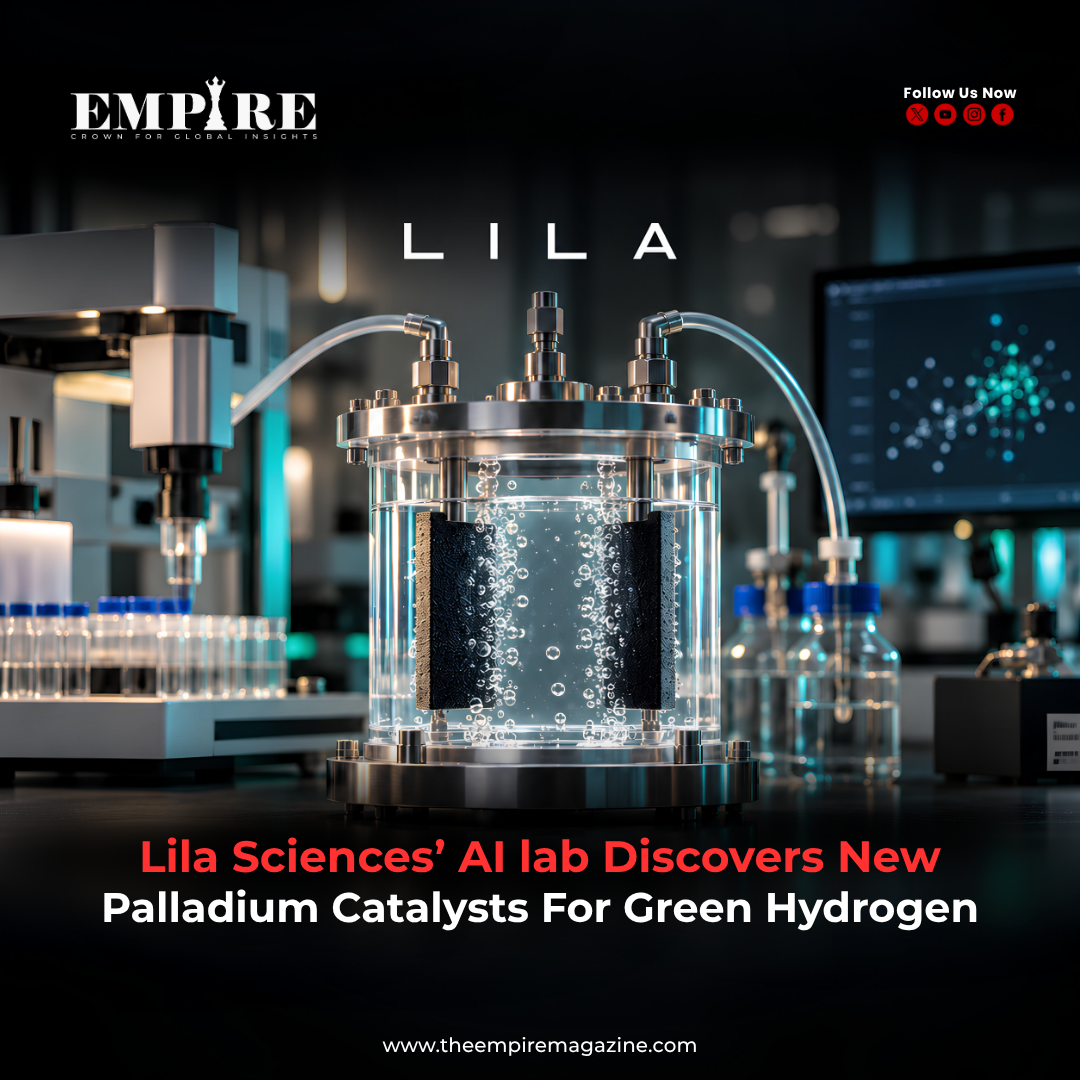
Lila Sciences has discovered new palladium catalysts that could support green hydrogen production. The company announced on September 25, 2026, that its AI-directed laboratory identified six promising material families. It is now studying how these findings could translate into industrial use.
The research, presented in a preprint submitted to arXiv on September 24, highlights an indium–manganese–palladium oxide that maintained an overpotential below 0.5 V for more than 1,000 hours in an acidic laboratory test. These palladium catalysts remain at the research stage.
Why Palladium Catalysts Matter for Green Hydrogen
Green hydrogen can be produced by using renewable electricity to split water into hydrogen and oxygen. This process, called electrolysis, takes place inside an electrolyzer.
In a proton exchange membrane, or PEM, electrolyzer, oxygen forms at the anode. Hydrogen ions move across the membrane and combine with electrons at the cathode to form hydrogen gas. Improving the oxygen-producing reaction can therefore help the overall process.
The electricity source remains essential. A better catalyst cannot, by itself, make hydrogen production low in emissions. Electricity costs, equipment efficiency and operating life also affect whether a project is practical.
Lila focused on acidic oxygen evolution, where catalysts must work efficiently while resisting corrosion. Iridium oxide is the established commercial choice for this environment. Ruthenium is another option, although stability remains a challenge. Their scarcity encourages researchers to investigate alternatives.
How Lila Sciences Uses AI to Discover Catalysts
Lila connects AI reasoning models with laboratory instruments and experimental data through facilities it calls AI Science Factories. The approach links three activities:
- Propose experiments: AI models suggest research directions and experimental designs.
- Test the ideas: Connected laboratory equipment generates physical measurements.
- Learn from results: New evidence informs the next experiments and helps develop the models.
This feedback matters because scientific predictions need experimental support. A suggested material becomes a useful lead when researchers can make it, measure its performance and reproduce the result. An unsuccessful experiment can also help narrow the search by showing which ideas need revision.
In the palladium catalysts study, the platform evaluated 2,942 catalysts across 53 material systems and 26 elements. Its search considered both activity and stability, aiming to find materials that could perform the reaction while resisting degradation.
The laboratory produced batches of 96 catalysts using physical vapour deposition. Researchers checked their composition, tested them in acid and examined them afterwards. Scientists also handled safety reviews and moved samples between instruments.
Lila says the palladium combinations surprised its scientists. Laboratory results persuaded them to investigate a direction they had initially considered unpromising.
What the Palladium Catalysts Achieved in Testing
Long-duration tests used 1 M sulfuric acid at 10 milliamperes per square centimetre. The preprint reports these results:
| Catalyst | Material combination | Reported test result |
|---|---|---|
| PdOₓ | Palladium oxide reference | Overpotential exceeded 0.5 V after about 200 hours. |
| NiTaPdOₓ | Nickel, tantalum and palladium oxide | Overpotential exceeded 0.5 V after about 470 hours. |
| InMnPdOₓ | Indium, manganese and palladium oxide | Overpotential stayed below 0.5 V for more than 1,000 hours. |
These formulations contain neither iridium nor ruthenium. The authors associate improved performance with a nanostructure that supports activity and protects palladium against corrosion.
Understanding the 0.5 V Measurement
Overpotential describes the extra electrode potential needed, beyond its equilibrium value, to sustain a particular current. It helps researchers assess the demands of an electrode reaction.
The reported 0.5 V threshold concerns that additional potential. It is not the total voltage required to operate an entire electrolyzer.
What Must Happen Before Industrial Use
Commercial adoption requires testing under demanding operating conditions. The U.S. Department of Energy’s 2026 PEM electrolysis targets include a current density of 3 amperes per square centimetre and a stack lifetime of 80,000 hours. These are development targets.
For context, the study’s current density was 0.01 amperes per square centimetre. The DOE target is therefore 300 times higher. Different test arrangements mean this comparison cannot predict how the new materials would perform in an industrial system.
DOE also states that performance, durability and cost objectives must be met together. Further evaluation of palladium catalysts would need to address:
- Performance at higher operating rates.
- Degradation during repeated start-stop cycles.
- Efficiency and durability when less catalyst is used.
- Behaviour in a complete electrolyzer stack.
A long laboratory test provides useful evidence, but developers still need to establish how the material behaves throughout the intended operating cycle.
Could Palladium Catalysts Reduce Hydrogen Costs?
Palladium already has an established industrial market. The U.S. Geological Survey places it among the six platinum-group metals and identifies its use in automotive catalytic converters. Platinum-group metals also serve chemical processing and other industries.
For hydrogen producers, palladium catalysts could expand material choices. However, their commercial value would depend on the amount needed, manufacturing costs, recovery options and replacement frequency. Existing industrial demand would also remain relevant when assessing procurement.
These considerations make a full cost assessment essential. A promising material does not establish a specific reduction in the cost of hydrogen.
Electricity and equipment costs would continue to shape project economics. DOE’s electrolysis research priorities include improving conversion efficiency, reducing capital costs and understanding equipment degradation. Palladium catalysts could contribute to these goals if further testing supports their performance.
Lila Sciences’ Wider AI Research Strategy
The discovery forms part of Lila’s effort to commercialise AI-driven research. In October 2025, the company announced a $350 million Series A, bringing the capital raised at that time to $550 million.
Lila said the funding would support expansion of its AI Science Factories and the availability of its platform to commercial partners. Its investors included NVentures, NVIDIA’s venture capital arm.
The business question extends beyond one successful experiment. Potential customers would need to assess whether the platform can repeatedly deliver useful discoveries, how quickly it does so and what resources are required to turn those findings into products.
Lila’s platform strategy treats newly generated experimental data as input for further model development. Its broader ambition is to connect reasoning, tools and physical testing across scientific fields. For businesses evaluating such platforms, repeated results across different research problems would provide stronger evidence of value than a single demonstration.
Next Research Steps for Palladium Catalysts
Lila says it is continuing long-term durability studies and evaluating the materials in forms closer to industrial applications. Those experiments will help determine whether the laboratory performance can be retained as the technology moves towards practical use.
Explore more global business, technology and innovation coverage in The Empire Magazine’s article archive.
Read our related business coverage: Starfish Space Otter Spacecraft Launch
Follow The Empire Magazine for global business, technology, innovation, and leadership insights:
Facebook: The Empire Magazine
Instagram: @the_empire_magazine
The Empire Magazine | Crown For Global Insights