
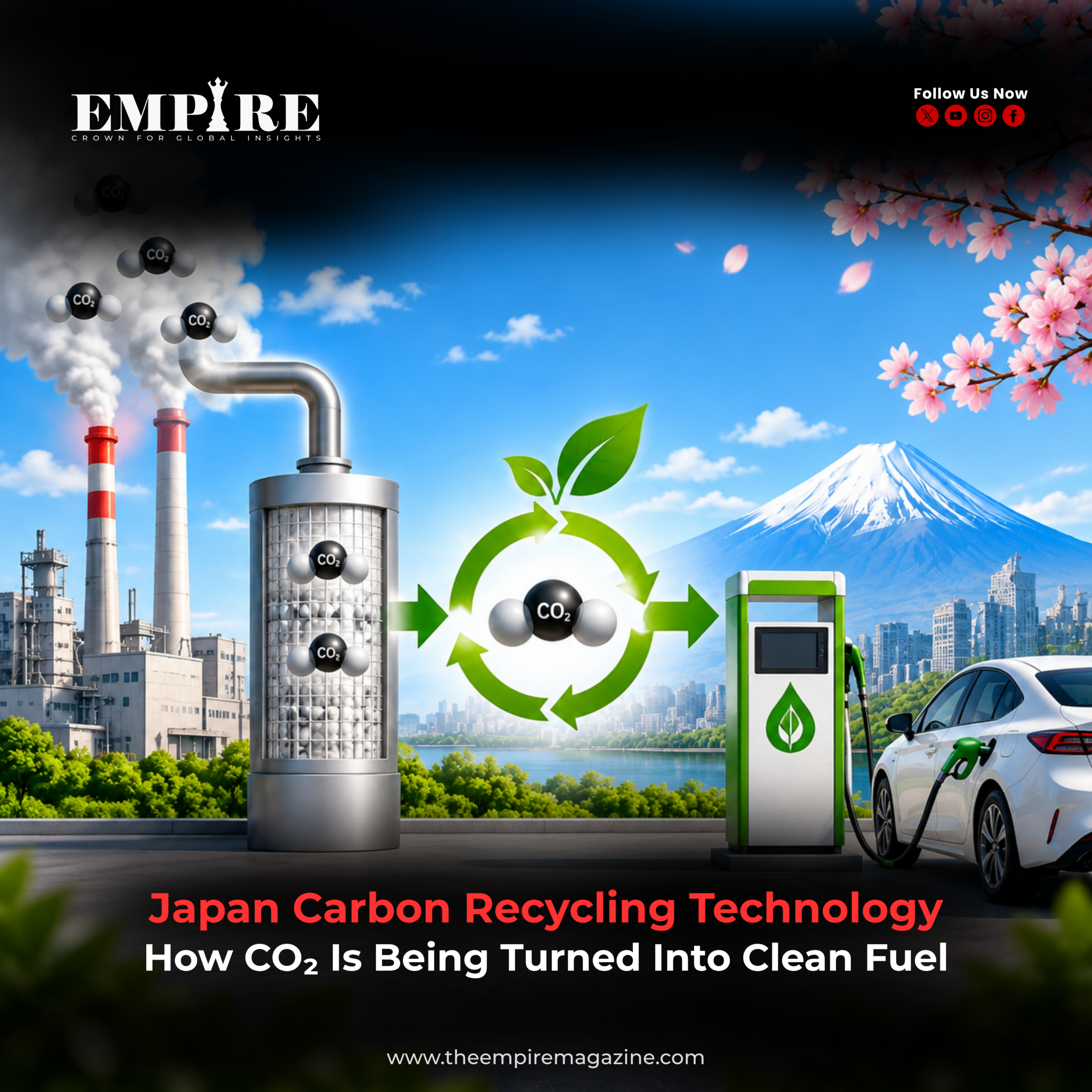
Japan Carbon Recycling Technology is creating a new approach to climate innovation by converting carbon dioxide (CO₂) emissions into useful products such as synthetic fuels, chemicals, and materials. Instead of treating CO₂ only as waste, Japan is investing in technologies that capture carbon emissions and reuse them as a resource for a more sustainable economy.
As countries around the world work toward reducing greenhouse gas emissions, carbon recycling has emerged as one of the technologies being explored alongside renewable energy, energy efficiency, and carbon capture solutions.
Japan has identified carbon recycling as an important part of its strategy to achieve carbon neutrality while maintaining industrial growth. Through government initiatives, research programmes, and industry partnerships, the country is developing technologies designed to transform captured carbon dioxide into products that can support a low-carbon future.
Japan Carbon Recycling Technology Uses CO₂ as a Resource Instead of Waste
Japan Carbon Recycling Technology is based on the idea of creating a circular carbon economy.
Traditional industrial systems often release carbon dioxide into the atmosphere after using fossil fuels. Carbon recycling aims to capture some of these emissions and reuse them to create new products.
The process generally involves three major steps:
Capturing Carbon Dioxide
CO₂ can be captured from industrial facilities, power plants, and other emission sources.
Converting CO₂ Into Useful Products
Captured carbon dioxide can be processed using chemical, biological, or electrochemical methods.
Creating New Applications
The converted carbon can be used in products such as fuels, chemicals, construction materials, and other industrial applications.
This approach does not eliminate the need for emission reduction, but it provides another pathway for managing unavoidable carbon emissions.
Japan Carbon Recycling Technology Focuses on Producing Clean Fuels
One of the most important areas of carbon recycling research is the development of carbon-neutral fuels.
Japan has been exploring technologies that use captured CO₂ combined with hydrogen to produce synthetic fuels.
These fuels can potentially support sectors where direct electrification is difficult, including:
- Aviation
- Shipping
- Heavy industries
- Long-distance transportation
Synthetic fuels created through carbon recycling aim to reuse carbon that has already been released rather than continuously adding new carbon from fossil sources.
The Japanese government has supported research into carbon recycling technologies through initiatives led by organisations such as the New Energy and Industrial Technology Development Organization (NEDO).
Japan Carbon Recycling Technology and the Role of Hydrogen
Hydrogen plays an important role in many carbon recycling processes.
When hydrogen produced from clean energy sources is combined with captured CO₂, it can create synthetic fuels and chemicals with lower carbon emissions compared with conventional fossil-based production methods.
Japan has been investing in hydrogen technology as part of its broader clean energy strategy.
Carbon recycling and hydrogen development are closely connected because hydrogen provides the additional element needed to convert carbon dioxide into useful products.
The combination of:
- Renewable energy
- Clean hydrogen
- Carbon capture
- Advanced chemical processes
creates new possibilities for reducing emissions from difficult-to-decarbonise industries.
Japan Carbon Recycling Technology Supports the Development of Sustainable Industries
Carbon recycling is not limited to fuel production.
Japan is also researching ways to use captured CO₂ in manufacturing and industrial processes.
Potential applications include:
Chemicals
CO₂ can be used as a raw material for producing certain chemical products.
Construction Materials
Some technologies explore using carbon dioxide in building materials.
Synthetic Materials
Carbon-based materials and products can potentially be created using captured emissions.
These applications support the idea of transforming carbon dioxide from an environmental challenge into an industrial resource.
Japan Carbon Recycling Technology Is Backed by Government and Industry Collaboration
Japan’s carbon recycling development involves cooperation between government agencies, research institutions, and private companies.
The Japanese government has promoted carbon recycling through its Green Growth Strategy, which identifies technologies needed to support carbon neutrality.
Japanese companies across sectors such as energy, engineering, and manufacturing are researching different approaches to carbon utilisation.
This collaboration is important because carbon recycling requires expertise from multiple fields, including:
- Chemistry
- Energy systems
- Engineering
- Manufacturing
- Environmental science
The development of practical carbon recycling solutions depends on combining research innovation with industrial implementation.
Japan Carbon Recycling Technology Faces Challenges Before Large-Scale Adoption
Although carbon recycling has significant potential, several challenges remain.
High Costs
Capturing and converting CO₂ requires advanced technology and significant investment.
Energy Requirements
Many carbon conversion processes require large amounts of energy. The environmental benefits depend on using low-carbon energy sources.
Technology Development
Many carbon recycling solutions are still being developed and require further research before widespread commercial adoption.
Market Competition
Carbon recycling technologies must become economically competitive with existing fossil-based systems.
These challenges mean carbon recycling will likely work alongside other climate solutions rather than replacing renewable energy and emission reduction efforts.
Japan Carbon Recycling Technology and the Global Race for Climate Innovation
Countries worldwide are exploring technologies to reduce carbon emissions and achieve climate goals.
Carbon capture, utilisation, and storage (CCUS) technologies are receiving increased attention as governments and industries look for solutions to address industrial emissions.
Japan’s approach focuses on combining technological innovation with industrial capability.
The country’s carbon recycling strategy reflects a broader global movement toward developing technologies that can support cleaner production systems.
Similar technology-driven transformations are happening across industries, from artificial intelligence to advanced manufacturing. Read more technology insights here: https://theempiremagazine.com/john-deere-ai-farming-revolution/
Japan Carbon Recycling Technology Represents a New Approach to Carbon Management
Japan Carbon Recycling Technology demonstrates how countries are exploring new ways to manage carbon emissions.
By converting CO₂ into fuels, chemicals, and materials, carbon recycling aims to create a more circular relationship with carbon resources.
The future success of these technologies will depend on continued research, cost reduction, clean energy availability, and large-scale industrial adoption.
As the world moves toward cleaner energy systems, Japan’s carbon recycling initiatives represent one example of how innovation can reshape the relationship between industry and the environment.
Follow The Empire Magazine for global business, technology, innovation, and leadership insights:
Facebook: https://www.facebook.com/profile.php?id=61573749076160
Instagram: https://www.instagram.com/the_empire_magazine/
The Empire Magazine | Crown For Global Insights