Indonesia | Politics & Governance
November 13, 2026
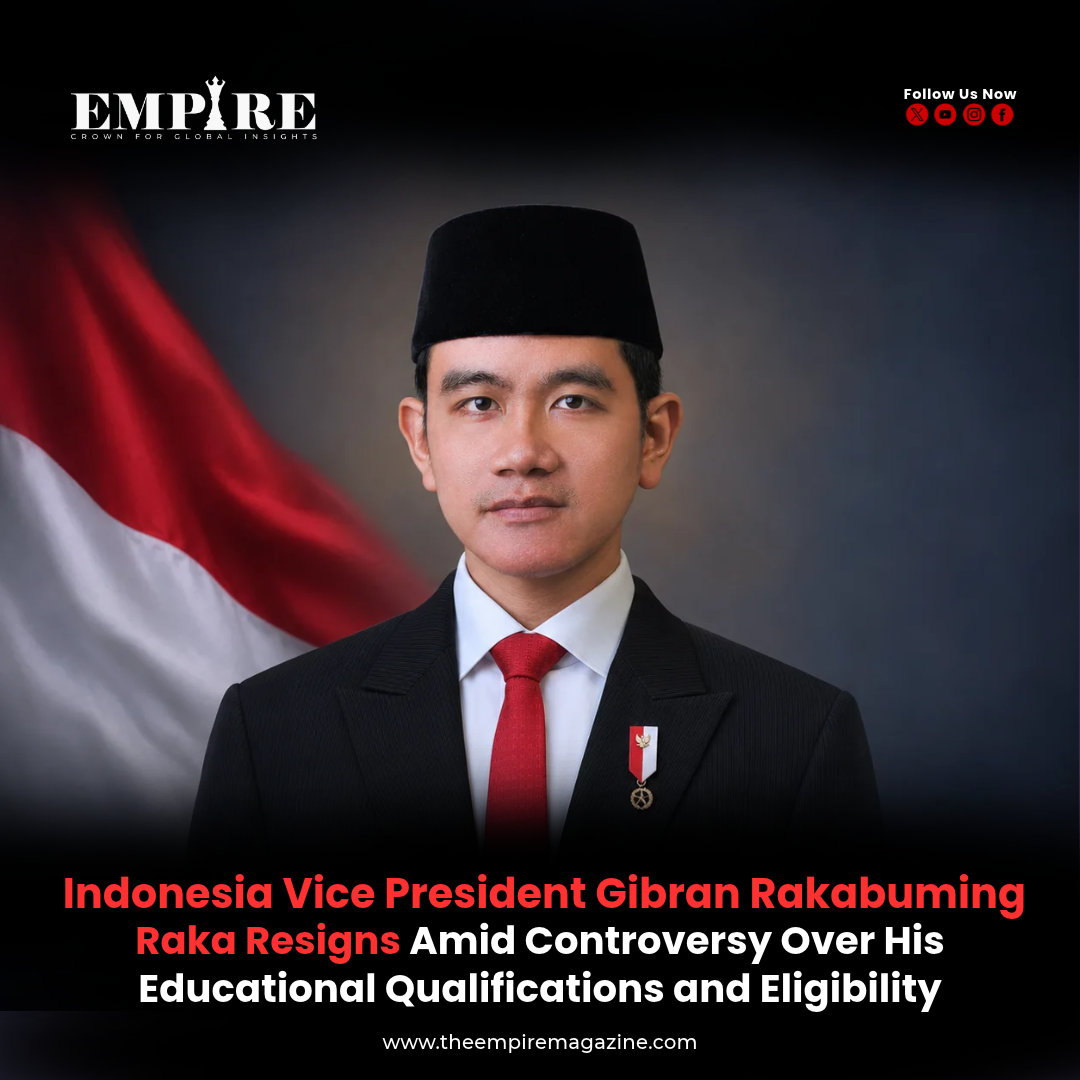
Gibran Rakabuming Raka has resigned as Indonesia’s vice president amid controversy over his educational qualifications and whether the documents supporting his candidacy satisfied the country’s election requirements.
President Prabowo Subianto accepted his resignation on November 12, 2026. Gibran also submitted his resignation letter to the People’s Consultative Assembly, known as the MPR, which will oversee the process of choosing a replacement.
The departure follows court proceedings concerning the recognition of his overseas education. However, Gibran has rejected suggestions that his resignation was caused by the diploma dispute, describing it as a personal decision and maintaining that his educational documents were complete.
What Gibran Rakabuming Raka Said About His Resignation
According to MPR Speaker Ahmad Muzani, Gibran Rakabuming Raka is resignation letter stated that he was leaving office at his own request. It referred to the interests of the country and the smooth functioning of government without identifying a specific reason for stepping down.
In a subsequent public statement, Gibran Rakabuming Raka said his decision was unrelated to questions about his diploma. He maintained that the relevant educational documents had already been submitted to the court.
His explanation is an essential part of the story. Although the resignation came amid the qualifications controversy, it should not be presented as his admission that the allegations against him were correct.
What Was the Educational Qualifications Dispute?
Indonesia’s election requirements include completion of senior secondary education or an equivalent qualification for presidential and vice-presidential candidates.
The dispute concerned whether Gibran Rakabuming Raka is overseas educational documents provided a valid basis for recognition as equivalent to the required Indonesian qualification.
This brought attention to both the supporting documents and the government’s education-equivalence certificate. The central legal question was whether the recognised qualification satisfied the requirements for candidacy.
The controversy developed through separate proceedings before the Constitutional Court and the Supreme Court. Their decisions addressed different legal questions and had different effects.
What the Constitutional Court Decided
On October 6, 2026, the Constitutional Court said it had not found convincing evidence establishing that Gibran Rakabuming Raka possessed an overseas diploma or certificate that could support the required secondary-school equivalence.
However, the court did not disqualify him in that case. It declared the application inadmissible because the applicants lacked the necessary legal standing.
The court also explained that Gibran Rakabuming Raka was already an inaugurated vice president, rather than a candidate participating in an ongoing presidential election process.
That distinction matters when describing the outcome. The court’s observations about the educational evidence and its decision on whether the case could proceed must be reported together.
Education-Equivalence Certificate Withdrawn After Supreme Court Ruling
A separate Supreme Court proceeding concerned the validity of the government certificate recognising Gibran Rakabuming Raka is educational equivalence.
Following that ruling, Indonesia’s Ministry of Primary and Secondary Education withdrew the certificate issued in 2019.
Education Minister Abdul Mu’ti confirmed the withdrawal to the national news agency ANTARA. Coordinating Minister Yusril Ihza Mahendra described the action as implementation of the Supreme Court’s decision and said the certificate no longer had binding legal force.
This development gave the controversy a concrete administrative consequence. The dispute involved the legal status of the certificate used to establish educational equivalence, alongside broader questions about eligibility for public office.
How President Prabowo Responded
Prabowo said he respected and supported Gibran Rakabuming Raka decision to resign. He also thanked him for his contribution during the election campaign and their two years in government.
In explaining the situation, the president referred to differences between foreign and Indonesian education systems. He said the legal decisions had identified shortcomings in fulfilling the requirements of Indonesia’s constitutional system.
Prabowo also highlighted Gibran’s work visiting regions and checking the implementation of government programmes.
The president’s remarks linked the departure to the legal circumstances surrounding eligibility. Gibran’s own statement, meanwhile, maintained that his resignation was a personal decision unrelated to his diploma.
Why Gibran’s Eligibility Had Already Attracted Attention
Gibran’s path to the vice presidency had previously drawn scrutiny over a separate issue: the minimum age for candidates.
On October 16, 2023, the Constitutional Court ruled that candidates could qualify if they were at least 40 years old or had held an elected public office, including a position won through regional elections.
Gibran, who had become mayor of Surakarta in 2021, was able to contest the vice presidency under that exception.
The age ruling and the later education dispute concern separate eligibility requirements. Meeting the age-related condition did not resolve questions about educational qualifications.
His political position also attracted attention because he is the son of former president Joko Widodo, commonly known as Jokowi.
How Indonesia Will Choose a New Vice President
Article 8(2) of Indonesia’s Constitution sets out the procedure for filling a vice-presidential vacancy.
The process involves three central steps:
- The president proposes two candidates for the vacant position.
- The MPR convenes a session to choose between those candidates.
- The selection must take place within 60 days of the vacancy.
The vacancy therefore does not require a new nationwide vice-presidential election.
In its November 12 announcement, the MPR said it planned a meeting on November 13 to organise the next stages. These included arranging the parliamentary timetable, requesting nominations and preparing to verify candidates’ documents.
What the Resignation Means for Indonesia
Gibran’s departure creates a significant leadership change within Prabowo’s administration and brings renewed attention to how candidate qualifications are checked.
From a governance perspective, the succession process will test the clarity of nomination procedures, the scrutiny of supporting documents and cooperation between the presidency and the MPR.
The political consequences will depend partly on whom Prabowo nominates and whom the assembly selects. Those decisions will shape the administration’s leadership for the remainder of the presidential term.
The next concrete developments to watch are the official nominations, verification of the candidates’ qualifications and the MPR’s selection timetable.
Explore more global business, technology and innovation coverage in The Empire Magazine’s article archive.
Read our related coverage: jensen-huang-resigns-nvidia-ceo/
Follow The Empire Magazine:
Facebook | Instagram
The Empire Magazine | Crown For Global Insights