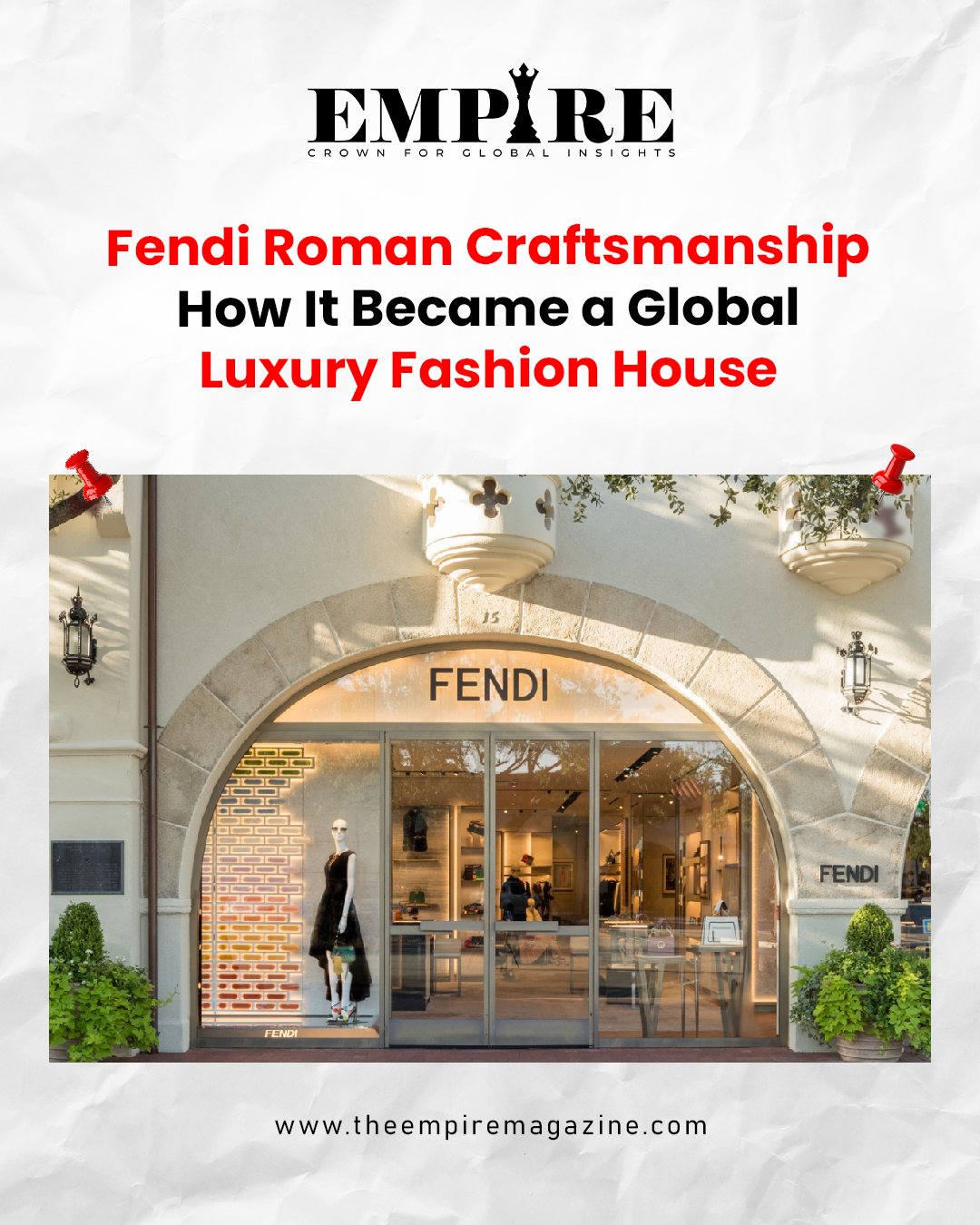
Fendi Roman Craftsmanship has shaped one of the most respected luxury fashion stories in the world. Founded in Rome in 1925 by Adele and Edoardo Fendi, the brand began as a fur and leather goods workshop. From the beginning, Fendi was connected to Italian craftsmanship, refined materials, and the culture of Roman elegance.
The house started with a clear identity: high-quality leather goods, expert fur work, and a strong relationship with local clients. Over time, that small Roman workshop grew into a global fashion house known for handbags, ready-to-wear, fur, accessories, menswear, womenswear, and luxury lifestyle products.
Fendi’s journey is not only a story of fashion. It is a story of family leadership, creative risk, craftsmanship, brand reinvention, and global expansion. The company transformed from a local Roman business into a luxury name recognized across Europe, Asia, the Middle East, and the Americas.
What makes Fendi different is the way it has protected its Roman roots while adapting to global luxury demand. The brand has never completely moved away from its original codes: fur, leather, craft, innovation, and elegance. Instead, it has modernized those codes for new generations of luxury consumers.
Fendi Roman Craftsmanship Began in Rome in 1925
Fendi Roman Craftsmanship began when Adele and Edoardo Fendi opened their first boutique in Rome. The business focused on leather goods and fur, two categories that became central to the brand’s identity. Rome was not just a location for Fendi; it became part of the brand’s character.
The city’s architecture, history, craftsmanship traditions, and sense of grandeur influenced the way Fendi built its luxury identity. Unlike some fashion houses that are strongly connected to Paris or Milan, Fendi’s identity is deeply Roman. This gives the brand a distinctive cultural position in the global fashion industry.
Rome offered Fendi a unique foundation. The city combined old-world craftsmanship with international tourism, aristocratic style, and a strong appreciation for handmade quality. This helped the brand attract customers who valued elegance and detail.
Fendi Roman Craftsmanship and the Family Business
Fendi Roman Craftsmanship became stronger when the second generation of the Fendi family joined the company. Adele and Edoardo’s five daughters — Paola, Anna, Franca, Carla, and Alda — helped expand the business and gave the house a powerful family-led identity.
Each sister played a role in the company’s growth. Together, they helped turn Fendi from a respected Roman shop into a more ambitious fashion house. Their leadership brought energy, organization, and a deeper creative direction to the brand.
The Fendi sisters understood that luxury needed both tradition and innovation. They protected the house’s expertise in fur and leather while also opening the door to new ideas, new markets, and new creative partnerships.
Fendi Roman Craftsmanship and Karl Lagerfeld’s Creative Era
Fendi Roman Craftsmanship entered a new stage when Karl Lagerfeld joined the brand in 1965. His arrival became one of the longest and most influential designer relationships in fashion history. Lagerfeld worked with Fendi for more than five decades and helped transform the house’s image.
Before Lagerfeld, fur was often seen as traditional and formal. At Fendi, he helped make fur lighter, more playful, more experimental, and more fashion-forward. This changed how the luxury world looked at the category.
Lagerfeld also created the famous double-F logo, often associated with “Fun Fur.” The logo became one of Fendi’s most recognizable visual codes and later appeared across bags, clothing, accessories, and branding.
Fendi Roman Craftsmanship and Innovation in Fur
Fendi Roman Craftsmanship became known for technical innovation in fur. The brand treated fur not only as a luxury material but also as a creative surface. Fendi experimented with cutting, dyeing, weaving, shaving, printing, and treating fur in new ways.
This innovation helped the brand stand out from other luxury houses. Fendi was not simply producing classic fur coats. It was turning fur into a modern fashion language.
The brand’s ability to mix traditional handwork with experimental techniques became one of its strongest advantages. It showed that craftsmanship did not have to mean staying in the past. Craftsmanship could also be used to create something modern and unexpected.
Fendi Roman Craftsmanship and the Baguette Bag
Fendi Roman Craftsmanship reached a new global audience with the Baguette bag. Designed by Silvia Venturini Fendi and introduced in the late 1990s, the Baguette became one of the most iconic handbags in fashion history.
The bag was designed to be carried under the arm, like a French baguette. Its compact shape, decorative variations, and strong personality made it different from many larger bags of the time. It quickly became a symbol of fashion confidence and individual style.
The Baguette helped create the modern idea of the “It bag.” It showed that a handbag could become a cultural object, not only a practical accessory. Fendi released the Baguette in many materials, colors, embroideries, and limited editions, making it collectible and highly recognizable.
Fendi Roman Craftsmanship and Silvia Venturini Fendi
Fendi Roman Craftsmanship was also shaped by Silvia Venturini Fendi, granddaughter of the founders. Her role in accessories and menswear helped carry the family legacy into the modern luxury era.
Silvia Venturini Fendi created not only the Baguette but also other important accessories such as the Peekaboo bag. The Peekaboo, introduced in 2009, became another major Fendi design because of its structured shape and distinctive opening that reveals the interior.
Her work helped prove that Fendi’s future did not depend only on fur and ready-to-wear. Accessories became a major part of the brand’s global business and cultural relevance.
Fendi Roman Craftsmanship and Global Expansion
Fendi Roman Craftsmanship became a global business through careful expansion. The brand moved beyond Rome while keeping its Italian identity. It built a presence in major luxury markets, including Europe, the United States, the Middle East, China, Japan, and other parts of Asia.
Global expansion helped Fendi reach new customers who were interested in Italian luxury, craftsmanship, and iconic handbags. Luxury shoppers increasingly looked for brands with strong heritage, and Fendi offered a powerful story: family roots, Roman identity, expert craft, and modern design.
Becoming part of LVMH also gave Fendi access to global resources, retail expertise, supply chain strength, and international luxury strategy. This helped the brand compete with other major fashion houses while maintaining its own identity.
Fendi Roman Craftsmanship and LVMH Ownership
Fendi Roman Craftsmanship continued under LVMH, the world’s leading luxury group. LVMH’s ownership gave Fendi stronger international support while allowing the brand to remain connected to its heritage.
This balance is important in luxury. A brand must grow globally, but it cannot lose the identity that made it valuable. For Fendi, Roman craftsmanship remains a core part of the story. Its headquarters in Rome and its continued focus on Italian artistry help protect that identity.
LVMH’s structure also allows Fendi to operate as a distinct Maison. This means the brand can build its own creative direction, retail experience, product strategy, and cultural positioning while benefiting from group-level luxury expertise.
Fendi Roman Craftsmanship and Ready-to-Wear
Fendi Roman Craftsmanship expanded into ready-to-wear and became more than an accessories and fur house. Its womenswear and menswear collections helped the brand become a complete fashion house with seasonal runway influence.
Fendi ready-to-wear often reflects a mix of structure, softness, Roman elegance, and modern luxury. The brand uses strong tailoring, rich textures, neutral tones, leather details, and creative material treatments. This gives Fendi a recognizable style without making it overly loud.
The brand’s runway collections also help support accessories, leather goods, footwear, and visual storytelling. In luxury fashion, runway identity is important because it creates desire around the entire brand universe.
Fendi Roman Craftsmanship and Modern Creative Direction
Fendi Roman Craftsmanship has continued through different creative eras. After Karl Lagerfeld’s death in 2019, the brand entered a new period of transition. Kim Jones later led womenswear and couture collections, while Silvia Venturini Fendi continued to guide accessories and menswear.
In recent years, Fendi has continued to evolve while respecting its house codes. The brand has focused on Roman identity, craftsmanship, feminine strength, family heritage, and luxury accessories. As Fendi moves through leadership changes, its challenge is to stay modern without weakening its heritage.
This is one reason craftsmanship remains so important. Creative directors may change, but the brand’s foundation in Roman craft gives Fendi continuity.
Fendi Roman Craftsmanship and Iconic Brand Codes
Fendi Roman Craftsmanship is supported by strong brand codes. The double-F logo, Baguette bag, Peekaboo bag, Selleria stitching, fur innovation, leather goods, and Roman references all help customers recognize the brand.
Luxury brands need strong codes because they create memory. A customer may recognize a Fendi bag shape, logo pattern, stitching style, or material treatment before reading the brand name. This recognition builds long-term value.
The Baguette and Peekaboo are especially important because they connect craftsmanship with commercial success. They are not only famous designs; they are business pillars that support Fendi’s global retail strength.
Fendi Roman Craftsmanship and Selleria Heritage
Fendi Roman Craftsmanship is also connected to Selleria, a hand-stitching tradition inspired by Roman master saddlers. Selleria reflects the brand’s focus on manual skill and leather expertise.
This kind of craftsmanship matters because luxury consumers increasingly want authenticity. They want to know that a product is not only expensive but also carefully made. Hand stitching, quality leather, and artisanal techniques help justify luxury value.
Fendi’s ability to highlight such details keeps the brand connected to its workshop roots, even as it operates globally.
Fendi Roman Craftsmanship and Luxury Brand Power
Fendi Roman Craftsmanship shows how a luxury house can grow without losing its origin story. The brand’s success comes from combining heritage with reinvention. It began with fur and leather, expanded through family leadership, transformed through Karl Lagerfeld, reached global pop culture through the Baguette, and strengthened its international position under LVMH.
Fendi’s power comes from its ability to feel both historic and modern. It can reference Rome, family, and craft while also producing contemporary runway collections, global campaigns, and modern accessories.
This balance is difficult to achieve. Many luxury brands either become too traditional or too trend-focused. Fendi has survived because it uses craftsmanship as a foundation for experimentation.
Fendi Roman Craftsmanship and the Future of Global Luxury
Fendi Roman Craftsmanship remains relevant because the luxury market continues to value heritage, quality, and emotional storytelling. Customers are not only buying a bag, coat, or garment. They are buying a piece of the brand’s history.
For modern luxury shoppers, the strongest brands offer more than logos. They offer identity, culture, design, and craftsmanship. Fendi’s Roman roots give it a story that competitors cannot copy.
As the luxury market changes, Fendi’s challenge is to keep attracting younger buyers while maintaining credibility with long-time clients. Its future will depend on how well it protects its craft, updates its icons, and continues telling the story of Rome through global fashion.
For more luxury brand and business insights, read more on The Empire Magazine.
Follow The Empire Magazine on Facebook and Instagram.
– The Empire Magazine
Crown For Global Insights