
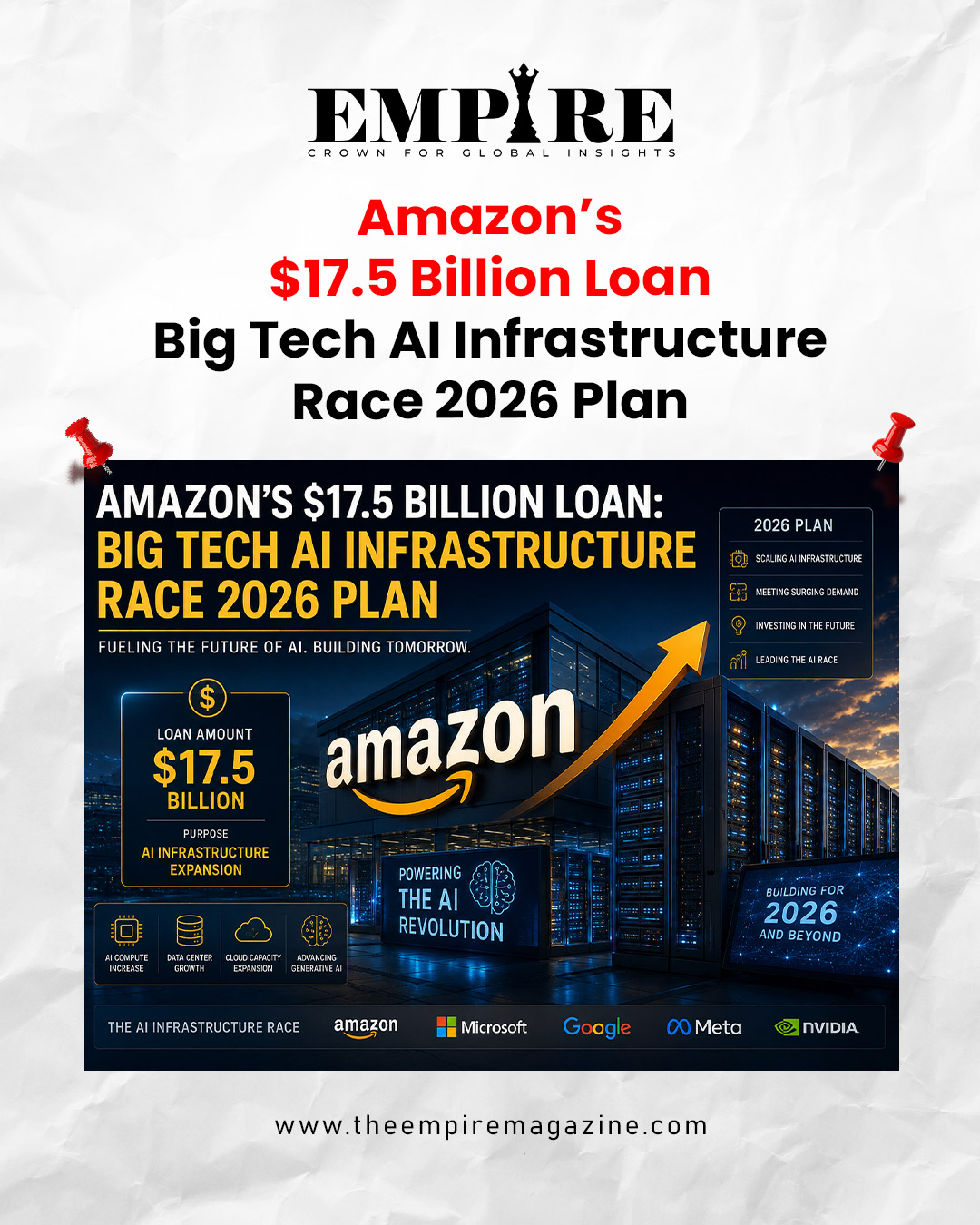
Amazon’s $17.5 Billion Loan is one of the clearest signs that artificial intelligence is changing how Big Tech finances growth. For years, the largest technology companies were known for strong cash reserves, high margins, and the ability to fund expansion internally. Now, the scale of AI infrastructure is becoming so large that even the biggest companies are turning to debt markets and large financing facilities.
Amazon secured a $17.5 billion delayed-draw term loan facility in June 2026. The loan gives the company access to capital that can be drawn over time, rather than borrowed all at once. This type of structure gives Amazon flexibility as it continues spending heavily on cloud infrastructure, data centers, chips, artificial intelligence systems, and other long-term technology investments.
The move reflects a broader trend in the technology industry. AI is not only a software race. It is also an infrastructure race. Companies need data centers, advanced processors, networking systems, electricity supply, cooling systems, real estate, and engineering talent. The companies that control the strongest infrastructure may gain an advantage in cloud services, AI model training, enterprise tools, and developer platforms.
Amazon’s $17.5 Billion Loan Shows AI Is Capital Intensive
Amazon’s $17.5 Billion Loan matters because AI infrastructure requires huge upfront investment. Unlike many internet businesses, where software can scale quickly at relatively low marginal cost, advanced AI needs physical capacity. Large AI models require powerful chips, massive data center space, high-speed networks, and reliable energy.
Amazon Web Services, known as AWS, is central to this strategy. AWS is one of the world’s largest cloud computing platforms and a major profit engine for Amazon. As companies adopt generative AI, machine learning, data analytics, and cloud-based automation, AWS must keep expanding its infrastructure to meet demand.
AI workloads are different from traditional cloud workloads. They often require specialized processors, large clusters of graphics processing units or custom AI chips, fast memory, and high-capacity networking. This makes infrastructure more expensive and more complex.
Amazon’s $17.5 Billion Loan and AWS Expansion
Amazon’s $17.5 Billion Loan supports the company’s ability to keep investing in AWS infrastructure. AWS competes with Microsoft Azure, Google Cloud, Oracle Cloud, and other enterprise cloud platforms. In the AI era, cloud providers are competing not only on storage or basic computing, but on access to powerful AI tools and hardware.
Amazon has developed its own chips, including Trainium and Inferentia, to support AI training and inference workloads. These chips are part of the company’s strategy to reduce dependence on third-party hardware and offer customers more cost-efficient AI computing.
The loan also fits into Amazon’s broader capital spending cycle. AI infrastructure projects can take years to build. Data centers require land, permits, power agreements, hardware supply, cooling design, construction, and customer demand planning. Financing gives Amazon more room to execute these long-term projects.
Amazon’s $17.5 Billion Loan and Big Tech Borrowing
Amazon’s $17.5 Billion Loan is part of a larger shift in Big Tech financing. Major technology companies are increasingly using bond markets, loan facilities, and other financing tools to support AI and cloud expansion. This is a change from the earlier image of Silicon Valley companies relying mainly on internal cash flow.
The reason is simple: AI infrastructure spending is extremely large. Data centers are no longer just warehouses filled with servers. They are energy-intensive industrial assets. They need advanced cooling, high-performance computing equipment, fiber connectivity, backup systems, and access to stable electricity.
The cost of staying competitive is rising. If a company slows down spending, it risks losing cloud customers, AI developers, enterprise contracts, and strategic relevance. If it spends too aggressively, it may pressure free cash flow and increase debt.
Amazon’s $17.5 Billion Loan and Debt Market Confidence
Amazon’s $17.5 Billion Loan also shows that lenders still see Amazon as a strong borrower. Large financial institutions are willing to provide major financing because Amazon has scale, diversified revenue, AWS profitability, strong market position, and global operations.
For lenders, Amazon is not a speculative startup. It is a large company with e-commerce, cloud computing, advertising, subscriptions, logistics, media, devices, and AI businesses. This makes the financing risk different from lending to a smaller AI company with uncertain revenue.
At the same time, the loan shows that even strong companies are preparing for heavier infrastructure costs. AI has shifted the financial conversation from “who has the best model?” to “who can fund the infrastructure behind the model?”
Amazon’s $17.5 Billion Loan and Data Center Demand
Amazon’s $17.5 Billion Loan is closely linked to rising data center demand. AI data centers are one of the most important assets in the current technology economy. They power model training, cloud applications, recommendation systems, enterprise AI tools, robotics, search, advertising systems, and customer support automation.
Data center growth is also putting pressure on energy markets. AI facilities need large amounts of electricity. Companies must secure power supply years in advance, and in some regions, grid limitations are becoming a bottleneck.
This is why AI infrastructure is not only a technology issue. It is also an energy, real estate, and finance issue. Big Tech companies must work with utilities, governments, construction firms, chip suppliers, and financial markets.
Amazon’s $17.5 Billion Loan and Power Infrastructure
Amazon’s $17.5 Billion Loan indirectly highlights the power challenge behind AI. As more data centers are built, electricity access becomes a competitive advantage. Companies that can secure reliable and affordable energy may deploy AI capacity faster.
Amazon has made large investments in renewable energy over the years, but AI growth creates new pressure. Data centers need electricity every hour, not only when wind or solar output is high. This creates demand for energy storage, grid upgrades, power purchase agreements, and sometimes new generation capacity.
AI infrastructure expansion will likely increase the importance of energy strategy for technology companies. Cloud providers are no longer only digital businesses. They are becoming major energy consumers and infrastructure operators.
Amazon’s $17.5 Billion Loan and the AI Chip Race
Amazon’s $17.5 Billion Loan also connects to the AI chip race. Advanced AI needs powerful processors. Companies use GPUs, custom accelerators, and specialized chips to train and run AI models. These chips are expensive, in high demand, and central to the economics of AI.
Amazon’s custom chip strategy gives it more control over performance and cost. Trainium is designed for AI training, while Inferentia is designed for inference. Training is the process of building or improving AI models. Inference is the process of running those models for real-world use, such as answering prompts, analyzing data, generating images, or supporting enterprise applications.
For cloud customers, chip availability matters. If AWS can offer powerful AI computing at competitive prices, it can attract startups, enterprises, developers, and government customers.
Amazon’s $17.5 Billion Loan and AI Customer Demand
Amazon’s $17.5 Billion Loan reflects growing customer demand for AI services. Businesses want AI tools for coding, customer service, logistics, marketing, data analysis, cybersecurity, finance, and operations. Many companies do not want to build their own AI infrastructure. They want cloud platforms that can provide compute power, models, security, and developer tools.
AWS is competing to serve that demand. Amazon Bedrock, custom AI chips, cloud storage, enterprise partnerships, and AI developer services are all part of its strategy. The more customers adopt AI, the more infrastructure AWS needs.
This creates a cycle. More AI demand requires more data centers. More data centers require more capital. More capital may require loans, bonds, and long-term financing.
Amazon’s $17.5 Billion Loan and Competitive Pressure
Amazon’s $17.5 Billion Loan is also a response to competitive pressure. Microsoft, Alphabet, Meta, Oracle, and other major technology companies are spending heavily on AI infrastructure. No major player wants to fall behind in computing capacity.
The competition is intense because AI may influence the next decade of cloud computing, enterprise software, search, advertising, devices, automation, and digital services. Companies are investing before all revenue is fully proven because they believe infrastructure leadership will be strategic.
Amazon has an advantage through AWS, but the market is moving fast. Microsoft has strong enterprise relationships and AI integrations. Google has deep AI research and cloud services. Meta is building large AI systems for social platforms and open-source models. Oracle is expanding cloud infrastructure for AI workloads.
Amazon’s $17.5 Billion Loan and Investor Questions
Amazon’s $17.5 Billion Loan may also raise investor questions. AI infrastructure spending can support future growth, but it can also pressure cash flow. Investors want to know whether massive AI capital expenditure will generate enough return.
This is one of the biggest debates in technology markets. AI demand is strong, but infrastructure costs are also high. Companies must prove that customers will pay enough for AI services to justify the spending.
Amazon’s loan gives it more financial flexibility, but it also shows that AI investment is not cheap. The winners may be companies that can convert infrastructure spending into real customer revenue, stronger cloud margins, and long-term platform control.
Amazon’s $17.5 Billion Loan and the Cloud Business Model
Amazon’s $17.5 Billion Loan shows how the cloud business model is changing. In the early cloud era, companies paid for computing, storage, databases, and networking. In the AI era, they also need access to specialized model training, inference capacity, AI agents, vector databases, data pipelines, and secure enterprise AI environments.
This makes cloud platforms more important but also more expensive to operate. The largest customers may sign long-term cloud commitments because they need guaranteed AI capacity. At the same time, cloud providers must buy hardware before the full revenue arrives.
This timing mismatch is one reason financing matters. A company may need to spend billions today to support customer demand tomorrow.
Amazon’s $17.5 Billion Loan and Enterprise AI
Amazon’s $17.5 Billion Loan supports the infrastructure needed for enterprise AI adoption. Large companies want AI systems that are secure, reliable, compliant, and integrated with existing business data. AWS is positioned to offer those services because many enterprises already use its cloud platform.
Enterprise AI may become one of the most important revenue opportunities for cloud providers. Businesses want AI tools that can support productivity, automation, software development, analytics, and customer service.
Amazon’s ability to finance infrastructure expansion could help AWS stay competitive as enterprise AI demand grows.
Amazon’s $17.5 Billion Loan and the Future of Big Tech Finance
Amazon’s $17.5 Billion Loan shows that Big Tech finance is entering a new era. Artificial intelligence is pushing technology companies toward infrastructure-style spending. This makes them look more like industrial companies in some ways, with heavy capital needs, long-term assets, and energy constraints.
The companies that win the AI race may not only be those with the best software. They may be the companies with the best financing, strongest cloud platforms, most efficient chips, largest data center networks, and most reliable access to power.
For Amazon, the loan is not only a financial transaction. It is a signal that the AI infrastructure race is becoming larger, more expensive, and more strategic. AWS, custom chips, data centers, and cloud services are now central to Amazon’s future growth story.
For more technology and business insights, read more on The Empire Magazine.
Follow The Empire Magazine on Facebook and Instagram.
– The Empire Magazine
Crown For Global Insights