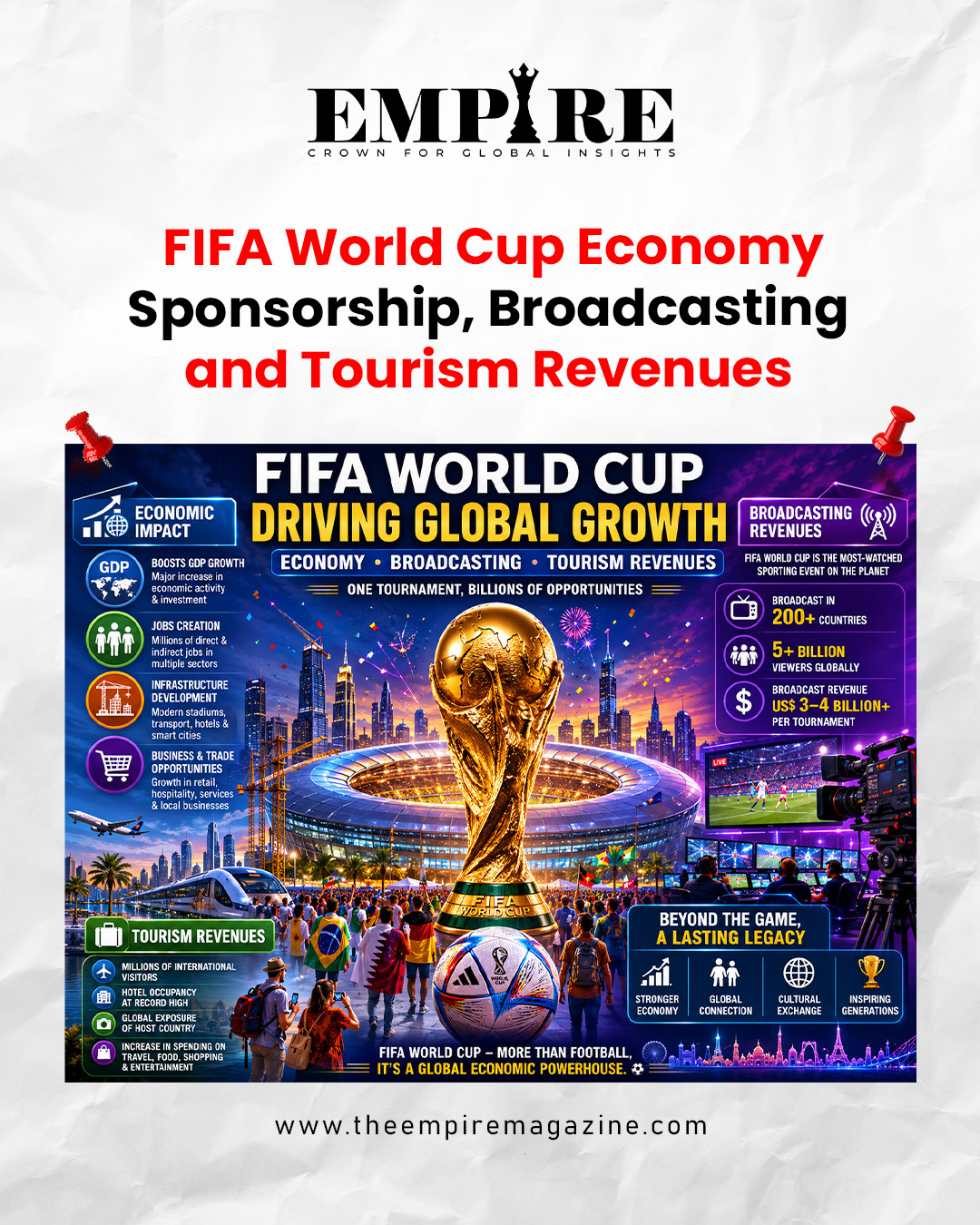
FIFA World Cup Economy is one of the strongest examples of how sport, media, tourism, sponsorship, and global branding come together to create a major business engine. The FIFA World Cup is not only a football tournament. It is a global commercial event that influences broadcasters, sponsors, airlines, hotels, restaurants, retailers, host cities, tourism boards, and national economies.
Every four years, the tournament attracts billions of viewers, millions of travelling fans, and some of the world’s biggest brands. This global attention gives FIFA and host countries the ability to generate revenue through television rights, digital media, sponsorship deals, licensing, hospitality packages, ticket sales, tourism spending, and infrastructure-linked activity.
The FIFA World Cup economy works because football has universal appeal. Unlike many sports that are strongest in specific regions, football connects Europe, South America, Africa, Asia, North America, and the Middle East. This global fan base makes the World Cup valuable for broadcasters and sponsors that want worldwide reach.
FIFA World Cup Economy and Broadcasting Rights
FIFA World Cup Economy depends heavily on broadcasting rights. Television and media rights are the largest revenue source for FIFA because broadcasters pay large sums to secure exclusive access to matches in their territories. These rights allow TV networks and streaming platforms to sell advertising, subscriptions, sponsorship packages, and premium coverage around the tournament.
Broadcasting rights are valuable because the World Cup delivers live audiences at a massive scale. In an era where many viewers skip ads or watch content on demand, live sports remain one of the most powerful formats for advertisers. World Cup matches create shared moments that audiences watch in real time, making them highly attractive for media companies.
The 2022 FIFA World Cup in Qatar showed how central broadcasting is to FIFA’s revenue model. FIFA reported record revenue during the 2019–2022 cycle, with television broadcasting rights forming a major part of that financial performance.
FIFA World Cup Economy and Global Media Reach
FIFA World Cup Economy benefits from global media reach. A single World Cup match can attract viewers across different continents, languages, and time zones. This gives broadcasters valuable content that can be sold across traditional TV, streaming platforms, mobile apps, highlight packages, and digital clips.
The 2026 FIFA World Cup is expected to increase this opportunity further because the tournament will expand to 48 teams and 104 matches. More matches mean more broadcast inventory, more advertising opportunities, and more content for fans. For FIFA, this creates stronger commercial potential across the tournament cycle.
Broadcasting also helps sponsors. Brands that partner with FIFA or advertise during matches benefit from global visibility. This is why media rights and sponsorship are connected parts of the same revenue machine.
FIFA World Cup Economy and Sponsorship Revenue
FIFA World Cup Economy is also driven by sponsorship. Global brands partner with FIFA because the World Cup gives them access to one of the largest audiences in sport. Sponsorship allows companies to associate themselves with passion, national pride, competition, celebration, and global unity.
FIFA sponsorship usually includes official partners, sponsors, regional supporters, and licensing opportunities. These brands can use the World Cup logo, tournament-related marketing, stadium visibility, fan campaigns, digital activations, and hospitality access.
Sponsorship works because the tournament is emotional. Fans are not only watching football; they are supporting their country, celebrating with friends, and engaging with a cultural moment. Brands want to be part of that emotional environment.
FIFA World Cup Economy and Brand Visibility
FIFA World Cup Economy gives sponsors visibility across stadiums, broadcasts, digital platforms, fan zones, merchandise, and event campaigns. This visibility can be more powerful than standard advertising because it is attached to an event people actively care about.
For global brands, the World Cup is also useful because it reaches both mature and emerging markets. A company can use the same tournament to speak to consumers in Europe, the United States, Latin America, Africa, the Middle East, and Asia.
This makes sponsorship a strategic investment. Brands are not only buying logo placement. They are buying global cultural relevance, consumer emotion, and association with the world’s biggest football stage.
FIFA World Cup Economy and Ticket Sales
FIFA World Cup Economy also includes ticket sales. Millions of fans want to attend matches live, especially when their national team is playing. Ticket revenue depends on stadium capacity, pricing, match demand, tournament format, and host-country accessibility.
The 2026 FIFA World Cup will be especially important for ticketing because it will be hosted across the United States, Canada, and Mexico, with 48 teams and 104 matches. The larger format creates more opportunities to sell tickets and hospitality packages.
Ticketing is not only about match entry. It also influences spending across transport, hotels, food, retail, and entertainment. A fan who buys a ticket often spends much more in the host city before and after the match.
FIFA World Cup Economy and Hospitality Packages
FIFA World Cup Economy is strengthened by hospitality. Corporate clients, wealthy fans, sponsors, and premium travelers often buy hospitality packages that include better seating, exclusive lounges, dining, and event access.
Hospitality is a high-value revenue stream because it targets premium customers. These packages cost far more than regular tickets and help generate strong event income. For host cities, hospitality visitors may also spend more on luxury hotels, restaurants, shopping, and private transport.
The growth of hospitality reflects how the World Cup has become both a sports event and a premium business event. Companies use World Cup hospitality to entertain clients, reward employees, and build relationships.
FIFA World Cup Economy and Tourism Spending
FIFA World Cup Economy strongly depends on tourism. When fans travel for the tournament, they spend money on flights, hotels, local transport, restaurants, shopping, entertainment, and attractions. This creates revenue for businesses beyond football.
Tourism benefits can be significant, especially for cities that already have strong infrastructure. Hotels often see higher demand during major matches. Restaurants, taxis, airports, shopping centers, and tourism operators can also benefit from increased visitor traffic.
The 2022 FIFA World Cup in Qatar showed how a host nation can use the tournament to promote itself globally. Qatar used the event to expand international visibility, showcase infrastructure, and support its long-term tourism ambitions.
FIFA World Cup Economy and Host-City Benefits
FIFA World Cup Economy can create direct and indirect benefits for host cities. Direct benefits include spending by visitors during the tournament. Indirect benefits include global exposure, improved infrastructure, future tourism interest, and stronger city branding.
For example, a city that hosts World Cup matches may attract fans who later return as tourists or business visitors. The event can also promote airports, hotels, convention centers, restaurants, and local attractions.
However, host-city benefits are not automatic. They depend on planning, transport capacity, hotel supply, safety, marketing, and the ability to convert temporary attention into long-term tourism value.
FIFA World Cup Economy and Infrastructure Investment
FIFA World Cup Economy often includes major infrastructure investment. Host countries may upgrade stadiums, airports, roads, metro systems, hotels, public spaces, and security systems. These investments can support the tournament and may also benefit residents afterward.
Infrastructure spending can create jobs and business opportunities during the preparation phase. Construction companies, engineering firms, logistics providers, hospitality groups, and local suppliers may benefit from World Cup-related projects.
However, infrastructure is also one of the most debated parts of the World Cup economy. If spending is too high or stadiums are underused after the tournament, the long-term return can be questioned. This is why modern host planning increasingly focuses on legacy use, existing venues, and sustainable infrastructure.
FIFA World Cup Economy and the 2026 Host Model
FIFA World Cup Economy for 2026 is different because the tournament will use many existing stadiums across North America. The United States, Canada, and Mexico already have large sports venues, airports, hotels, and transport systems in many host cities.
This can reduce the need for building new stadiums compared with some previous tournaments. It also allows host cities to focus on event operations, tourism management, security, branding, and fan experiences.
The 2026 tournament’s expanded size means more matches and more teams, which can create more travel demand. At the same time, the spread across three countries also means economic benefits will be distributed across multiple cities and regions.
FIFA World Cup Economy and Licensing
FIFA World Cup Economy includes licensing and merchandise. Official merchandise, video games, collectibles, apparel, toys, and branded products allow FIFA and its partners to earn revenue from fan demand.
World Cup merchandise benefits from national pride. Fans buy jerseys, scarves, flags, caps, balls, and souvenirs to show support for their teams. Retailers and brands can see strong demand during the tournament period.
Licensing also supports digital products and branded experiences. As fan engagement becomes more digital, licensing can include online content, gaming-related items, and official tournament products.
FIFA World Cup Economy and Fan Culture
FIFA World Cup Economy is powered by fan culture. Supporters do not only watch matches; they celebrate, travel, buy products, attend fan zones, and share content online. This creates commercial activity across many industries.
Fan culture also increases the value of sponsorship and broadcasting. A passionate fan is more likely to watch matches live, engage with brands, buy merchandise, and travel for the event.
This emotional energy is one of the reasons the World Cup remains so valuable. It combines sport, identity, entertainment, and national pride in a way few events can match.
FIFA World Cup Economy and Local Business Impact
FIFA World Cup Economy can support local businesses. Restaurants, hotels, bars, transport services, event agencies, security firms, retailers, and tourism operators may see higher demand during the tournament.
Fan zones and public viewing areas can also create economic activity. Even people who do not attend matches may spend money watching games in public spaces or entertainment venues.
Small businesses can benefit if they are connected to tourism flows. For example, souvenir shops, local food vendors, tour guides, and ride services may see increased demand when fans arrive in the city.
FIFA World Cup Economy and Employment
FIFA World Cup Economy can create temporary employment in construction, hospitality, tourism, event management, transportation, security, media, and retail. These jobs may support the preparation and tournament period.
However, many World Cup jobs are temporary. The real long-term employment impact depends on whether the host country can turn event investment into lasting tourism, business, and infrastructure benefits.
This is why governments often use the World Cup as part of a broader economic strategy instead of treating it as a one-time event.
FIFA World Cup Economy and Financial Risks
FIFA World Cup Economy also includes risks. Hosting the tournament can be expensive. Security, infrastructure, operations, transport, public services, and venue preparation require major spending.
If costs rise too high, the public return may be debated. Some host countries have faced criticism for expensive stadiums that were not used enough after the event. Others have been questioned over public spending, labor conditions, or environmental impact.
The strongest World Cup economic strategy is not only about earning revenue during the tournament. It is about long-term planning. Hosts need to make sure stadiums, transport systems, tourism campaigns, and urban upgrades continue to serve communities after the final match.
FIFA World Cup Economy and Long-Term Value
FIFA World Cup Economy creates the most value when short-term spending supports long-term goals. A host nation can use the tournament to improve tourism branding, strengthen infrastructure, attract investment, and build international recognition.
The challenge is measuring real impact. Some benefits are direct, such as hotel revenue or ticket sales. Others are indirect, such as global exposure or future tourism interest. Because of this, World Cup economic impact should be viewed carefully, with both benefits and costs considered.
FIFA World Cup Economy and the Future of Sports Revenue
FIFA World Cup Economy will continue to grow as sports media becomes more valuable and global fan engagement expands. The 2026 tournament is expected to be the largest World Cup ever, with more teams, more matches, more host cities, and more commercial opportunities.
Broadcasting will remain a major revenue driver. Sponsorship will continue to attract global brands. Hospitality and ticketing will benefit from expanded match inventory. Tourism will support hotels, restaurants, airlines, and local businesses in host cities.
The World Cup shows how sport can become a global economic platform. It connects fans, brands, governments, broadcasters, and local businesses through one event. That combination is why the FIFA World Cup remains one of the most powerful revenue engines in global sports.
For more business and sports economy insights, read more on The Empire Magazine.
Follow The Empire Magazine on Facebook and Instagram.
– The Empire Magazine
Crown For Global Insights