
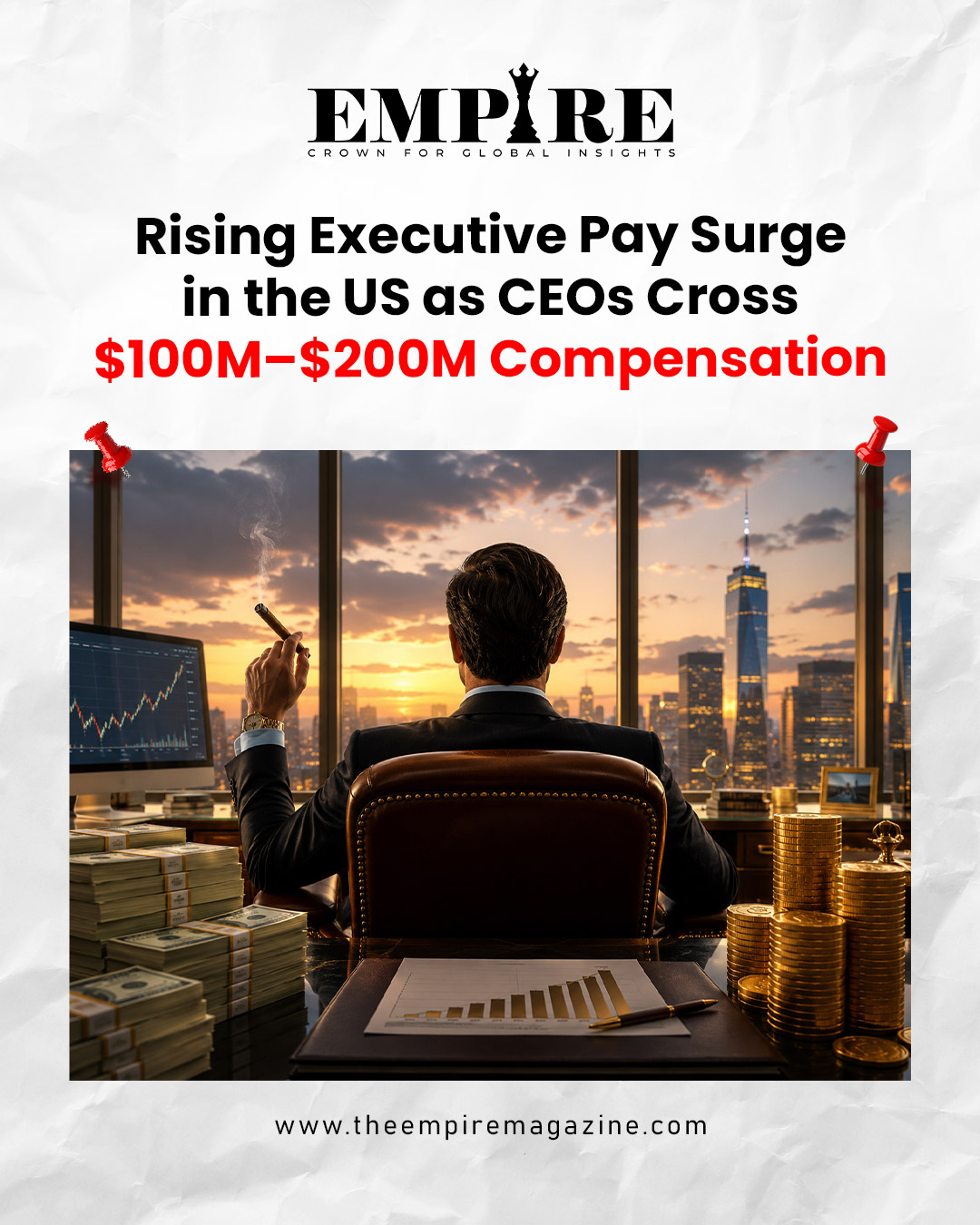
Executive pay in the US reaches historic highs as CEO compensation crosses $100M – $200M. Explore why executive salaries are rising, what drives these packages, and what it means for businesses, investors, and employees. The rising executive pay surge in the United States has pushed CEO compensation beyond $100 million and, in some cases, close to $200 million. Driven by stock-based incentives, shareholder expectations, and AI-led business transformation, executive compensation has become one of corporate America’s most debated topics.
Rising Executive Pay Surge in the US as CEOs Cross $100M–$200M Compensation
The rising executive pay surge in the United States has once again ignited conversations across boardrooms, financial markets, and workplaces worldwide. Over the last few years, compensation packages for America’s top executives have expanded at an unprecedented pace, with several chief executive officers now earning well above $100 million annually, while a select few have approached or even crossed the $200 million mark through stock awards and long-term incentive plans. Although executive compensation has always reflected a company’s ambition and market performance, today’s packages are increasingly shaped by shareholder returns, technological transformation, and fierce competition for visionary leadership. Companies are no longer simply paying executives for managing daily operations they are investing in leaders capable of navigating economic uncertainty, accelerating artificial intelligence adoption, driving digital transformation, and creating long-term shareholder value. However, as executive salaries continue climbing, questions surrounding income inequality, employee morale, corporate governance, and ethical leadership are becoming equally important. Investors, employees, policymakers, and economists are now examining whether these extraordinary rewards genuinely reflect exceptional performance or whether corporate America is entering a new era where executive compensation is growing faster than the businesses and workforces these leaders represent.
Executive Pay Reaches a New Era
The latest executive compensation trends illustrate how dramatically the corporate landscape has evolved. Unlike previous decades when CEO salaries were largely composed of fixed annual pay and cash bonuses, today’s highest-paid executives receive the majority of their compensation through stock options, restricted stock units, and long-term equity incentives whose value can increase significantly as company performance improves. This approach aligns executive interests with shareholders while encouraging sustainable growth rather than short-term profitability. Companies operating in technology, artificial intelligence, pharmaceuticals, financial services, and consumer innovation have particularly embraced performance-linked compensation as competition for experienced leadership intensifies. Boards increasingly believe that transformational leaders capable of delivering innovation deserve compensation reflecting the immense value they create over multiple years. The surge has also been fuelled by exceptional stock market performance among several large corporations, allowing equity-based awards to multiply in value far beyond their original estimates. Consequently, headline figures showing CEOs earning over $100 million often include long-term incentives accumulated across several years rather than purely annual cash earnings. Nevertheless, these figures have become powerful symbols of changing corporate priorities, where leadership, innovation, and strategic execution are considered among the most valuable assets any organisation can possess.
Why Executive Pay Surge Is Growing Rapidly
Behind the rising executive pay surge lies a combination of economic, competitive, and structural factors that have transformed executive remuneration across corporate America. Public companies today operate in an environment defined by global competition, disruptive technologies, geopolitical uncertainty, and rapidly changing consumer expectations, making experienced leadership more valuable than ever before. Directors argue that attracting a world-class CEO often requires compensation packages capable of competing with global opportunities, particularly in sectors where exceptional leadership can add billions of dollars in market value. The rapid expansion of artificial intelligence has further intensified this competition, as businesses seek executives capable of integrating emerging technologies while maintaining operational resilience and regulatory compliance. Compensation committees have therefore shifted toward equity-heavy packages that reward measurable business outcomes such as revenue growth, profitability, innovation, sustainability targets, and shareholder returns. In many cases, executives receive the full value of these awards only if demanding performance milestones are achieved over several years, theoretically reducing the risk of rewarding underperformance. At the same time, activist investors continue pushing boards to hold management accountable for long-term value creation, reinforcing the belief that compensation should directly reflect measurable corporate success rather than seniority alone. While this philosophy has strengthened the connection between executive rewards and company performance, it has also contributed to compensation figures that appear unprecedented compared with historical norms.
Investors Continue to Reward Performance of the Executive
From an investor perspective, high executive compensation is often viewed through the lens of value creation rather than absolute salary figures. Shareholders generally support generous pay packages when they coincide with sustained revenue growth, rising share prices, successful acquisitions, breakthrough innovations, and expanding global market presence. Companies that consistently outperform competitors often justify executive compensation by demonstrating measurable financial returns that significantly exceed the cost of leadership incentives. This perspective explains why many institutional investors continue approving substantial executive pay packages despite growing public scrutiny. Nevertheless, shareholder expectations have also become considerably stricter, with investors increasingly demanding transparency regarding compensation structures, performance metrics, succession planning, and governance practices. Proxy advisory firms now play a significant role in evaluating whether executive rewards genuinely reflect company performance, encouraging boards to maintain stronger accountability and clearer communication with stakeholders. Regulatory disclosures have also improved, allowing shareholders to understand how compensation decisions are made and whether executive incentives align with broader corporate objectives. As businesses become increasingly dependent on visionary leadership to navigate economic volatility and technological disruption, many investors continue viewing executive compensation as a strategic investment rather than simply an employment expense, provided the promised business outcomes are consistently delivered.
Employees Question the Growing Pay Gap: between executive earnings and average employee wages
While investors often focus on shareholder value, employees frequently evaluate executive compensation through a different lens, fairness, workplace culture, and shared prosperity. As CEO compensation reaches historic levels, the widening gap between executive earnings and average employee wages has become a significant topic of discussion across industries. Many workers acknowledge the importance of exceptional leadership but question whether compensation differences of several hundred times the median employee salary reflect balanced corporate priorities. Organisations increasingly recognise that maintaining employee trust requires demonstrating equal commitment to workforce development, competitive wages, learning opportunities, healthcare benefits, and career progression alongside executive rewards. Businesses that successfully balance executive incentives with meaningful investment in their people often strengthen engagement, retention, and organisational culture, reinforcing the idea that long-term success depends on leadership at every level rather than exclusively within the executive suite. Corporate leaders are therefore facing growing expectations to communicate openly about compensation philosophy while ensuring employees understand how business growth ultimately creates broader opportunities throughout the organisation. In today’s transparent corporate environment, executive compensation is no longer viewed in isolation but as one component of a company’s overall commitment to fairness, purpose, and sustainable value creation.
AI, Innovation and the Future of Executive Compensation
Looking ahead, the future of executive compensation is likely to become even more closely tied to innovation, artificial intelligence, sustainability, cybersecurity, and long-term resilience. Boards are increasingly designing compensation frameworks that reward executives not merely for financial performance but also for responsible leadership, environmental commitments, digital transformation, talent development, and effective risk management. As AI continues reshaping industries, companies capable of successfully integrating new technologies while maintaining ethical governance may see executive incentives become even more performance-driven. Simultaneously, increasing regulatory oversight and shareholder activism are expected to encourage greater transparency and stronger links between compensation and measurable outcomes. Rather than signalling unchecked corporate excess, the rising executive pay surge reflects a broader transformation in how organisations define leadership value in an increasingly complex global economy. The challenge for corporate America will be balancing competitive executive rewards with employee wellbeing, public trust, and responsible governance. Ultimately, sustainable leadership is measured not solely by financial returns or compensation figures but by an executive’s ability to build resilient organisations that generate innovation, create meaningful employment, deliver shareholder value, and contribute positively to society. As this debate continues evolving, executive compensation will remain one of the defining indicators of how businesses choose to reward leadership in the modern era.
The rising executive pay surge
The rising executive pay surge represents more than just record-breaking salary figures—it reflects the changing expectations placed on today’s corporate leaders. As CEOs shoulder greater responsibility for steering organisations through technological disruption, geopolitical uncertainty, and rapidly evolving markets, boards continue placing unprecedented financial value on visionary leadership. Yet the sustainability of this trend will ultimately depend on maintaining a careful balance between rewarding exceptional performance and preserving stakeholder trust. Investors, employees, regulators, and consumers increasingly expect executive compensation to be transparent, performance-driven, and aligned with broader organisational success. Companies that strike this balance will not only attract outstanding leaders but also strengthen long-term resilience, credibility, and sustainable growth in an increasingly competitive global economy.
Executive Pay Reflects Corporate Strategy More Than Ever
Executive pay has evolved beyond being a measure of an individual’s salary; it has become a strategic tool that reflects a company’s long-term vision and competitive ambitions. Boards of directors are increasingly designing compensation structures that encourage innovation, sustainable growth, and responsible decision-making. Rather than focusing solely on annual financial performance, modern executive pay packages often reward leaders for achieving milestones related to digital transformation, customer satisfaction, environmental sustainability, and organisational resilience. This shift demonstrates how executive pay is now closely aligned with broader business objectives rather than short-term profits alone.
Executive Pay Varies Widely Across Industries
Not every sector experiences the same level of executive pay, as compensation largely depends on industry dynamics, company size, and market performance. Technology, artificial intelligence, financial services, and healthcare companies continue to offer some of the most competitive executive compensation packages due to their rapid innovation cycles and significant market valuations. In contrast, traditional manufacturing and retail businesses often adopt more conservative remuneration models. As industries continue embracing digital transformation, executive pay is expected to remain highest in sectors where visionary leadership can directly influence global competitiveness and shareholder value.
Transparency Is Shaping the Future of Executive Pay
Growing public scrutiny has made transparency an essential element of executive pay discussions. Investors, regulators, and employees increasingly expect companies to clearly explain how executive compensation is determined and whether it genuinely reflects business performance. Annual proxy statements, shareholder votes on executive remuneration, and enhanced corporate governance practices are encouraging organisations to build greater accountability into their compensation frameworks. As expectations around responsible leadership continue to evolve, executive pay will likely become even more closely linked to measurable outcomes, ethical governance, and long-term value creation rather than headline compensation figures alone.
For more business and retail insights, read more on The Empire Magazine
Previous article: https://theempiremagazine.com/uschina-trade/
Magazine Feautures | Podcasts: Empire Global Talks
Follow The Empire Magazine on Facebook | Instagram | LinkedIn | YouTube
The Empire Magazine | Crown for Global Insights