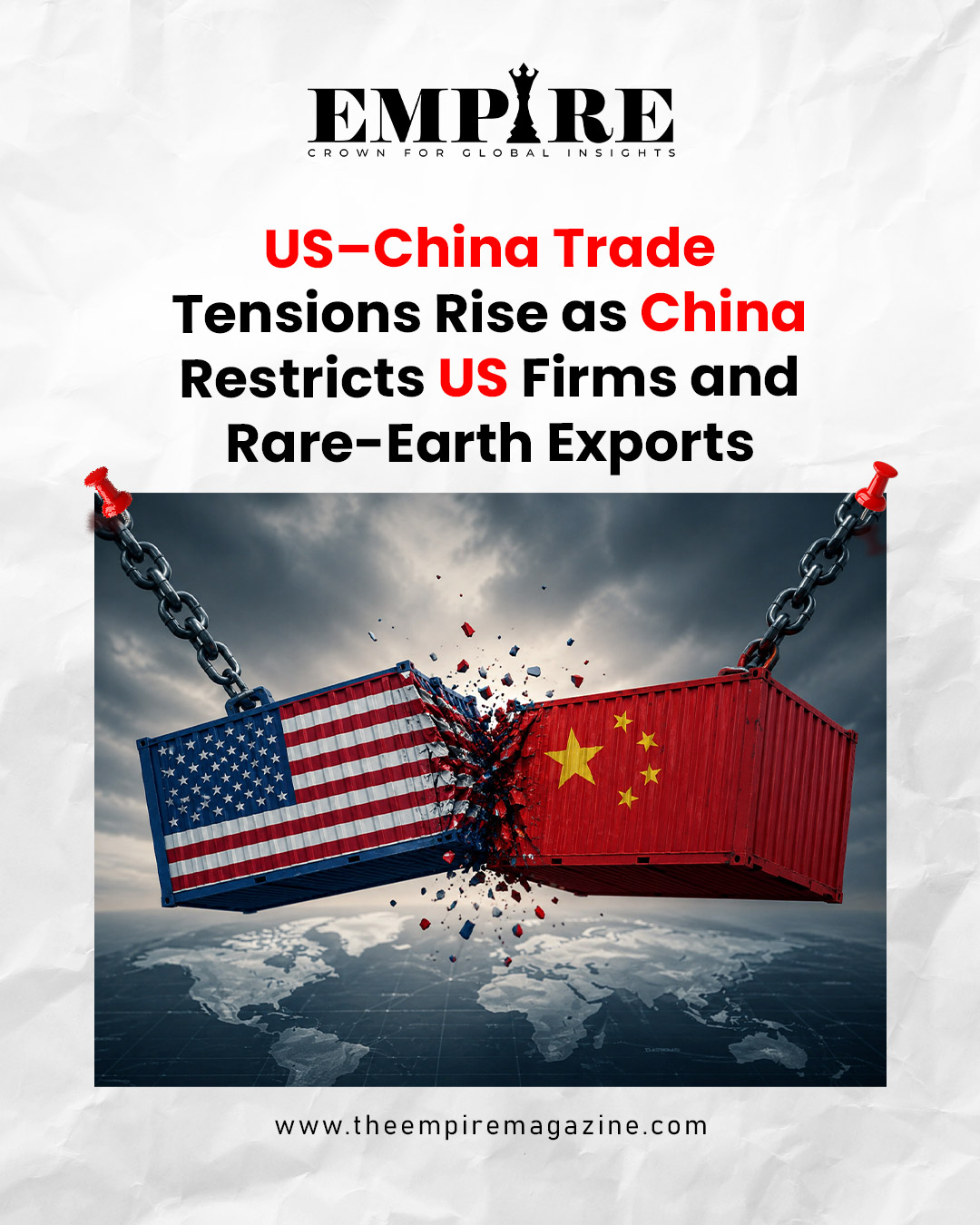
US–China trade tensions deepen as China tightens restrictions on US firms and rare-earth exports, raising concerns over global supply chains, technology, and economic growth. The latest escalation in US–China trade tensions marks another turning point in the evolving rivalry between the world’s two largest economies. China’s restrictions on US firms and tighter controls over rare-earth exports highlight how critical minerals have become powerful geopolitical assets. At the same time, Washington’s technology export controls continue to reshape global manufacturing and investment patterns.
US–China Trade Tensions Rise as China Restricts US Firms and Rare-Earth Exports
The US–China trade tensions have entered another critical phase as Beijing tightens restrictions on American companies while imposing stricter controls over the export of rare-earth minerals, materials that are indispensable for the global technology, defense, electric vehicle (EV), and renewable energy industries. The latest measures reflect the increasingly strategic nature of economic competition between the world’s two largest economies, where trade policy is now closely intertwined with national security, technological leadership, and geopolitical influence.
Over the past several years, Washington and Beijing have moved beyond tariff disputes into a broader contest involving semiconductors, artificial intelligence, critical minerals, advanced manufacturing, and investment screening. China’s latest restrictions are widely viewed as a response to expanding US export controls on advanced chips, semiconductor manufacturing equipment, and investment limitations targeting sensitive Chinese technologies.
For multinational corporations, investors, and governments worldwide, the renewed US–China trade tensions represent more than another diplomatic disagreement, they pose significant challenges for global supply chains, inflation management, industrial production, and long-term economic growth.
US–China Trade Tensions Intensify Through Rare-Earth Export Restrictions
China dominates the global rare-earth supply chain, accounting for nearly 70% of worldwide mining production and an even larger share of rare-earth processing and refining. These minerals; including neodymium, dysprosium, terbium, samarium, and praseodymium, are critical components used in electric vehicle motors, wind turbines, fighter aircraft, smartphones, satellites, missile guidance systems, robotics, and advanced electronics.
By strengthening export licensing requirements and increasing oversight of strategic mineral shipments, Beijing is signaling that access to critical resources can become a geopolitical tool. Export approvals now involve stricter reviews for companies purchasing certain rare-earth products, particularly where military or advanced technology applications may exist.
The decision follows a broader trend in which governments increasingly classify critical minerals as national security assets. Similar policies have emerged across Europe, the United States, Japan, Australia, and Canada, reflecting growing concerns over concentrated supply chains.
Industry analysts believe that even modest disruptions in China’s exports could significantly affect manufacturers worldwide because replacing China’s processing capabilities remains difficult despite efforts to diversify production.
China Restricts US Firms Amid Growing Technology Rivalry in US-China
Alongside mineral export controls, China has continued tightening regulatory scrutiny of selected American companies operating within its market. Authorities have expanded reviews related to cybersecurity, procurement eligibility, market access, and compliance requirements, creating greater uncertainty for US businesses with operations in China.
The restrictions are viewed by many observers as reciprocal measures following Washington’s tightening controls on semiconductor exports, AI chips, quantum computing technologies, and outbound investments involving sensitive Chinese sectors.
The competition has increasingly shifted toward technological dominance. Artificial intelligence, advanced semiconductor manufacturing, aerospace technologies, quantum computing, biotechnology, and cybersecurity now represent the primary battlegrounds between the two economies.
Many American corporations continue to maintain significant investments in China due to its vast consumer market and manufacturing ecosystem. However, companies are increasingly reassessing operational risks while expanding production into countries such as India, Vietnam, Mexico, Malaysia, and Indonesia to reduce dependence on a single manufacturing base.
Business leaders emphasize that diversification does not necessarily mean abandoning China but rather creating more resilient global supply networks capable of withstanding geopolitical disruptions.
Global Supply Chains Face Fresh Pressure from US–China Trade Tensions
The renewed US–China trade tensions are expected to have far-reaching implications across global manufacturing industries. Rare-earth materials are deeply integrated into numerous industrial supply chains, meaning even temporary export disruptions could affect production schedules worldwide.
Automobile manufacturers rely heavily on rare-earth magnets for electric motors. Renewable energy companies require these materials for high-efficiency wind turbines. Consumer electronics producers use them in smartphones, laptops, cameras, medical imaging equipment, and telecommunications infrastructure.
Defense industries are particularly vulnerable because advanced weapons systems, radar equipment, precision-guided missiles, aircraft engines, and naval technologies all require specialized rare-earth elements.
As companies seek alternative suppliers, costs may rise significantly due to limited refining capacity outside China. Building new mines and processing facilities requires years of regulatory approvals, environmental assessments, and substantial investment.
Governments are therefore accelerating initiatives to secure domestic mineral production, establish strategic reserves, and strengthen partnerships with mineral-rich countries across Africa, Australia, South America, and Southeast Asia.
Rare-Earth Exports Become a Strategic Economic Weapon for US-China
Rare-earth minerals have become one of the most powerful instruments in modern economic diplomacy. Unlike oil or natural gas, rare-earth processing requires highly specialized infrastructure that only a few countries currently possess at commercial scale.
China spent decades building this dominance through consistent investment, integrated industrial policy, and processing expertise. Today, while several countries mine rare-earth ores, much of the material still travels to China for separation, refining, and manufacturing into finished components.
This structural advantage provides Beijing with considerable leverage during periods of geopolitical tension. The United States has responded by supporting domestic mining projects, expanding investments in processing facilities, encouraging recycling of rare-earth materials, and strengthening cooperation with allies through initiatives aimed at reducing dependency on Chinese supply chains.
Australia has emerged as one of the largest alternative suppliers, while Canada and several African nations are attracting significant exploration investments. India is also accelerating efforts to develop its own critical mineral resources as part of its broader manufacturing ambitions.
Despite these initiatives, experts believe achieving meaningful diversification could take several years because rare-earth supply chains involve mining, chemical processing, magnet production, and advanced manufacturing capabilities that require coordinated industrial development.
US–China Trade War Reshapes Global Manufacturing and Investment
The evolution of the US–China trade war extends beyond tariffs into what economists increasingly describe as economic decoupling or strategic de-risking.
Rather than completely separating their economies, both countries are attempting to reduce vulnerabilities in sectors considered strategically important. This includes semiconductors, telecommunications equipment, artificial intelligence, pharmaceuticals, batteries, clean energy technologies, aerospace components, and critical minerals.
Multinational corporations have adopted “China Plus One” strategies by establishing manufacturing facilities in additional countries while maintaining selective operations inside China. India, Vietnam, Thailand, Mexico, and Indonesia have become major beneficiaries of this shift as companies diversify production capacity.
Investment decisions are increasingly influenced by geopolitical considerations alongside traditional business metrics such as labor costs and market demand.
Financial markets also remain sensitive to developments in bilateral relations. Announcements involving export controls, sanctions, tariffs, or investment restrictions frequently trigger volatility across technology, mining, automotive, and manufacturing sectors.
Although both governments continue diplomatic engagement through high-level meetings, structural disagreements over technology, industrial policy, intellectual property, cybersecurity, and national security remain unresolved.
Future Outlook: Can Global Cooperation Ease US–China Trade Tensions?
The future of US–China trade tensions will largely depend on whether both governments can establish stable mechanisms for managing strategic competition without allowing economic disputes to escalate into broader geopolitical conflicts.
Most economists agree that complete economic separation is unlikely due to the deep integration of global commerce. Bilateral trade remains substantial, and both countries continue to benefit from investment, consumer demand, and interconnected supply chains.
However, strategic industries, including semiconductors, artificial intelligence, rare-earth minerals, electric vehicles, and defense technologies, are expected to remain areas of heightened competition.
Governments worldwide are responding by pursuing greater supply-chain resilience, investing in domestic manufacturing, expanding critical mineral partnerships, and encouraging technological self-reliance.
For businesses, the current environment demands greater flexibility, diversified sourcing strategies, enhanced geopolitical risk management, and long-term investment planning. The latest restrictions underscore that global trade is no longer shaped solely by economics. National security, technological leadership, resource control, and strategic resilience are becoming equally important drivers of international commerce. As the United States and China continue redefining the rules of economic competition, businesses and policymakers across the globe must prepare for an era where supply chains, innovation, and geopolitics remain deeply interconnected.
The latest escalation in US–China trade tensions marks another turning point in the evolving rivalry between the world’s two largest economies. China’s restrictions on US firms and tighter controls over rare-earth exports highlight how critical minerals have become powerful geopolitical assets. At the same time, Washington’s technology export controls continue to reshape global manufacturing and investment patterns.
As governments accelerate efforts to secure alternative supply chains and strengthen domestic industries, the global economy faces a prolonged period of strategic realignment. While dialogue between Washington and Beijing remains essential, businesses should prepare for continued uncertainty, higher supply-chain costs, and increased geopolitical risks. The future of global trade will increasingly depend on resilience, diversification, and international cooperation rather than efficiency alone.
For more business and retail insights, read more on The Empire Magazine
Previous article: https://theempiremagazine.com/openai-nvidia/
Magazine Feautures | Podcasts: Empire Global Talks
Follow The Empire Magazine on Facebook | Instagram | LinkedIn | YouTube
The Empire Magazine | Crown for Global Insights