
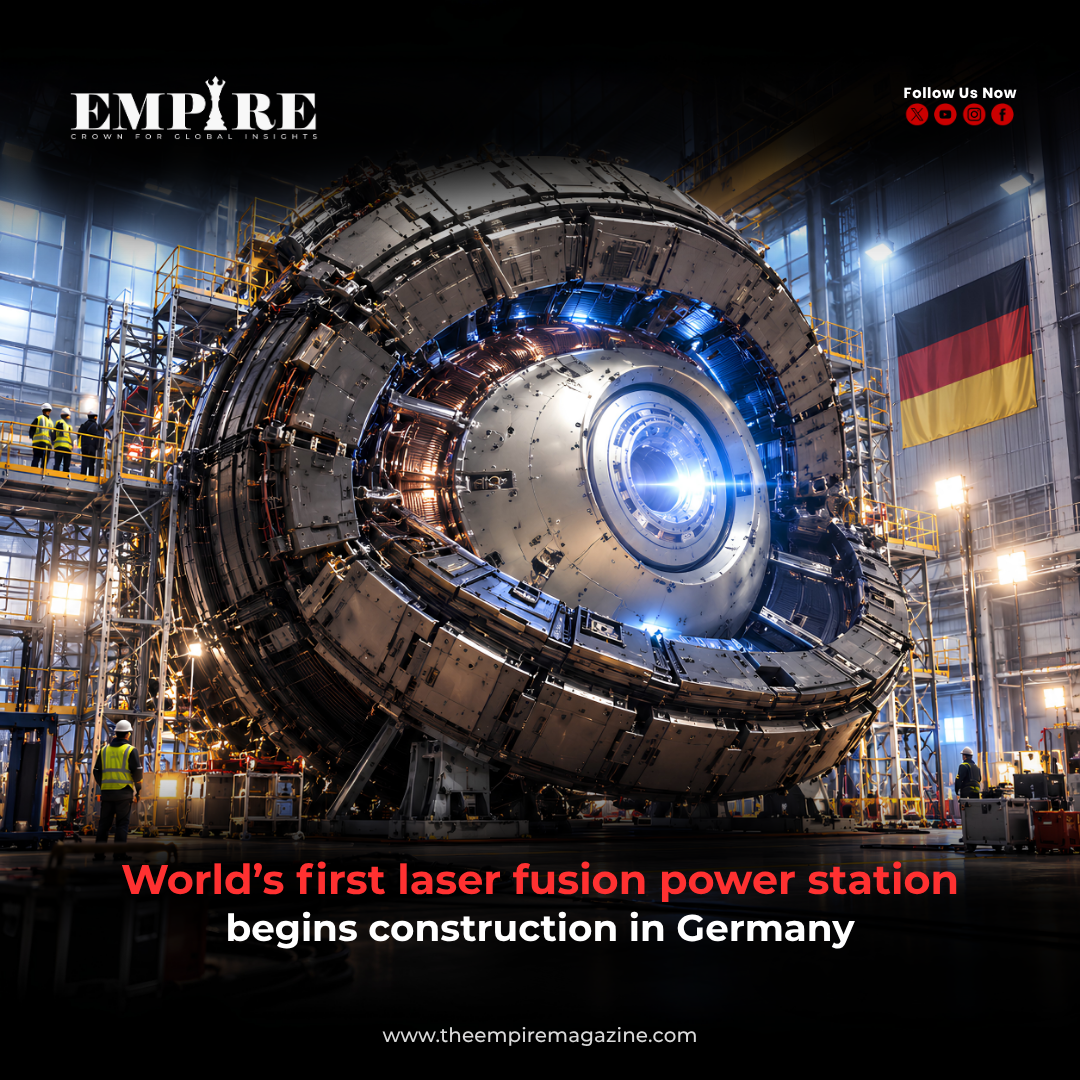
World’s first laser fusion power station begins construction in Germany as researchers and energy companies move closer toward developing a new generation of clean energy technology. The project represents a major step in the global effort to create practical fusion power, a technology that aims to reproduce the energy-producing process of the Sun on Earth.
Fusion energy has been studied for decades because of its potential to provide large amounts of energy with low carbon emissions. Unlike traditional fossil fuel power plants, fusion systems are designed to generate energy by combining atomic nuclei rather than burning fuel.
Germany’s investment in laser-based fusion technology highlights the country’s growing interest in exploring future energy solutions as nations search for reliable and sustainable power sources.
The development comes during a period of increasing global investment in fusion research, with companies and governments working to overcome the engineering challenges required to make fusion commercially viable.
World’s First Laser Fusion Power Station Begins Construction Through Advanced Energy Research
World’s first laser fusion power station begins construction as Germany explores a new approach to producing clean electricity.
The project is connected to efforts by private companies and research organisations developing laser-driven fusion technology. Unlike traditional fusion experiments that use magnetic fields to contain plasma, laser fusion uses powerful laser systems to compress and heat fuel pellets until fusion reactions occur.
The basic principle behind fusion is based on combining lightweight atomic nuclei, such as hydrogen isotopes, to release energy.
This process is different from nuclear fission, which is used in conventional nuclear reactors and involves splitting heavy atoms.
Laser fusion research focuses on achieving conditions where the energy produced by fusion reactions can eventually exceed the energy required to start the reaction.
World’s First Laser Fusion Power Station Begins Construction Using Laser-Driven Fusion Technology
Laser fusion represents one of the most advanced areas of energy research.
The technology relies on extremely powerful lasers that deliver energy to tiny fuel capsules. The intense energy creates conditions of extremely high temperature and pressure, allowing fusion reactions to occur.
The process involves several important steps:
Fuel Pellet Compression
Powerful laser beams target a small fuel capsule, compressing the material to extreme conditions.
Fusion Reaction
The pressure and heat allow hydrogen isotopes to combine, releasing energy.
Energy Capture
Future power stations would need systems capable of converting this released energy into usable electricity.
Although laboratory experiments have demonstrated important progress, building a commercial fusion power station remains a major engineering challenge.
World’s First Laser Fusion Power Station Begins Construction as Germany Targets Future Clean Energy
Germany has been investing heavily in renewable energy and technologies that can support long-term energy security.
While solar and wind power are major parts of Germany’s energy strategy, researchers continue exploring additional technologies that could provide reliable energy generation.
Fusion energy is being studied because of several potential advantages:
- Large energy output
- Low carbon emissions during operation
- Availability of fuel sources
- Reduced long-lived radioactive waste compared with traditional nuclear technologies
However, fusion power is still under development and has not yet become a commercial electricity source.
Projects like Germany’s laser fusion initiative aim to move the technology closer to practical application.
World’s First Laser Fusion Power Station Begins Construction During Global Fusion Race
The development of laser fusion technology is part of a growing international competition to achieve commercial fusion energy.
Countries and private companies around the world are investing in different fusion approaches.
Major research efforts include:
- Magnetic confinement fusion
- Laser-driven fusion
- Alternative plasma technologies
The United States, United Kingdom, China, Japan, and several European countries are conducting fusion research programmes.
The recent progress in fusion has increased interest from investors and energy companies looking for future alternatives to traditional energy systems.
Germany’s project represents one contribution to this broader global effort.
World’s First Laser Fusion Power Station Begins Construction With Major Engineering Challenges Ahead
Although fusion energy has enormous potential, scientists and engineers still face significant challenges.
Achieving Continuous Fusion
Many fusion experiments have demonstrated short bursts of energy production, but operating a continuous power station requires further development.
Improving Efficiency
Fusion systems require advanced equipment capable of producing more energy than the systems consume.
Reducing Construction Costs
Building fusion facilities requires complex technology and significant investment.
Developing Industrial Systems
A commercial fusion plant needs reliable systems for fuel handling, maintenance, and electricity generation.
Solving these challenges will determine how quickly fusion technology can move from research projects to commercial energy production.
World’s First Laser Fusion Power Station Begins Construction and the Future of Energy Innovation
The development of laser fusion power represents a significant direction in future energy research.
If commercial fusion becomes possible, it could transform the global energy landscape by providing another source of low-carbon electricity.
Fusion technology could potentially support:
Energy Security
Countries could reduce dependence on limited fossil fuel resources.
Industrial Power Needs
Large-scale industries require reliable energy supplies.
Climate Goals
Low-carbon energy technologies are important for reducing greenhouse gas emissions.
The future of fusion will depend on continued scientific research, technological improvements, and investment.
The same global technology transformation can be seen across industries where innovation is creating new solutions for major challenges.
Read more technology and innovation insights here: https://theempiremagazine.com/julie-kegels-lvmh-prize-2026/
World’s First Laser Fusion Power Station Begins Construction as Scientists Work Toward Commercial Fusion
Germany’s laser fusion power station project represents an important milestone in the development of advanced energy technology.
While commercial fusion power remains a long-term goal, projects like this demonstrate continued progress in understanding and engineering fusion systems.
The transition from experimental fusion research to practical power generation will require years of development, testing, and improvement.
As countries continue investing in clean energy technologies, laser fusion remains one of the most ambitious scientific efforts aimed at creating a new generation of sustainable power.
Follow The Empire Magazine for global business, technology, innovation, and leadership insights:
Facebook: https://www.facebook.com/profile.php?id=61573749076160
Instagram: https://www.instagram.com/the_empire_magazine/
The Empire Magazine | Crown For Global Insights