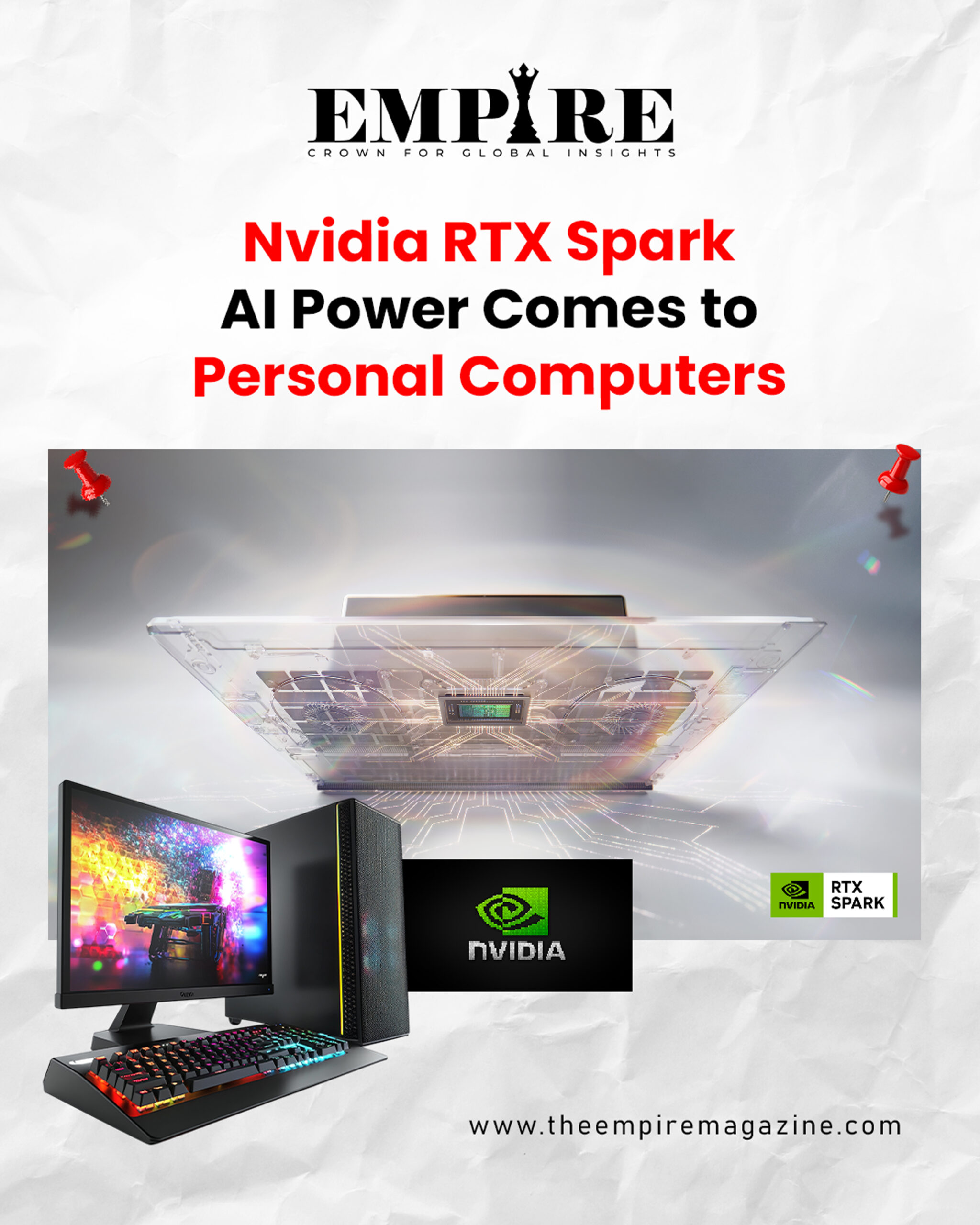
Nvidia RTX Spark is becoming a major development in the personal computer market because it brings high-performance artificial intelligence computing directly to Windows laptops and compact desktops. For years, powerful AI workloads were mostly connected to cloud data centers, enterprise servers, and specialized workstations. RTX Spark changes that direction by placing strong AI processing capability inside personal computers designed for developers, creators, gamers, and professionals.
Nvidia and Microsoft announced RTX Spark-powered Windows PCs as part of a new generation of computers built for personal AI agents. Nvidia said RTX Spark delivers 1 petaflop of AI performance, full-stack Nvidia AI and RTX graphics technology, up to 128GB of unified memory, and strong performance-per-watt for local AI workloads.
This matters because AI is moving from cloud-only services to local computing. Instead of sending every task to a remote server, personal computers can run some AI models, agents, creative tools, and development workflows directly on the device.
What Nvidia RTX Spark Does
Nvidia RTX Spark is a superchip platform designed for slim laptops and small desktops. Microsoft’s Windows update described RTX Spark as offering up to 6,144 Blackwell RTX cores, up to 20 Arm-based power-efficient CPU cores, and up to 128GB of unified memory.
The chip combines CPU, GPU, AI acceleration, memory, and Nvidia software technologies into one platform. This is important because AI workloads need more than traditional processing. They require fast parallel computing, large memory capacity, efficient data movement, and optimized software.
AI, Graphics, and Windows in One Platform
RTX Spark is designed to support both AI and RTX graphics. That means the same system can be used for AI agents, creative workflows, gaming, 3D design, video editing, coding, and model development.
Nvidia’s RTX Spark product page says the platform is built for small, ultra-efficient desktops and is designed to run personal AI agents at the desk, while also supporting gaming and creation with RTX graphics.
Why Personal AI Computers Matter
Personal AI computers matter because AI is becoming part of daily work. Users increasingly want AI tools for writing, research, coding, image editing, video creation, file organization, data analysis, design, and automation. Running these tools locally can improve speed, privacy, and availability.
Cloud AI services remain important, but local AI gives users more control. A local AI agent can work with files, folders, apps, documents, and workflows on a personal machine without needing every task to move through an external cloud service.
Local AI and Privacy
Privacy is one reason local AI is becoming important. When AI runs on a personal computer, some tasks can be handled directly on the device. This can reduce the need to send sensitive files, business documents, or creative assets to external servers.
This is especially useful for developers, legal teams, financial professionals, designers, creators, and companies that work with confidential information.
RTX Spark and Personal AI Agents
Nvidia and Microsoft positioned RTX Spark PCs as machines built for personal AI agents. Personal agents are AI systems that can support tasks such as organizing files, summarizing documents, searching information, generating content, automating workflows, and helping users operate software.
Nvidia said RTX Spark powers the world’s first Windows PCs purpose-built for personal agents and includes new security support through Microsoft and Nvidia collaboration.
From Chatbots to Agentic Computing
The move from chatbots to agents is important. A chatbot usually responds to questions. An AI agent can take steps, use tools, remember context, and complete tasks across applications.
For personal computers, this means the operating system may become more AI-driven. A user may ask the computer to find files, prepare summaries, organize media, create presentations, edit visuals, or automate repeated work.
DGX Spark and the Desktop AI Connection
Before RTX Spark for Windows PCs, Nvidia introduced DGX Spark as a compact personal AI supercomputer for developers and researchers. Nvidia says DGX Spark is powered by the GB10 Grace Blackwell Superchip, includes 128GB of unified system memory, and can run AI models up to 200 billion parameters locally.
DGX Spark helped show that desktop AI systems could bring data-center-style workflows closer to individual developers. RTX Spark extends that direction into consumer and professional Windows PCs.
AI Development on the Desk
DGX Spark is designed for prototyping, fine-tuning, inference, and AI agent development. Nvidia says developers can test and validate models locally, then move work to DGX Cloud or other Nvidia-accelerated data centers.
This workflow matters because AI developers often need to test models before deploying them at scale. Local AI systems can reduce waiting time, lower cloud dependency during development, and support faster experimentation.
PC Makers Supporting RTX Spark
RTX Spark is expected to appear in Windows laptops and compact desktops from major PC manufacturers. Nvidia’s RTX Spark page lists brands such as Acer, ASUS, Dell, Gigabyte, HP, Lenovo, and MSI as part of the platform ecosystem.
The Verge reported that Microsoft, Asus, HP, MSI, Lenovo, and Dell are preparing RTX Spark-powered laptops, with devices expected to arrive starting in fall 2026. Reported models include Microsoft Surface Laptop Ultra, Asus ProArt models, MSI Prestige N16 Flip AI Plus, Dell XPS 16, HP OmniBook systems, and Lenovo Yoga Pro devices.
Why OEM Support Matters
OEM support matters because a chip platform succeeds only if major computer makers build real products around it. Support from multiple brands can help RTX Spark reach creators, developers, gamers, students, and enterprise users.
Different laptop and desktop designs can also serve different markets. Creators may want high-resolution displays and editing power. Developers may want memory and AI performance. Business users may want secure AI agents and strong battery life.
Nvidia’s Move Into PC Chip Competition
RTX Spark also represents a strategic move by Nvidia into broader PC computing. Nvidia has long been known for GPUs used in gaming, graphics, data centers, and AI acceleration. RTX Spark brings Nvidia deeper into the full PC chip platform space.
Business Insider reported that Nvidia’s RTX Spark announcement at Computex affected shares of Intel, AMD, and Qualcomm because the platform pushes Nvidia further into PC chip territory.
Competition With Intel, AMD, and Qualcomm
Intel and AMD have long dominated PC processors, while Qualcomm has been expanding Arm-based Windows laptops. RTX Spark adds another competitive direction because Nvidia combines CPU, GPU, AI acceleration, and graphics technologies in one platform.
This competition could push the PC market toward more AI-focused designs. Future PCs may be judged not only by CPU speed or battery life, but also by local AI performance, memory capacity, model support, and agent capability.
Why AI PCs Are Becoming Important for Creators
Creators are one of the strongest target markets for AI PCs. Video editors, designers, 3D artists, photographers, animators, musicians, and content teams increasingly use AI tools to generate, edit, enhance, upscale, organize, and automate media.
Generative Media on Local Machines
AI-powered creative tools can benefit from local computing. A creator may want to generate visuals, edit video, remove backgrounds, improve audio, upscale images, or run AI-assisted design tools without waiting for cloud processing.
RTX Spark’s combination of AI performance and RTX graphics makes it relevant for creative work where both visual processing and AI acceleration are needed.
Developers and Researchers Benefit From Local AI
Developers and researchers need systems that can run models, test agents, build AI apps, and experiment with workflows. Local AI computers can help them work faster because they do not need to depend entirely on rented cloud GPUs for every test.
Prototyping AI Applications
RTX Spark and DGX Spark fit into a workflow where developers prototype locally and deploy at scale later. This is useful for startups, students, independent developers, and enterprise teams testing AI features.
For businesses, local AI development can support internal tools, custom agents, document assistants, coding assistants, and industry-specific applications.
Challenges for Nvidia RTX Spark
Nvidia RTX Spark also faces real challenges. AI PCs need strong software support, battery efficiency, Windows compatibility, developer adoption, and clear consumer value. Many users will not buy a new computer only because it has AI hardware unless the software experience is useful.
Software Will Decide Adoption
Hardware creates capability, but software creates demand. RTX Spark’s success depends on AI agents, creative apps, developer tools, gaming performance, and Windows features that clearly benefit users.
Nvidia and Microsoft’s collaboration is important because Windows remains a major personal computing platform. If AI agents become deeply integrated into Windows workflows, demand for local AI hardware could grow.
What Nvidia RTX Spark Means for the Future of PCs
Nvidia RTX Spark shows that personal computers are entering a new stage. The PC is no longer only a device for documents, browsing, media, gaming, and productivity. It is becoming a local AI workstation capable of running agents, models, creative tools, and automation.
For more technology and business insights, read this feature on The Empire Magazine.
Follow The Empire Magazine on Instagram and Facebook.
– The Empire Magazine
Crown For Global Insights