AI Chip Demand Is Reshaping the Semiconductor Industry
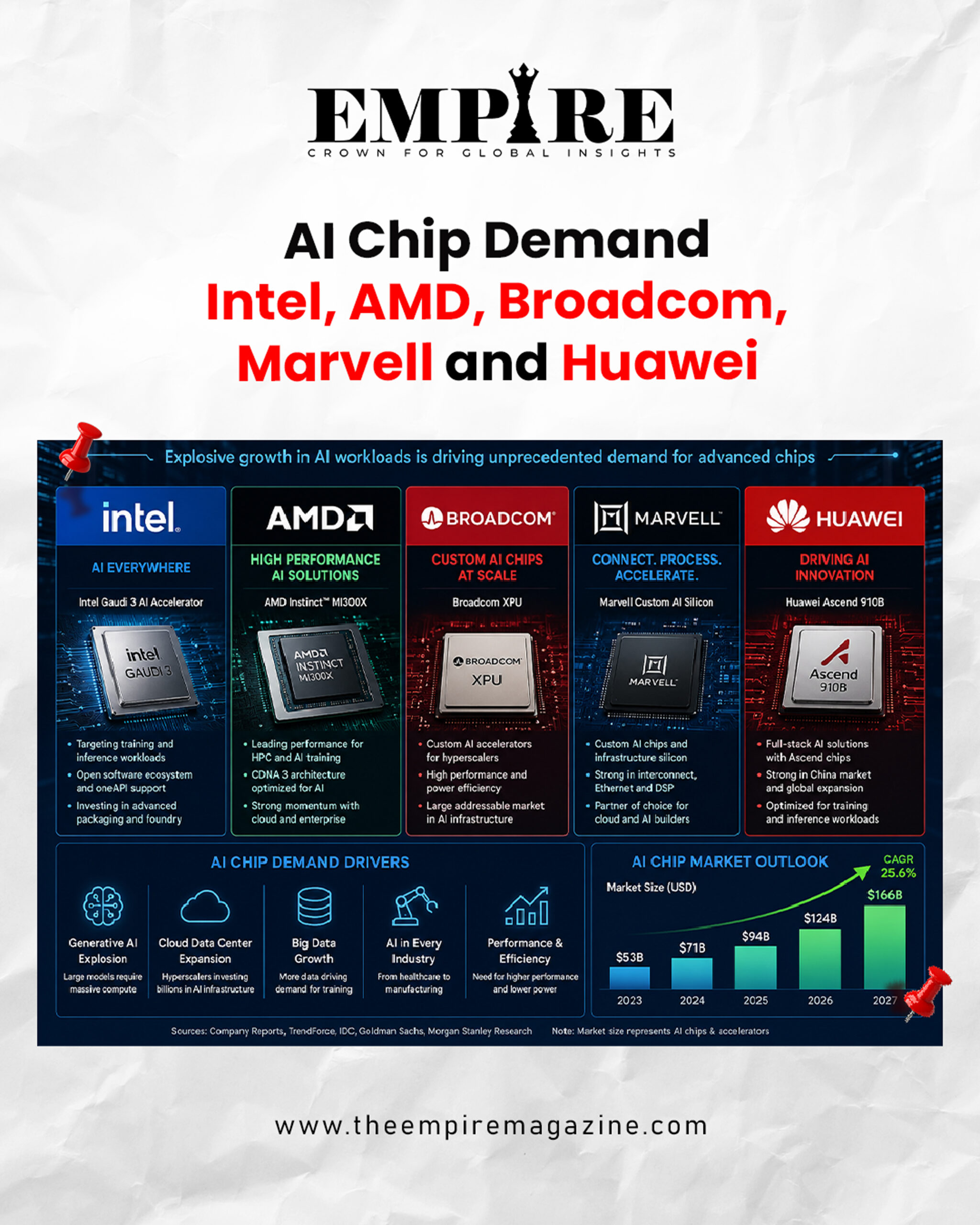
AI Chip Demand has become one of the most important forces in the global semiconductor market. Companies such as Intel, AMD, Broadcom, Marvell, and Huawei are all trying to capture growth from artificial intelligence infrastructure. The rise of generative AI, large language models, cloud computing, enterprise automation, and AI-powered applications has created massive demand for chips that can train models, run inference, move data, and support advanced data centers.
The AI chip market is not limited to one type of processor. It includes GPUs, CPUs, custom accelerators, networking chips, optical interconnects, memory systems, advanced packaging, and complete rack-scale infrastructure. This is why many semiconductor companies are trying to position themselves in different parts of the AI supply chain.
Nvidia remains the dominant leader in AI accelerators, but competitors and partners are moving quickly. Intel, AMD, Broadcom, Marvell, and Huawei are each pursuing AI demand through different strategies.
Why AI Chip Demand Is Growing
Artificial intelligence requires huge computing power. Training large AI models needs thousands of chips working together. Running AI services for millions of users also requires strong inference systems. As companies add AI to search, software, customer service, coding, finance, healthcare, advertising, and cloud platforms, demand for computing infrastructure continues to rise.
Data Centers Are Driving the Market
AI data centers are now central to semiconductor demand. Cloud providers, social media companies, enterprise software firms, and AI startups are buying chips, servers, networking equipment, and storage systems to support AI workloads.
This has changed the chip industry. The most valuable opportunities are no longer only in PCs or smartphones. The biggest growth is coming from data centers and AI infrastructure.
Intel: Using CPUs and Foundry Ambitions
Intel is one of the oldest and most important semiconductor companies in the world. It has historically led the PC and server CPU markets. In the AI era, Intel is trying to benefit from rising demand for CPUs, accelerators, advanced packaging, and foundry services.
Reuters reported in 2026 that Intel’s central processing unit business saw strong demand from companies offering AI services. Even though GPUs receive more attention in AI, CPUs remain important because they manage data center operations, support workloads, and work alongside accelerators.
Intel’s AI Challenge
Intel’s challenge is that it must compete with AMD in CPUs, Nvidia in AI accelerators, and TSMC in advanced manufacturing. The company has invested heavily in its foundry strategy and advanced packaging technologies.
Intel’s EMIB packaging technology is also relevant because AI systems need better ways to connect chips, memory, and components. As AI systems become more complex, packaging and integration can become as important as chip design.
AMD: The Strong Challenger in AI Accelerators
AMD has become one of the strongest challengers in the AI chip race. The company competes in CPUs through its EPYC server processors and in AI accelerators through its Instinct GPU family.
Reuters reported that AMD forecast quarterly revenue above expectations in 2026 because AI chip demand remained strong. This shows that customers are looking for alternatives and additional supply beyond Nvidia.
AMD Instinct and Data Center Growth
AMD’s Instinct accelerators are designed for AI training and inference. The company is also using its CPU strength to build a broader data center platform. EPYC processors are important for cloud providers and enterprise customers that need strong performance and efficiency.
AMD’s position is supported by major partnerships, advanced chiplet design, and reliance on TSMC manufacturing. The company is also investing heavily in Taiwan’s AI ecosystem, including advanced packaging and next-generation infrastructure.
Broadcom: Custom AI Chips for Hyperscalers
Broadcom is a major semiconductor and infrastructure software company. In the AI market, Broadcom is especially important because of its custom silicon business and networking technologies.
Large cloud companies often want custom AI chips designed for their own workloads. These chips can reduce dependence on standard GPUs and improve performance for specific AI systems. Broadcom has become a key partner for hyperscalers building custom accelerators.
Why Custom Silicon Matters
Custom AI chips are designed for specific customers and workloads. A cloud provider may want a chip optimized for its own AI models, data centers, power systems, or software stack.
This creates a major opportunity for Broadcom because hyperscalers are investing billions in AI infrastructure. Custom silicon can help them control cost, performance, and supply chain risk.
Marvell: Interconnects and Custom AI Infrastructure
Marvell is another important player in AI infrastructure. The company designs custom silicon, data center networking, optical interconnects, and storage-related chips. These technologies are critical because AI data centers need to move huge amounts of data quickly.
Reuters reported that Marvell expects its custom chip revenue to exceed $10 billion by fiscal 2029 as AI adoption grows. The company also projected strong data center growth as hyperscalers invest in custom chips and connectivity.
Networking Is Critical for AI
AI systems depend on many chips working together. If data cannot move quickly between processors, memory, servers, and data centers, performance suffers. This is why networking and interconnect technologies are essential.
Marvell’s optical and networking products support the infrastructure behind AI models. As AI workloads grow, demand for faster and more efficient data movement is expected to rise.
Huawei: China’s AI Chip Alternative
Huawei has become one of China’s most important AI chip companies. Its Ascend chip series is central to China’s effort to reduce dependence on U.S. chip suppliers. Reuters reported that Huawei’s Ascend chips are powering Chinese AI models, including DeepSeek’s latest flagship model.
U.S. export controls have limited China’s access to some advanced AI chips from companies such as Nvidia. This has increased demand for domestic alternatives, and Huawei is one of the companies trying to fill that gap.
Huawei and China’s AI Strategy
Huawei is not only building chips. It is building a wider AI ecosystem that includes hardware, software, cloud services, and developer tools. This matters because AI chips need strong software support to compete.
China’s AI chip strategy is also connected to national technology independence. Domestic chips can help Chinese companies continue AI development despite restrictions on advanced foreign hardware.
Energy Efficiency Is Becoming More Important
AI chip demand is also creating power and cooling challenges. Data centers require huge amounts of electricity, and AI workloads are especially energy intensive. TSMC has said that energy efficiency is becoming a major force in chip design because customers want better performance without sharply increasing power use.
Beyond Raw Computing Power
The AI chip race is no longer only about maximum performance. Companies also need efficiency, reliability, memory bandwidth, packaging, software compatibility, and supply chain security.
Advanced packaging, chiplets, photonics, and 3D stacking are becoming more important as traditional chip scaling becomes harder.
Why Competition Is Increasing
Intel, AMD, Broadcom, Marvell, and Huawei are all targeting different parts of AI chip demand. Intel wants to regain strength through CPUs, packaging, and foundry services. AMD wants to challenge Nvidia in accelerators and data centers. Broadcom and Marvell are building custom chip and networking businesses for hyperscalers. Huawei is supporting China’s domestic AI hardware needs.
Customers Want More Options
Cloud providers and AI companies do not want to depend on one supplier. More competition can improve availability, pricing, supply security, and product specialization.
This is why custom chips, alternative accelerators, and regional AI hardware strategies are becoming more important.
The Future of AI Chip Demand
AI Chip Demand is expected to remain strong as companies build AI agents, recommendation engines, enterprise tools, search systems, robotics, autonomous vehicles, and cloud AI services. The next stage of growth will depend on chips that are faster, more efficient, easier to scale, and better integrated into full data center systems.
For more technology and business insights, read this feature on The Empire Magazine.
Follow The Empire Magazine on Instagram and Facebook.
– The Empire Magazine
Crown For Global Insights