
United States | Business News & Entertainment
Information checked on 4 November 2026.
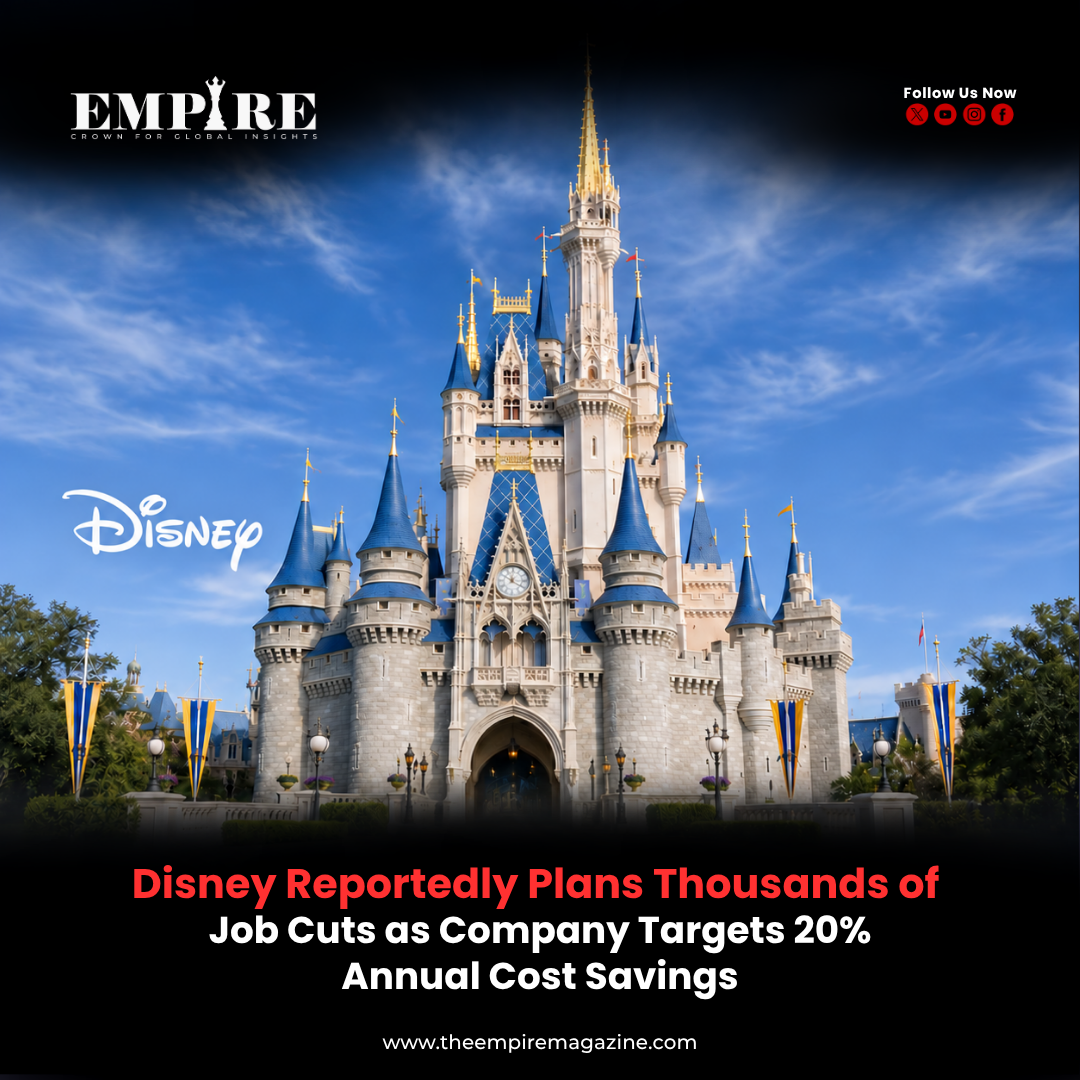
Disney job cuts could affect thousands of employees as the entertainment company considers further cost reductions, according to Bloomberg News. The report says some managers have been asked to identify savings equivalent to 20% of annual costs.
The reported plans would extend a restructuring effort already underway across the company. However, an exact number of affected positions, a detailed implementation schedule and a division-by-division breakdown have not been publicly specified.
Reuters, which covered Bloomberg’s reporting, said Disney did not immediately respond to its request for comment outside regular business hours.
The development raises a central question for Disney under chief executive Josh D’Amaro: how can the company reduce expenses while preserving the creative talent, operational capabilities and customer experiences that support its business?
What the Reported Disney Job Cuts Involve
Bloomberg’s reporting describes a combination of potential job eliminations and other expense reductions. The impact could vary across Disney’s operations.
That distinction matters for understanding the headline figure. A request to reduce annual spending can cover several categories of expenditure; it does not translate directly into an equivalent percentage of employees losing their jobs.
Understanding the 20% Savings Target
The reported target concerns costs within the areas assigned to certain managers. It should not be applied to Disney’s entire annual expenditure without further information.
Annual savings also differ from an immediate improvement in cash flow. In a restructuring, expenses such as severance, transition work and changes to operating systems can arise before recurring savings become visible.
For readers assessing the development, the useful measures will be the eventual scope of the programme, its implementation costs and the savings Disney actually achieves.
Disney Had Already Disclosed a Cost Review
The latest reporting follows an earlier public statement from Disney about reducing expenditure.
In its 5 August 2026 shareholder letter, the company said it was evaluating savings across the enterprise, including reductions in labour costs and selling, general and administrative expenses.
Management connected that work with creating additional capacity to invest in growth. The company also indicated that the review was ongoing and that further updates would follow.
This provides an official foundation for the broader cost-reduction strategy. It does not confirm every detail of the newly reported layoff plans.
For a business spanning entertainment production, streaming, sports and physical destinations, reducing expenses requires decisions about which functions can operate more efficiently and which capabilities need continued investment.
Josh D’Amaro’s Leadership Provides the Strategic Context
Josh D’Amaro became Disney’s chief executive on 18 March 2026, succeeding Bob Iger.
Before taking the top role, he led Disney Experiences, the business encompassing the company’s theme parks, resorts, cruise operations and related activities.
His appointment placed an executive with extensive experience in Disney’s physical experiences business at the centre of the wider group’s strategy.
A More Connected Disney Business
During Disney’s August earnings commentary, D’Amaro described an approach focused on closer coordination across the company.
His priorities included investment in creative work and intellectual property, greater use of technology, and stronger direct relationships with fans.
The commercial logic is that a successful story can create value across several businesses. A film can support streaming engagement, merchandise sales and attractions, while a familiar character can help connect those experiences.
From a business perspective, restructuring therefore presents a balancing task: simplifying how the company operates while retaining the expertise needed to make those connections work.
Earlier Disney Layoffs Show an Ongoing Restructuring
The latest report follows several rounds of workforce reductions during 2026.
According to Variety’s reporting, earlier changes included:
| Period | Reported workforce changes |
|---|---|
| April 2026 | Approximately 1,000 roles eliminated, primarily associated with the consolidation of enterprise marketing |
| July 2026 | Several hundred positions cut across corporate functions and businesses including Pixar, ESPN and Disney Entertainment Television |
| September 2026 | A few hundred employees affected, primarily in human resources and information technology |
Variety also reported that Disney offered early-retirement packages to some longstanding executives in August.
These developments establish that workforce restructuring predates the latest report. They should not be combined into a precise annual total because several of the published figures are approximate.
The new reporting also does not provide enough detail to calculate how the proposed reductions would relate to every earlier workforce action.
Disney’s Financial Results Add Important Context
Disney’s cost review has taken place alongside growth in several financial measures.
For its fiscal third quarter of 2026, the company reported:
| Financial measure | Reported result | Year-on-year change |
|---|---|---|
| Revenue | $25.2 billion | Up 7% |
| Income before income taxes | $3.6 billion | Up 14% |
| Total segment operating income | $5.6 billion | Up 21% |
Total segment operating income is a non-GAAP financial measure and should not be confused with net income.
These results show why workforce reductions cannot automatically be read as evidence that every part of a company is contracting.
A business can increase revenue while changing its organisation, reducing selected expenses or redirecting resources. The relevant question is whether those changes improve its ability to generate sustainable returns.
For Disney, future disclosures will help show how much restructuring contributes to earnings and how much improvement comes from customer demand, pricing, content performance or new capacity.
Disney’s Workforce Extends Across Many Different Businesses
Disney’s fiscal 2025 annual report recorded approximately 231,000 employees worldwide, including around 172,000 in the United States and 59,000 outside the country.
These figures describe the workforce at that fiscal year-end. They are not a confirmed employee count for November 2026.
The annual report also describes a workforce comprising full-time, part-time and seasonal employees. Across parts of the business, workers are covered by collective bargaining agreements or represented by other employee organisations.
That scale makes broad statements about workforce reductions difficult to interpret without more detail.
A change affecting corporate administration can have different implications from one involving production teams, technology specialists or guest-facing operations. The eventual distribution of any reductions will therefore matter as much as the overall number.
Investment and Technology Remain Part of the Strategy
According to the latest reporting, D’Amaro intends to reinvest part of the potential savings in programming, technology, theme parks and cruise operations.
Disney’s public comments also connect operating efficiency with investment in new content and guest experiences.
What Disney Has Said About AI
In his August commentary, D’Amaro discussed using artificial intelligence to support creative work, including parts of pre-production and post-production, and to personalise customer experiences.
He presented those tools as supporting human creativity.
Those comments establish that AI is part of Disney’s technology strategy. They do not establish that the newly reported job reductions would all result from employees being replaced by AI.
Assessing that relationship would require more specific information about affected roles, changes to workflows and the responsibilities retained by employees.
What Employees and Investors Will Be Watching
For employees, the immediate questions concern which teams might be affected, when decisions would be communicated and what support would be available.
For investors, a credible assessment would require details about the expected recurring savings, implementation expenses and consequences for the businesses involved.
The longer-term test is operational. Lower expenditure is useful only if Disney can continue delivering the films, programmes, digital services and physical experiences that customers choose to pay for.
Potential measures of progress include service quality, production execution, customer retention and the performance of new investments. These are areas to monitor, rather than outcomes established by the current reporting.
Disney’s Next Scheduled Financial Update
Disney has scheduled its fiscal full-year and fourth-quarter 2026 results for 17 November 2026, with an investor webcast beginning at 8:30 a.m. Eastern Time.
That provides a scheduled opportunity for management to discuss business performance and operating priorities. The company has not stated that it will announce a detailed workforce plan at that event.
Until further disclosures emerge, the distinction remains clear: Disney has publicly acknowledged an ongoing cost review, while the scale and structure of the latest reported job cuts remain to be confirmed.
Explore more global business, technology and innovation coverage in The Empire Magazine’s article archive.
Read our related coverage: kimi-antonelli-youngest-f1-world-champion/
Follow The Empire Magazine:
Facebook | Instagram
The Empire Magazine | Crown For Global Insights