The Israeli startup is developing behavioural AI for brokerage risk management, with broader ambitions to model how people and AI agents respond to changing circumstances.
Israel | Startup News, Artificial Intelligence and Fintech
Information checked on 3 November 2026.
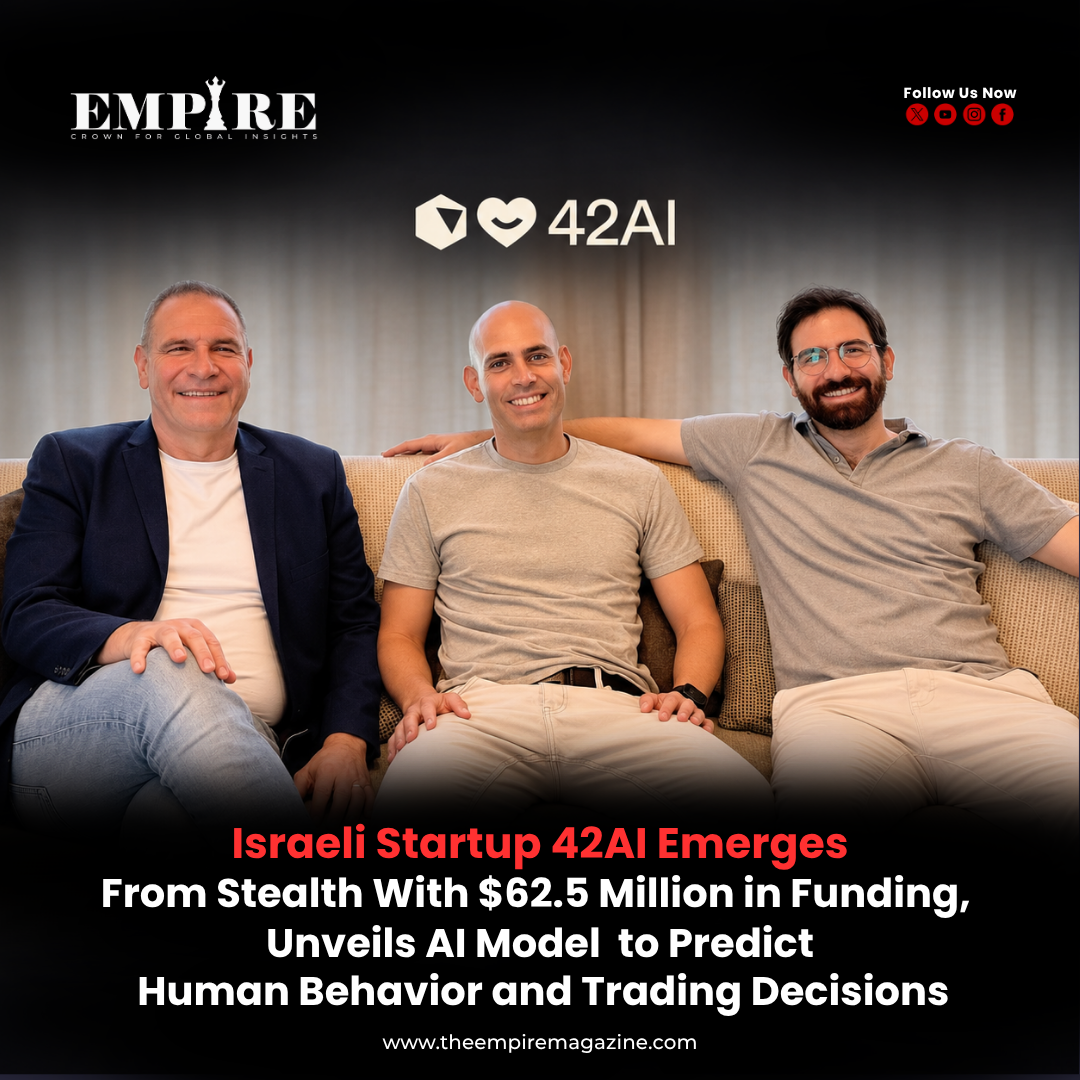
Israeli startup 42AI has emerged from stealth with $62.5 million in funding and an AI system designed to forecast human behaviour. Its launch, reported on 2 November 2026, brings attention to a different application of artificial intelligence: estimating how particular people might respond when circumstances change.
The company calls its technology a Behavioral World Model. Its initial commercial focus is financial services, where anticipating client trading activity could help brokerages prepare for changes in exposure.
The proposition is ambitious. Predicting behaviour requires understanding both the individual and the situation, including influences that may never appear in a dataset.
42AI’s public materials explain its approach, while a research preprint provides a narrower view of its experimental results. Together, they offer a basis for examining the technology without treating its forecasts as certainties.
What the $62.5 Million Funding Announcement Covers
According to launch reporting, the $62.5 million accumulated over three years, with backing from the founders and Infinity Group. It was not raised entirely from external investors in a single newly completed round.
The company’s leadership includes Amit Gal-Or as chief executive, Ehud Ezra as chief technology officer, and Amir Gal-Or as co-founder and chairman. Amir Gal-Or is also a managing partner of Infinity Group.
42AI describes a team combining AI engineering with psychology, psychiatry, neuroscience and other disciplines. Its website lists Professor Roi Reichart as head of cognitive AI and Professor Eyal Fruchter as head of behavioural research.
That combination reflects the company’s central premise: useful forecasts require a representation of the person making a decision, alongside information about the circumstances surrounding it.
How 42AI Approaches Behaviour Prediction
42AI says its technology converts information into representations of behavioural drivers, then uses those representations to estimate responses to events.
The company distinguishes between two related systems:
| System | Stated purpose |
|---|---|
| Large Behavioral Model | Predicting an individual’s response to a particular event or situation |
| Behavioral World Model | Modelling how behaviour develops across time as circumstances change |
This distinction matters when interpreting the company’s research. Evidence about responses to individual scenarios does not automatically establish performance across a sequence of real-world decisions.
The underlying idea is that people can react differently to the same information. A sharp market movement, for example, might lead one trader to reduce exposure while another increases it.
A useful model would need to estimate those differences while updating its forecasts as new information becomes available.
Why Psychological Context Matters to the Company
In a February 2026 essay, CTO Ehud Ezra argued that descriptions of what people say they prefer can be insufficient for forecasting what they actually choose.
He proposed incorporating structured behavioural information into model training, rather than relying only on a written description of someone’s personality.
This is the company’s research argument. Its practical value depends on whether the additional information improves predictions in carefully designed tests and subsequent deployments.
Why Brokerages Are the First Commercial Target
42AI’s website describes a brokerage application intended to forecast client trades up to 24 hours ahead, including the instrument, direction and volume.
The proposed benefit is earlier visibility into potential exposure. If many clients are likely to take similar positions, a brokerage may need to prepare for a concentration of activity.
Launch reporting says the company is working with 10 large brokerages. This is a company-reported adoption figure.
The commercial test extends beyond whether a forecast sounds plausible. It must arrive early enough to inform a decision, remain useful during volatile conditions and improve on the information the brokerage already has.
For example, a risk team would need to assess whether a forecast helps it prepare more effectively after accounting for errors and the cost of acting on incorrect signals.
What the Published Research Shows
A preprint titled “Decoding the Human Factor: High Fidelity Behavioral Prediction for Strategic Foresight” was submitted to arXiv on 19 February 2026. Its authors include Ehud Ezra.
The paper describes a Large Behavioral Model adapted from Llama 3.1 8B Instruct and conditioned on structured psychological profiles.
Researchers evaluated predictions on scenarios held out from training. In a configuration using 20 traits, the model reported 62% accuracy and a 0.45 macro-F1 score, a measure summarising performance across response classes.
The authors also identify limitations. Participants were volunteers, and some data depended on recalled experiences or hypothetical situations. Responses in those settings may differ from actions taken under real pressure.
These findings concern a particular experimental task. They do not independently validate the commercial system’s live trading forecasts.
The paper provides evidence about the research approach while leaving further questions about performance across populations, environments and longer sequences of decisions.
How to Interpret the 98% Accuracy Claim
Launch coverage reported a 98% accuracy claim, with the clarification that it concerned trading flows falling within predicted ranges, rather than correctly forecasting every individual trade.
The distinction is substantial.
A range can capture many outcomes while still being too broad to support a useful decision. Assessing such a forecast requires examining both how often the outcome falls inside the range and how narrow that range is.
A meaningful evaluation would also establish the test period, market conditions, comparison methods and treatment of unusual events.
Consequently, the headline percentage alone cannot establish how precisely the system predicts individual choices. Independent assessment would require more detailed evidence about the task being measured and the conditions under which the result was obtained.
The Data and Privacy Questions Behind Behavioural AI
A system that models individuals raises questions about how its information is collected, interpreted and used.
For a business evaluating this technology, those questions include which records contribute to a profile, whether the information remains relevant and who can access the resulting forecasts.
An incorrect profile could also persist unless the system can recognise changing circumstances and revise its assumptions.
From a business perspective, the purpose of the prediction matters. Using a forecast to prepare operational capacity creates different considerations from using it to influence how a particular customer is treated.
Clear explanations, defined uses and a process for reviewing errors would help customers assess the service. These are practical considerations for evaluating behavioural AI, rather than capabilities established by the funding announcement.
Where 42AI Wants to Expand
42AI’s public materials identify potential applications beyond brokerage exposure, including fraud protection, cybersecurity and personalised AI interactions.
It also describes ambitions to model the behaviour of AI agents.
These opportunities involve different prediction problems. A system estimating trading activity cannot be assumed to perform equally well when assessing fraud or anticipating an agent’s actions.
Each application would require relevant data, a defined outcome and evaluation against alternatives suited to that task.
The company’s broader opportunity is to make behavioural modelling useful across several industries. Its challenge is to demonstrate that usefulness separately in each setting.
What Will Demonstrate Progress
For 42AI, the next important evidence will concern how its forecasts perform outside selected demonstrations.
| Area | Evidence that would help assess progress |
|---|---|
| Predictive performance | Results on new data, with clearly defined metrics and uncertainty |
| Comparison with alternatives | Testing against existing methods and simpler forecasting approaches |
| Commercial usefulness | Measurable improvements after implementation costs and prediction errors |
| Changing behaviour | Evidence that forecasts adapt when people or circumstances change |
| Accountability | Clear explanations of data use, decision boundaries and error handling |
The startup has identified a potentially valuable problem: organisations frequently make decisions without knowing how the people around them will respond.
Its funding and early deployments give it an opportunity to develop that proposition further. The lasting value will depend on whether its forecasts remain useful, understandable and dependable when conditions become difficult to predict.
Explore more global business, technology and innovation coverage in The Empire Magazine’s article archive.
Read our related coverage: kimi-antonelli-youngest-f1-world-champion/
Follow The Empire Magazine:
Facebook | Instagram
The Empire Magazine | Crown For Global Insights