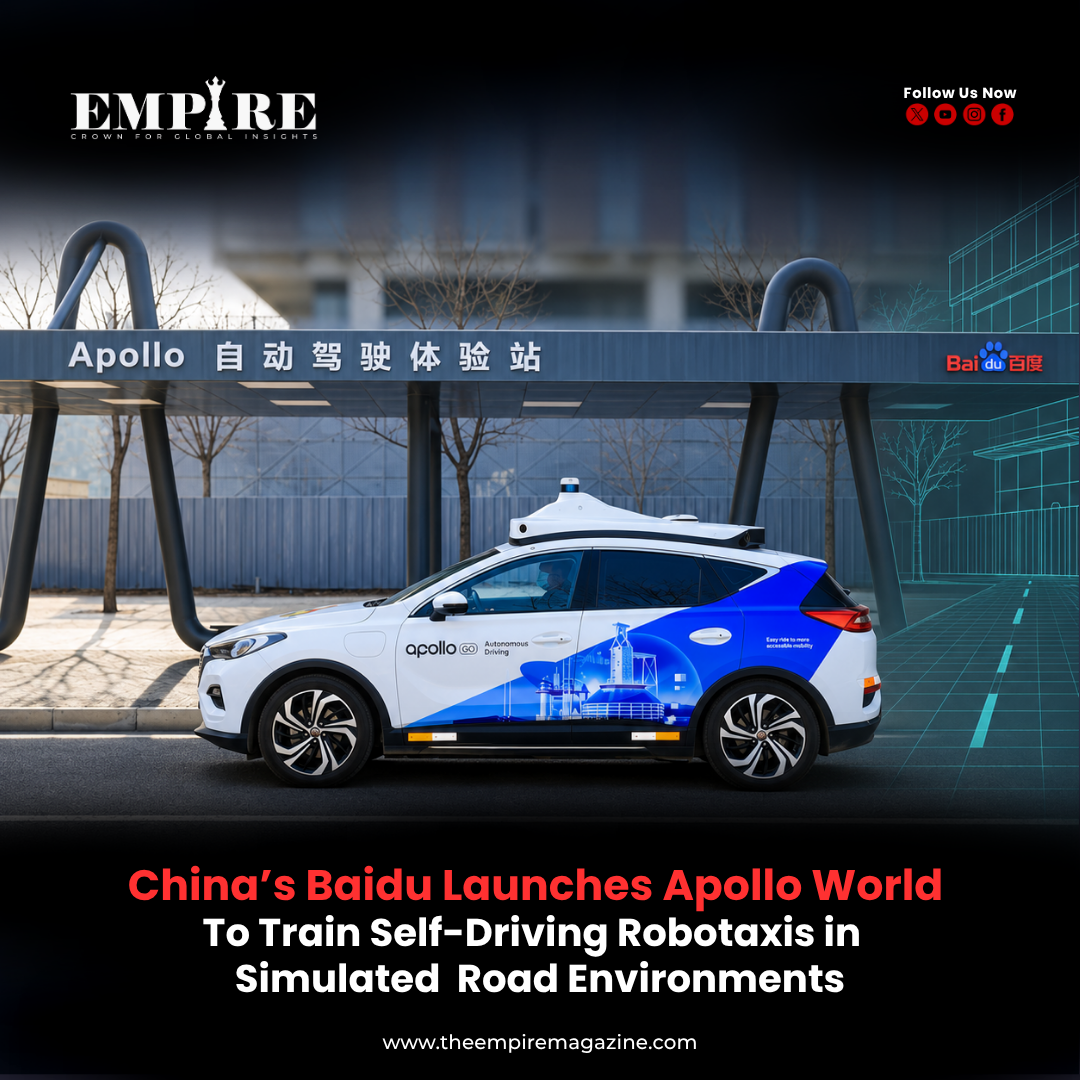
Baidu says its new AI system can generate up to 100,000 kilometres of simulated driving daily, supporting the development and testing of autonomous taxis.
China | Technology & Innovation
Information checked on 4 November 2026.
Baidu Apollo World is bringing a new virtual training environment to the company’s autonomous-driving programme. Unveiled on 3 November 2026 at a Baidu AI Day event in Shenzhen, the system is designed to help robotaxis practise driving through simulated road environments.
According to Baidu, Apollo World can generate up to 100,000 kilometres of simulated driving per day. The company compares that volume with approximately three years of real-world testing by a single autonomous vehicle equipped with a safety driver.
The announcement addresses a practical challenge for the robotaxi industry: testing driving software across a wide variety of situations while managing development time, cost and exposure to risk.
For businesses expanding autonomous transport, the value will depend on how effectively lessons from virtual environments translate into reliable performance on public roads.
How Baidu Apollo World Works
Baidu describes Apollo World as an interactive world model. Its virtual traffic participants can respond to the robotaxi’s actions, while simulated camera and lidar observations provide information to the driving software.
The software makes a driving decision, the environment changes and new observations follow. Baidu says the system also supports complete journeys through virtual cities and is already being used in Apollo Go’s international testing and validation.
This approach allows developers to examine a sequence of decisions and their consequences. A successful manoeuvre at one junction becomes part of a longer journey involving changing traffic conditions and interactions.
Why Rare Road Scenarios Matter
Everyday driving involves situations that are difficult to reproduce consistently. A vehicle may approach the same junction hundreds of times without encountering the particular combination of events that exposes a weakness in its software.
Consider an illustrative situation: a robotaxi approaches a crossing while a parked delivery vehicle partly obscures a cyclist. The outcome could change depending on the cyclist’s speed, the robotaxi’s position and the behaviour of nearby traffic.
A useful simulation allows developers to vary those conditions and examine how the driving system responds.
Waymo has previously described this process in its own development work. Its simulations modify recorded situations, introduce additional road users and change traffic speeds to explore alternative outcomes. The company also uses road experience to check whether its simulated environments remain realistic.
For developers, this creates an opportunity to investigate difficult encounters repeatedly. It also helps them compare software versions under controlled conditions, making it easier to identify whether a change improves one behaviour while weakening another.
Simulation Is an Established Part of Autonomous Driving
Baidu Apollo World enters a field where virtual testing already plays a substantial role.
NVIDIA’s autonomous-vehicle development tools, for example, combine reconstructed driving environments, generated scenario variations and interactive testing. Its documentation describes changing weather, lighting and unusual traffic situations to expand the range of conditions developers can examine.
Baidu also has an existing history of synthetic driving data. Its Apollo Synthetic dataset, documented in 2019, includes computer-generated environments such as highways, residential streets, urban intersections and parking garages.
That dataset illustrates another benefit of virtual environments: developers can obtain precise labels identifying objects, distances and road features. They can also vary environmental conditions that would be difficult or expensive to collect systematically on real roads.
Against this background, the useful questions about Apollo World concern the quality of its interactions, the consistency of its simulated observations and its effectiveness in improving driving software.
What the 100,000-Kilometre Claim Means
The headline figure describes virtual testing capacity. It provides an indication of how much simulated driving Baidu says the system can produce.
Evaluating that capacity requires more information than a distance total.
A kilometre involving a difficult junction, several interacting vehicles and restricted visibility may offer a different testing challenge from a kilometre along a clear, straight road. Repeating familiar conditions also serves a different purpose from exploring unfamiliar situations.
A useful assessment would therefore examine:
- The variety and difficulty of the scenarios.
- How accurately vehicles and pedestrians behave.
- Whether simulated sensor observations remain consistent.
- How reliably results predict performance outside the simulator.
- The computing resources required to run the tests.
The three-year comparison should be understood within Baidu’s stated reference point: the mileage accumulated by a safety-driver-equipped test vehicle. Demonstrating equivalent learning or safety outcomes would require additional evidence.
How Apollo World Fits Apollo Go’s International Expansion
Apollo Go is Baidu’s robotaxi service. Apollo World supports the development and evaluation of the technology behind that service.
International deployment provides a practical reason to invest in better testing tools. A new operating location can introduce unfamiliar road layouts, traffic patterns and passenger pickup arrangements.
Baidu’s overseas activity already includes Dubai. On 20 August 2026, Uber announced that fully driverless Apollo Go vehicles had become available through its platform in selected parts of Jumeirah and Umm Suqeim, with New Horizon Luxury Transport serving as the fleet operator.
That deployment predates Apollo World’s public unveiling and provides context for Baidu’s international ambitions.
From a business perspective, simulation could help teams investigate local driving situations before expanding an operating area. Its usefulness would depend on how closely the virtual conditions represent the locations where the vehicles will operate.
For related regional coverage, read The Empire Magazine’s article on inDrive’s planned robotaxi trials in Kazakhstan.
The Business Case for Virtual Robotaxi Training
The potential commercial benefit lies in improving the efficiency of development and evaluation.
If engineers can reproduce a difficult encounter, compare alternative responses and identify weaknesses earlier, they may be able to make better use of physical vehicles and road-testing time.
Repeatability also matters when software changes frequently. A team needs to understand whether an update improves performance across an existing test collection, including situations that previous versions handled successfully.
However, the financial outcome will depend on implementation. Running detailed simulations requires computing capacity, engineering work and continuing checks on the simulator itself.
For Baidu Apollo World, meaningful business indicators would include the cost of completing a useful evaluation, the time needed to investigate failures and the extent to which virtual testing improves deployment decisions.
These are potential benefits to assess as the technology develops. The announcement alone does not establish a particular reduction in operating costs or an improvement in robotaxi profitability.
Why Real-Road Validation Remains Essential
Simulation is most useful when its results remain connected to physical-world evidence.
Waymo’s published explanation of its development process describes real-world driving as an essential part of validation. It also discusses calibrating simulations against road experience and checking that simulated traffic continues to behave realistically.
That principle matters when assessing any autonomous-driving simulator. Developers need evidence that the behaviours rewarded during virtual testing remain appropriate in the actual operating environment.
The following questions provide a practical framework for evaluating progress:
| Area | Evidence Worth Examining |
|---|---|
| Scenario coverage | Whether testing includes diverse, difficult and locally relevant situations. |
| Simulation accuracy | How closely simulated observations and behaviours match real encounters. |
| Software improvement | Whether updates perform better across a consistent evaluation set. |
| Passenger experience | Whether driving becomes smoother and more predictable. |
| Development efficiency | Whether useful testing results require less time or lower overall expenditure. |
These measures would help explain how virtual training contributes to the quality of an autonomous service.
What to Watch Next
The next stage for Baidu Apollo World will be judged through evidence connecting simulation with deployment.
Useful disclosures would include evaluation methods, examples of weaknesses identified during virtual testing and measurements showing how resulting software changes performed on real roads.
For passengers, the outcome is practical: a service that handles everyday journeys and difficult situations consistently. For operators, it is the ability to develop and expand that service with a clearer understanding of performance.
Apollo World gives Baidu another tool for pursuing those goals. Its long-term significance will depend on the quality of the driving decisions that emerge from its virtual environments.
Explore more global business, technology and innovation coverage in The Empire Magazine’s article archive.
Read our related coverage: disney-job-cuts-cost-savings/
Follow The Empire Magazine:
Facebook | Instagram
The Empire Magazine | Crown For Global Insights