The French luxury house takes the leading luxury position with an estimated brand value of $45.2 billion, highlighting the importance of craftsmanship, customer loyalty and consistent brand management.
France | Luxury Brand News and Business
Information checked on 1 November 2026.
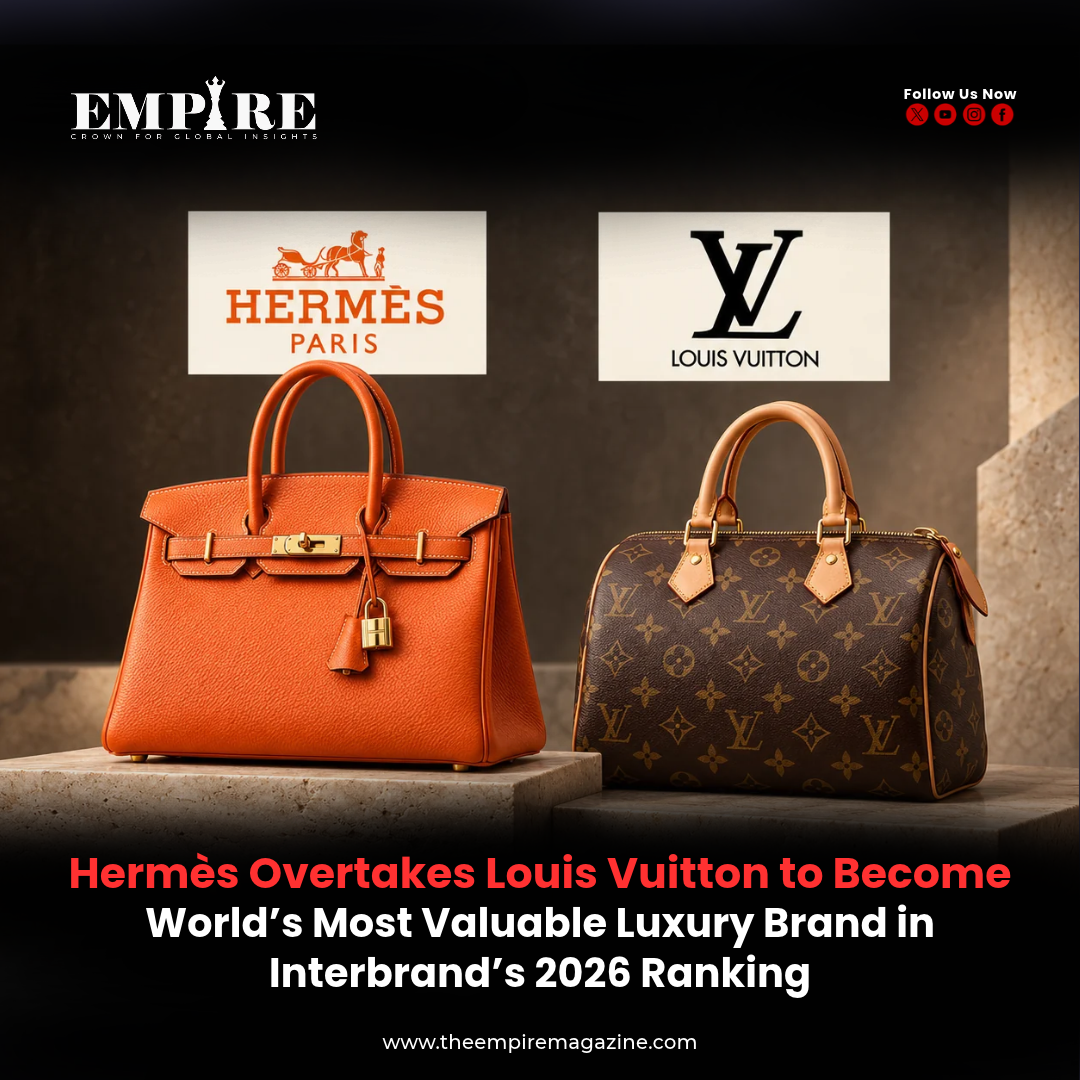
Hermès tops Louis Vuitton in Interbrand’s Best Global Brands 2026 ranking, becoming the highest-valued luxury brand in this year’s assessment.
Released on 28 October 2026, the ranking values Hermès at approximately $45.2 billion, an increase of 10.6% from the previous year. Louis Vuitton follows at $45.1 billion, down 6.9%.
Across the complete ranking, which includes companies from multiple industries, Hermès stands at 15th, immediately ahead of Louis Vuitton in 16th place.
The change brings attention to how luxury businesses sustain demand and protect their identity through uneven market conditions. It also requires a clear distinction: Interbrand’s figures estimate brand value, which measures something different from annual revenue or a company’s stock-market valuation.
How Hermès Tops Louis Vuitton in the 2026 Ranking
The latest results reverse the two brands’ positions in the previous edition.
In 2025, Interbrand valued Louis Vuitton at approximately $48.4 billion, placing it 12th overall. Hermès stood at $40.9 billion, in 21st place.
Hermès has therefore climbed six positions in the global ranking, while Louis Vuitton has moved down four.
Their 2026 valuations are close. The published, rounded figures put the difference at approximately $100 million. The change in leadership reflects both an increase in Hermès’ estimated brand value and a reduction in Louis Vuitton’s.
Selected luxury brands in the 2026 ranking show how differently established names are performing:
| Brand | Global rank | Estimated brand value | Annual change |
|---|---|---|---|
| Hermès | 15 | $45.2 billion | +10.6% |
| Louis Vuitton | 16 | $45.1 billion | −6.9% |
| Chanel | 24 | $32.9 billion | +8.1% |
| Cartier | 69 | $12.2 billion | +9.4% |
| Dior | 85 | $8.9 billion | −5.0% |
| Tiffany & Co. | 91 | $8.1 billion | +6.2% |
| Gucci | 93 | $8.1 billion | −30.7% |
| Prada | 96 | $7.6 billion | −15.1% |
Values are Interbrand’s published estimates in US dollars. Global positions cover all industries; displayed values are rounded.
What Interbrand’s Brand Valuation Measures
Interbrand evaluates three main elements: the financial performance associated with branded products and services, the influence of the brand on purchasing decisions, and its competitive strength.
Its approach examines how a brand contributes to customer choice and its ability to sustain demand and profitability.
For a luxury business, that can involve the reasons a customer chooses one house over another, the loyalty that develops over time and the commercial strength of its identity.
The ranking also has eligibility requirements. Brands need international reach, sufficient public financial information, global awareness and an expectation of positive long-term economic profit, among other conditions.
The result should therefore be understood specifically as Interbrand’s assessment of qualifying global brands. The $45.2 billion figure represents an estimated brand asset; it is separate from the value investors place on Hermès International’s shares.
The Business Model Behind Hermès’ Position
Hermès describes its strategy around three connected priorities: creative development, craftsmanship and a carefully managed distribution network.
The company’s published strategy also emphasises its independence, family shareholders and long-term approach to investment.
Craftsmanship Depends on Production and Training
Hermès maintains substantial manufacturing operations in France. Its disclosures for 2025 state that 75% of its products, including all leather goods products, were manufactured in the country.
The company connects production with the transfer of skills between experienced artisans and new recruits. Its workshop model makes training part of how manufacturing capacity develops.
Hermès also says it plans to open approximately one additional leather goods workshop annually in France through 2030.
For the business, this creates an operational challenge: increasing output while maintaining the quality and consistency associated with its products. Expansion requires skilled people and production capacity as well as customer demand.
Distribution Shapes the Customer Relationship
Hermès operates a retail network in which most stores are directly managed, alongside its own e-commerce platform.
Its strategy gives store managers a role in selecting products for their customers. This allows local assortments to sit within a shared brand identity.
The company also places emphasis on products designed for long use and repair. That approach extends the customer relationship beyond the original sale.
One business implication is that brand management reaches into manufacturing, service and retail decisions. The experience customers receive must support the expectations created by the name.
What Hermès’ Latest Sales Results Show
Hermès’ financial results provide additional context, although revenue growth and brand-value growth are separate measures.
In its 22 October 2026 update, the company reported third-quarter revenue of €4.096 billion, increasing 4.3% at constant exchange rates and 5.5% at reported exchange rates.
For the first nine months of 2026, revenue reached €12.26 billion, up 5.5% at constant exchange rates.
Leather Goods and Saddlery remained a strong contributor, with third-quarter sales increasing 10.8% at constant exchange rates.
Performance varied across categories. Ready-to-wear and Accessories declined 2.0%, while Watches fell 6.0%, both at constant exchange rates during the quarter.
These results show continued overall growth alongside weaker areas. They provide operating context for the brand’s position, rather than a direct calculation of Interbrand’s valuation.
Louis Vuitton’s Position Within LVMH
Louis Vuitton remains part of LVMH, whose financial disclosures cover a much broader portfolio of luxury businesses.
On 12 October 2026, LVMH reported approximately €57.1 billion in revenue for the first nine months of the year. Group revenue rose 2% organically, while reported revenue declined 2%.
Its Fashion and Leather Goods division recorded a 5% organic revenue decline in the third quarter. LVMH said the division was affected by weaker demand in China, while the US market remained supportive.
The group also highlighted Louis Vuitton’s product development and store experiences, including activity marking the Monogram’s 130th anniversary.
These figures require careful interpretation. Fashion and Leather Goods includes several houses, so its revenue movement cannot be presented as Louis Vuitton’s individual sales performance.
Likewise, the 6.9% reduction in Louis Vuitton’s Interbrand brand valuation should not be described as a matching fall in its revenue.
Luxury Brands Are Moving in Different Directions
Interbrand’s accompanying analysis describes an increasing divide between luxury brands gaining value and those losing ground.
The improvement at Chanel, Cartier and Tiffany & Co. sits alongside declines at Dior, Gucci and Prada. This makes a single description of the entire luxury sector less useful than examining individual brands.
Interbrand identifies customer desirability, cultural relevance and the quality of the customer experience as important considerations in sustaining premium positioning.
Its luxury-sector analysis also associates Hermès’ performance with craftsmanship, controlled availability and initiatives that bring customers closer to the making process.
These are interpretations of brand performance. They do not establish that any one initiative produced a particular percentage increase in valuation.
What the Ranking Means for Luxury Business Strategy
For luxury executives, the change raises a practical question: how can a business grow while preserving the qualities that customers value?
The Hermès model puts production skills, distribution and customer relationships at the centre of that question. Its operating choices offer a useful case study in managing the connection between commercial expansion and brand identity.
For other houses, the priorities may differ. New collections, improved service, stronger retail experiences or clearer positioning may be needed to maintain customer preference.
The next financial disclosures will help show whether current trends continue across products and regions. Future brand assessments will provide another perspective on how those commercial developments affect customer preference and long-term earning potential.
For Hermès, maintaining its new position will depend on continuing to deliver the product quality and customer experience behind the valuation.
Explore more global business, technology and innovation coverage in The Empire Magazine’s article archive.
Read our related coverage: tech-stock-sell-off-ai-spending/
Follow The Empire Magazine:
Facebook | Instagram
The Empire Magazine | Crown For Global Insights