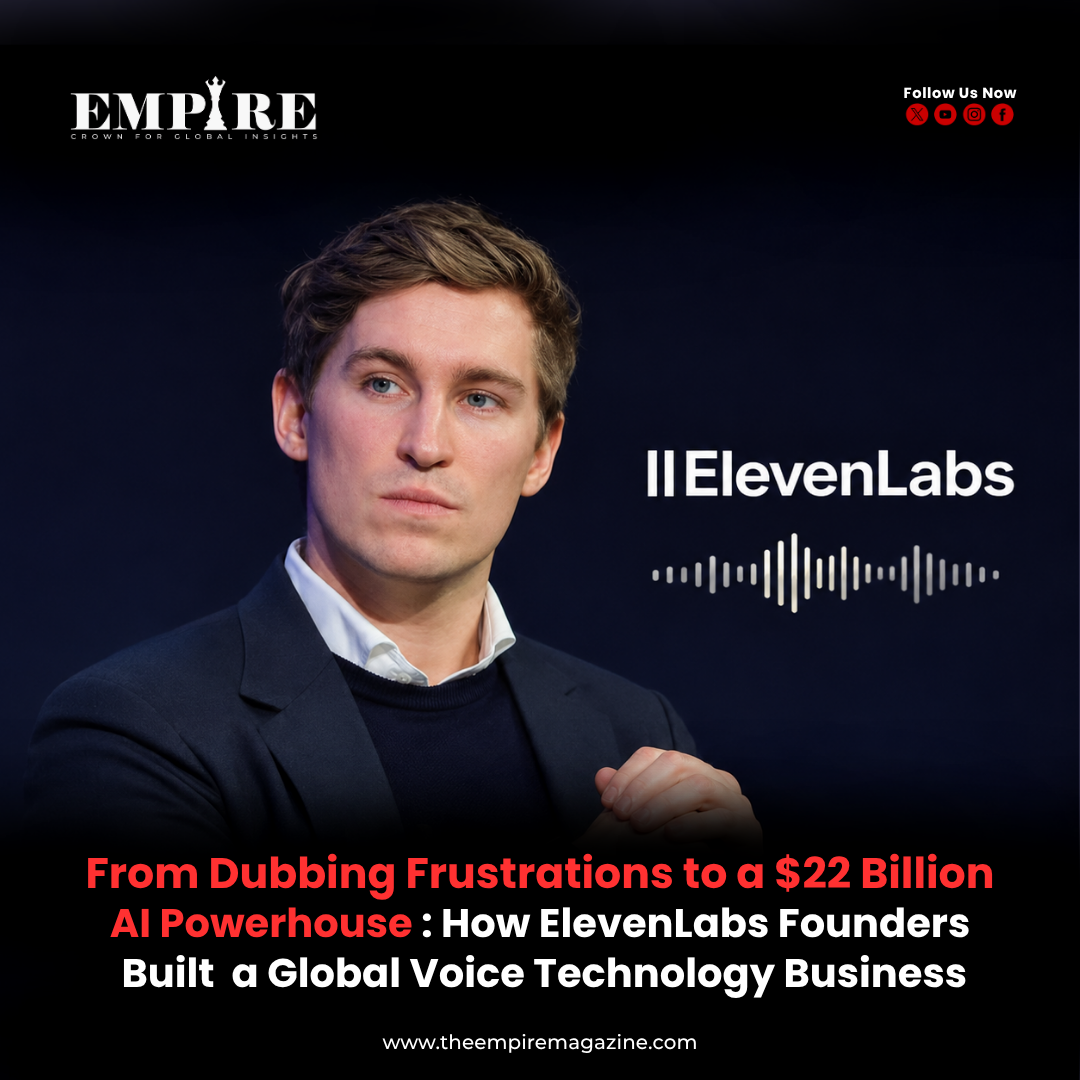
Inspired by the dubbing they heard growing up in Poland, Mati Staniszewski and Piotr Dąbkowski built a company serving creators, publishers and enterprise customers.
United Kingdom and Poland | Startup Stories, Artificial Intelligence and Technology
Information checked on 3 November 2026.
ElevenLabs founders Mati Staniszewski and Piotr Dąbkowski began with a familiar frustration: the poor-quality dubbing of American films they watched while growing up in Poland. They wanted technology to carry a speaker’s expression and identity across languages more convincingly.
That ambition became ElevenLabs in 2022. Four years later, the company announced an employee share transaction valuing the business at $22 billion.
Its development connects several stages of building an AI company: identifying a specific problem, developing the underlying technology, attracting early users and adapting the product to larger commercial needs.
The valuation is one milestone. The more revealing story is how a voice-generation tool became part of publishing, customer service and business communications.
Where the ElevenLabs Founders Began
Staniszewski and Dąbkowski were friends before they became business partners. According to early investor Concept Ventures, they met as teenagers at Copernicus High School in Warsaw.
Their professional paths later gave them different kinds of technology experience. Staniszewski worked at Palantir before becoming ElevenLabs’ chief executive. Dąbkowski, a former Google machine-learning engineer, became its chief technology officer.
The problem that brought them together involved more than translating words. A performance carries meaning through timing, emphasis, tone and emotion. A translated voice can communicate the dialogue while losing some of those qualities.
Their ambition was to improve that experience through AI and make content accessible across languages.
This gave the startup a concrete starting point. The founders could work towards an improvement that people could hear, rather than asking customers to understand an abstract technical capability.
Building the First Product Before Expanding the Business
ElevenLabs spent 2022 developing its audio models and launched its public beta in January 2023.
The initial platform allowed users to generate speech from text. Its tools offered synthetic voices, voice customisation and cloning capabilities, opening applications in narration, games and other forms of digital content.
By 20 June 2023, the company reported more than one million registered users. That figure reflected early interest, although registrations alone did not establish the size of its paying customer base.
Its early announcements also identified business relationships with organisations including Storytel, TheSoul Publishing, Embark Studios and Paradox Interactive.
These applications gave the technology several routes into commercial work. An author might need narration, a game developer might need character dialogue, and a publisher might want to make written material available in audio.
Each use case placed different demands on quality, editing and consistency.
Returning to the Original Dubbing Problem
On 10 October 2023, ElevenLabs introduced AI Dubbing, bringing its early ambition into a dedicated product.
The company described a tool that could translate spoken content into other languages while preserving characteristics of the original speaker’s voice. At launch, it supported more than 20 languages.
The product combined speech generation, voice cloning and audio processing. It was designed to handle recordings with multiple speakers while maintaining distinctions between their voices.
For creators and media businesses, the potential benefit was a more accessible route to multilingual production.
However, commercial usefulness depends on the finished result. Accurate pronunciation, appropriate translation and the intended emotional delivery still matter when content reaches an audience.
From Voice Generation to a Broader AI Business
ElevenLabs now describes its business through three main platforms:
| Platform | Main purpose | Intended users |
|---|---|---|
| ElevenCreative | Creating and editing speech, music and other media | Creators, publishers and marketing teams |
| ElevenAgents | Deploying conversational voice and chat agents | Businesses serving customers and employees |
| ElevenAPI | Providing developer access to its AI audio models | Software developers and product teams |
This structure reflects an expansion from producing audio to supporting ongoing interactions.
A recorded narration is a finished piece of content. A conversational agent must respond to changing requests, use relevant information and work within the systems of the organisation deploying it.
In its September 2026 announcement, ElevenLabs said enterprise customers accounted for 55% of revenue. That company-reported figure illustrates how business adoption had become a substantial part of its commercial activity.
How Partnerships Put the Technology Into Everyday Work
Spotify: Connecting Voice Generation With Publishing
Spotify provides an example of how ElevenLabs moved into an established distribution process.
In February 2025, Spotify announced support for audiobooks narrated using ElevenLabs. Authors could create audio and submit it through the supported distribution workflow.
The relationship developed further in 2026. Spotify announced Audiobook Creation Tools, powered by ElevenLabs and built into Spotify for Authors.
Spotify’s current support documentation describes a process in which an author uploads an EPUB manuscript, chooses a digital voice, reviews pronunciations and previews chapters before publication. It lists availability in the United States and in English.
Books produced through the tool carry a “Narrated by Digital Voice” label.
For ElevenLabs, the commercial significance is integration: its technology becomes part of the process an author uses to create and publish a book.
Deutsche Telekom: Moving Into Customer Conversations
The partnership with Deutsche Telekom shows a different application.
ElevenLabs has described work across the telecom company’s customer service and consumer products. Its August 2026 account also explains how engineers worked directly with Deutsche Telekom’s team, including on-site support in Germany.
Separately, Deutsche Telekom presented its Magenta AI Call Assistant at Mobile World Congress in March 2026. Developed with ElevenLabs, the concept included live translation, call summaries and contextual assistance within phone calls.
These projects illustrate the demands of enterprise deployment. Voice quality must work alongside response speed, system integration and dependable operation.
The business opportunity therefore involves helping customers introduce the technology into existing services, as well as supplying the underlying models.
What the $22 Billion Valuation Represents
On 30 September 2026, ElevenLabs announced that it had completed a $300 million employee tender offer at a $22 billion valuation.
The transaction was led by Wellington and T. Rowe Price. It valued the company at twice the level announced in its February 2026 Series D.
An employee tender provides eligible shareholders with an opportunity to sell shares. The resulting valuation reflects the price agreed for ownership in the business; it is separate from annual revenue, profit or cash received by the company.
For the founders, it marks substantial investor confidence. Sustaining that confidence will depend on continued customer demand and the economics of delivering its services.
Voice Technology Also Has an Accessibility Role
ElevenLabs’ work extends to people with communication needs through its Impact Program.
The programme provides access to its technology for eligible individuals and nonprofit organisations. Its applications include personalised synthetic voices used with assistive communication tools.
The company has also set a goal of providing free lifetime access to voice technology for one million people living with permanent voice loss. This is a programme ambition, rather than a claim that one million people have already received support.
This application connects with the founders’ original interest in preserving vocal identity. A recognisable voice can have personal significance as well as commercial value.
Why Trust Is Part of the Business Model
Realistic voice generation creates responsibilities around consent, identity and disclosure.
ElevenLabs says its safeguards include automated detection, human review, restrictions on certain high-risk voices and enforcement against prohibited use. Its Professional Voice Cloning product requires verification that a voice belongs to the person creating the clone.
The company also acknowledges that safeguards can make mistakes or fail to detect misuse.
For a voice technology business, trust affects adoption. A publisher needs confidence about the rights attached to narration. An enterprise needs clear controls over its agents. An individual needs to understand how a digital version of their voice can be used.
These requirements are part of delivering a usable product.
What the ElevenLabs Startup Story Shows
The sequence of ElevenLabs’ development suggests three practical lessons for entrepreneurs.
First, a specific frustration can provide a useful starting point when it leads to a clear product goal. Better dubbing gave the founders a problem they could explain and an improvement users could assess.
Second, the underlying technology can support several markets. Speech generation created opportunities in publishing, entertainment, accessibility and customer communication.
Third, expansion requires adapting to the customer’s work. The Spotify and Deutsche Telekom examples show how distribution, integration and implementation become important as a startup grows.
For the ElevenLabs founders, the next challenge is to maintain quality and trust while serving increasingly varied uses. The business will ultimately be judged by how reliably people can create, communicate and complete useful tasks with its technology.
Explore more global business, technology and innovation coverage in The Empire Magazine’s article archive.
Read our related coverage: kimi-antonelli-youngest-f1-world-champion/
Follow The Empire Magazine:
Facebook | Instagram
The Empire Magazine | Crown For Global Insights