
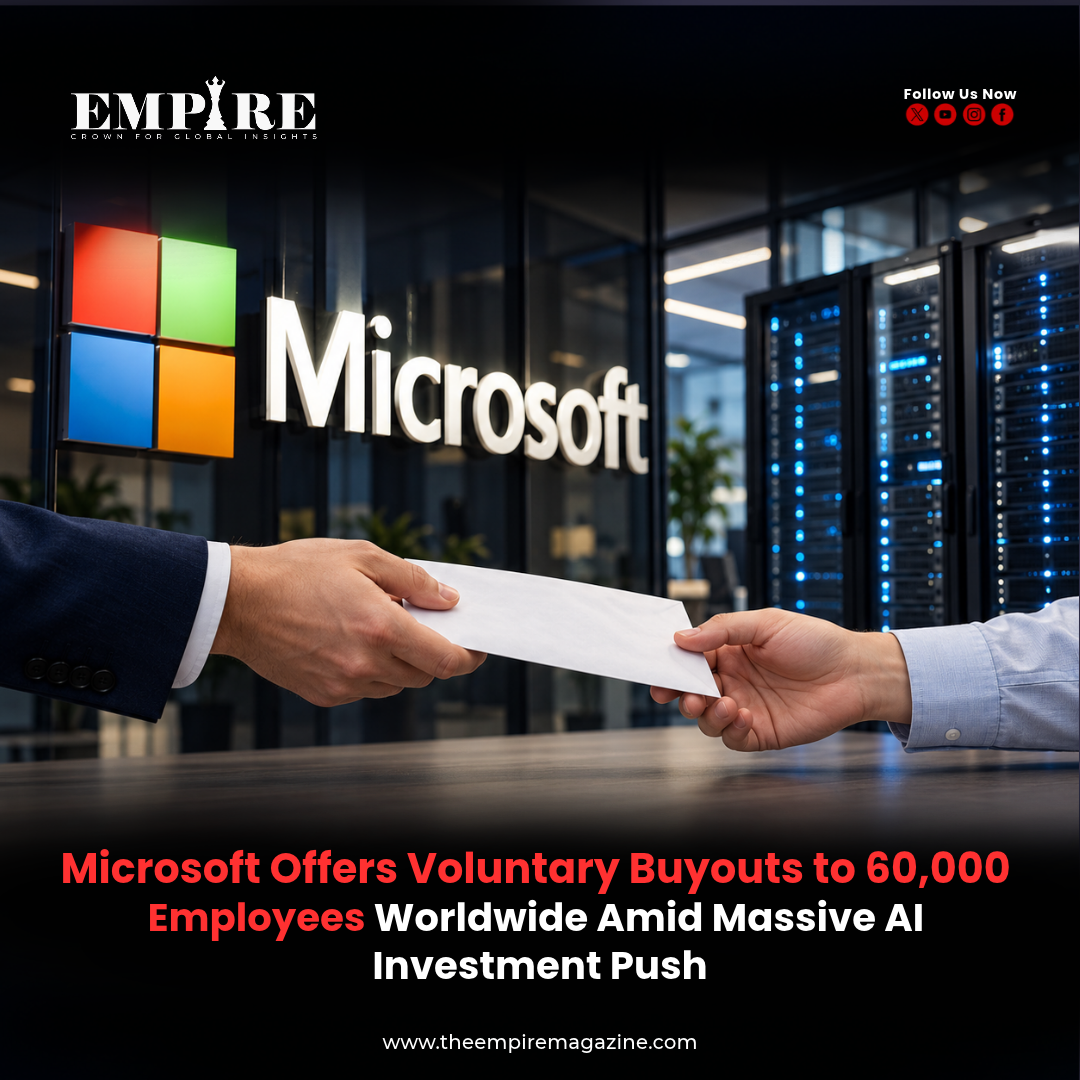
The offer covers selected teams in the United States, Canada, the United Kingdom and India as Microsoft reviews workforce needs while investing heavily in artificial intelligence infrastructure.
United States | Business News, Technology & Artificial Intelligence
Information checked on 27 October 2026.
The Microsoft voluntary buyouts announced on 26 October 2026 will be available to approximately 60,000 employees, giving eligible workers an opportunity to leave the company with financial support.
The initiative, called the Voluntary Exit Offer, applies to participating teams in four countries. It comes as Microsoft manages workforce costs alongside substantial investment in artificial intelligence, cloud computing and data centres.
The figure describes the number of employees eligible to consider the offer. It does not establish how many people will accept or how much Microsoft’s workforce will ultimately shrink.
For the company, the programme creates another way to adjust staffing. For employees, the decision will depend on the individual package, departure timetable and their plans beyond Microsoft.
Who Is Eligible for Microsoft Voluntary Buyouts?
Microsoft’s official announcement says the programme covers eligible employees at internal level 70 and below within participating organisations.
Eligibility also depends on geography and the team in which an employee works.
Four Countries Are Included
The offer is available to qualifying employees in:
- United States
- Canada
- United Kingdom
- India
The programme therefore reaches several major employment markets, but it is not available automatically to every Microsoft employee worldwide.
Microsoft says participation varies according to business priorities, customer commitments and workforce needs.
Participation Varies Across Business Units
Reuters reported, citing a person familiar with the matter, that participating areas include AI experiences, Copilot, finance, human resources, Xbox, and Windows + Devices.
The same report said marketing, commercial business and security were excluded.
These reported categories describe the programme’s scope. Individual eligibility is determined through the company’s offer process.
What Microsoft Has Said About the Programme
In the public announcement, Chief People Officer Amy Coleman described the initiative as a way to support eligible employees considering a future outside Microsoft while helping participating organisations adapt to changing needs.
The company said employees would receive individual offer details electronically. Its announcement identifies financial support and career-planning resources as elements of the programme.
The approach gives employees a choice about whether to participate. However, the availability of an offer does not establish that an employee intends to leave or that their current role has already been eliminated.
What Do the Buyout Packages Include?
Business Insider reported that the offers resemble Microsoft’s standard severance arrangements, with terms varying according to an employee’s location, seniority and length of service.
The publication’s review of US offers identified salary-based payments, continued stock vesting and health-insurance support.
Individual Terms Matter
Those reported US arrangements should not be assumed to apply identically in Canada, India or the United Kingdom.
The value of an offer can also differ between employees in the same country. A single headline payment figure would therefore give an incomplete picture of the programme.
The Personal Offer Sets Out the Applicable Package
Microsoft’s public announcement does not provide one universal payment schedule for all eligible employees.
Each employee’s documentation is the relevant source for their compensation, benefits, conditions and departure arrangements.
Reported Decision and Departure Timeline
Business Insider reported that eligible employees would have until early December to decide, with departures scheduled for the end of 2026.
Microsoft’s public announcement describes the programme as time-limited. Individual communications will set out the applicable deadlines and process.
Why 60,000 Eligible Employees Does Not Mean 60,000 Job Cuts
Microsoft’s fiscal 2026 annual report records approximately 223,000 full-time employees as of 30 June 2026.
Against that workforce figure, 60,000 eligible employees represent approximately 27% of the total.
That comparison explains the programme’s scale, but participation remains voluntary. The number of employees who accept could be substantially smaller than the eligible population.
Future workforce totals will also reflect hiring, other departures and organisational changes. The eventual headcount impact cannot be calculated from eligibility alone.
For readers following technology-sector employment, three measures should remain distinct:
| Measure | What it describes |
|---|---|
| Employees eligible | People permitted to consider the offer |
| Offers accepted | Employees who choose to participate |
| Net workforce change | The combined effect of departures, hiring and other staffing changes |
The announcement establishes the first measure. It does not yet establish the final two.
How the Programme Fits Microsoft’s AI Investment Strategy
The buyouts come during a period of substantial spending on computing infrastructure.
Reuters reported that Microsoft had forecast approximately $175 billion in capital expenditure for the 2026 calendar year.
That figure concerns capital spending. It is not the cost of the buyout programme or an estimate of the savings that employee departures would generate.
Cloud Growth Provides Business Context
Microsoft’s annual report shows Microsoft Cloud revenue of $214.4 billion in fiscal 2026, compared with $168.9 billion in fiscal 2025.
The company’s Microsoft Cloud measure includes Microsoft 365 Commercial cloud, Azure and other cloud services, the commercial portion of LinkedIn, and Dynamics 365.
It is therefore a broad cloud-business measure, rather than a standalone figure for AI revenue.
The commercial challenge is to translate infrastructure investment into services customers use and pay for consistently. Revenue growth, operating costs and the utilisation of new capacity all matter when assessing that spending.
The Announcement Does Not Establish Direct AI Replacement
Microsoft has described the offer in terms of employee choice and changing organisational needs.
The available announcement does not establish that every participating role is being replaced by an AI system. Investment in AI infrastructure, organisational restructuring and automation can influence a company at the same time without producing a simple one-to-one relationship between technology spending and individual departures.
That distinction is important when explaining what the programme means for employment.
How This Differs From Microsoft’s Earlier Retirement Offer
Microsoft introduced a voluntary retirement programme earlier in 2026 for a smaller group of US employees, with eligibility linked to age and length of service.
The October programme extends the opportunity to selected teams across four countries. Microsoft says it builds on insights gained from the earlier initiative.
The two programmes should be treated as separate announcements. Their eligible populations do not reveal how many employees ultimately departed under either offer.
What the Buyouts Could Mean for Microsoft’s Operations
From a business perspective, voluntary departures can help an organisation adjust staffing, but their value depends on more than reducing payroll.
Teams also need to maintain customer support, retain essential expertise and transfer responsibilities effectively.
A programme may produce short-term exit costs before any longer-term savings emerge. Its operational effects will depend on which employees leave, how their work changes and whether replacement hiring is required.
These are considerations for assessing the outcome, rather than results Microsoft has already disclosed for the new offer.
What to Watch as the Programme Progresses
The next developments will be the number of employees accepting the offer, the distribution of departures and any financial disclosures about associated costs.
For Microsoft’s broader strategy, future results will also show how cloud and AI demand develops alongside infrastructure spending.
The immediate confirmed development is a voluntary exit opportunity for approximately 60,000 eligible employees. Its eventual effect on staffing, expenses and service delivery will become clearer as employees make their decisions and the programme progresses.
Explore more global business, technology and innovation coverage in The Empire Magazine’s article archive.
Read our related coverage: indrive-robotaxi-kazakhstan-2027/
Follow The Empire Magazine:
Facebook | Instagram
The Empire Magazine | Crown For Global Insights