
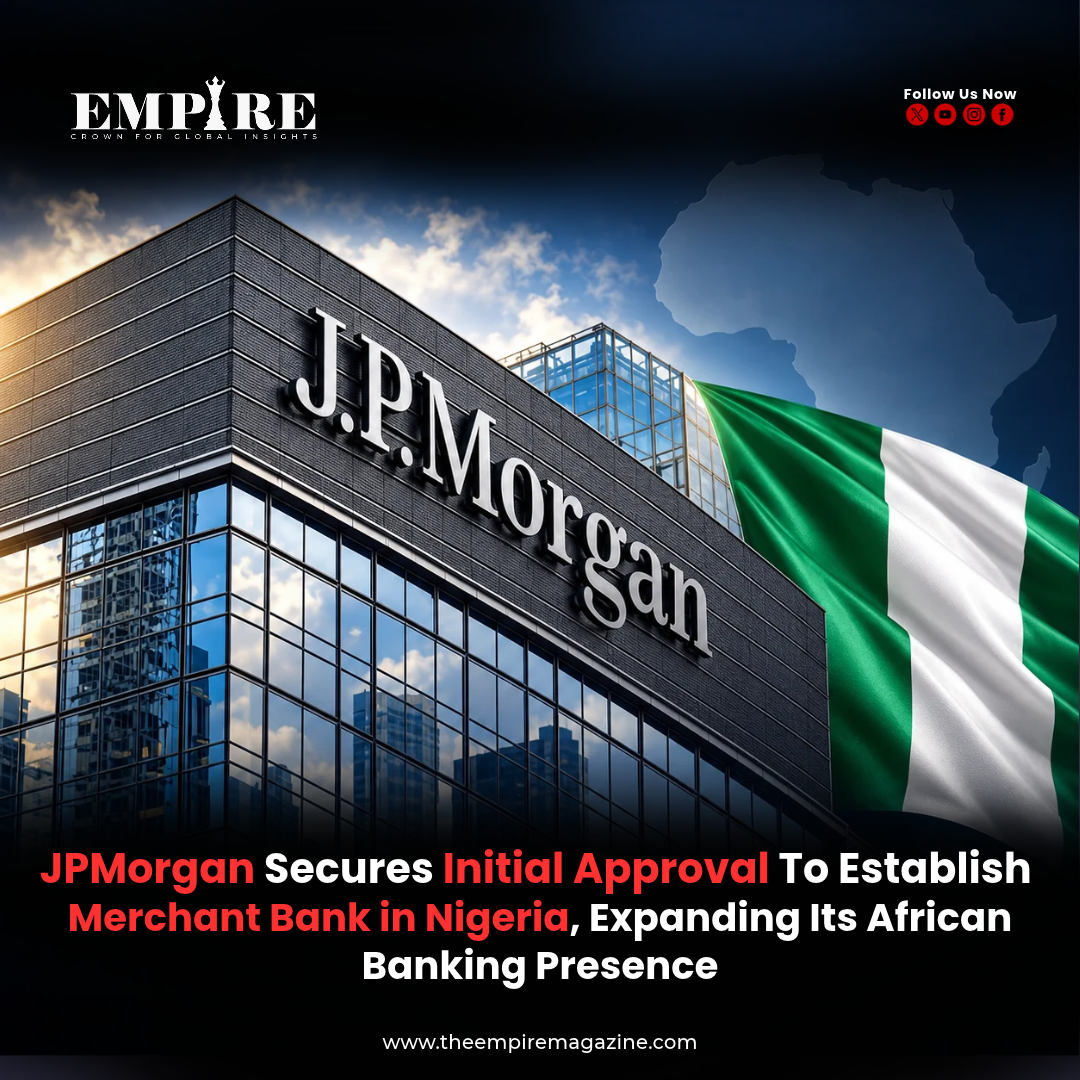
The Central Bank of Nigeria has advanced the proposed institution’s application, with final licensing and operational requirements still to be completed.
Nigeria | Business News and Banking
Information checked on 26 October 2026.
The proposed JPMorgan merchant bank in Nigeria has received approval in principle from the Central Bank of Nigeria (CBN), advancing the US banking group’s plans to expand its institutional banking activities in the country.
Announced on 23 October 2026, the decision covers the planned JPMorgan Merchant Bank Nigeria Limited. The institution is expected to focus on wholesale banking, capital markets and advisory services, according to Reuters’ reporting of the CBN statement.
The approval represents an initial regulatory step. JPMorgan must complete the remaining establishment requirements and obtain a final banking licence before the proposed institution can begin operations.
The development builds on a longstanding relationship with Nigeria, where JPMorgan’s predecessor businesses have operated for decades.
What the JPMorgan Merchant Bank Approval Means
Approval in principle allows the proposed institution to move forward through the establishment process. It does not authorise the bank to begin providing banking services immediately.
The distinction matters for businesses assessing the announcement. The CBN has advanced the application, while final operating authorisation remains outstanding.
Regulatory Requirements Still to Be Completed
According to the CBN statement, the proposed institution must satisfy the applicable regulatory conditions, including:
- Incorporation with Nigeria’s Corporate Affairs Commission.
- Completion of the necessary operational arrangements.
- Fulfilment of the remaining regulatory requirements.
These conditions form part of the process for establishing the bank and preparing it for authorised operations.
Final Banking Licence Required Before Operations
The decisive regulatory milestone will be the issuance of a final banking licence.
A confirmed opening date was not included in the reported approval. Businesses should therefore distinguish the progress of the application from the date on which customers can begin using the proposed bank’s services.
Planned Services: Wholesale Banking, Capital Markets and Advisory
The proposed bank’s expected focus places it within corporate and institutional finance. Its intended activities concern the financing and advisory needs of larger organisations and financial institutions.
Wholesale Banking
Wholesale banking generally serves businesses, institutions and other substantial clients.
For the proposed Nigerian institution, the announcement identifies this as a broad area of focus. Detailed product offerings, eligibility requirements and service terms will depend on subsequent disclosures and the final authorisation.
Capital Markets
Capital-markets services help organisations access financing through instruments such as bonds and shares.
The CBN’s merchant-banking framework includes activities involving the arrangement and coordination of securities issuance, subject to applicable rules.
These provisions explain the wider licence category. They should not be treated as confirmation that JPMorgan’s proposed bank will offer every permitted service.
Corporate and Investment Advisory
Advisory services support decisions involving corporate finance, investment and business strategy.
Nigeria’s merchant-banking framework also provides for financial consultancy, corporate advisory and treasury-management activities. The eventual scope of JPMorgan’s Nigerian offering will become clearer through its final licence and product announcements.
JPMorgan’s Banking History in Nigeria
The proposed merchant bank would extend an established relationship with Nigeria.
JPMorgan’s own corporate history records a Chase Manhattan Bank branch opening in Lagos in 1961, followed by a representative office in Nigeria in 1982.
Earlier Merchant-Banking Activities
Other predecessor institutions also participated in Nigerian merchant banking.
In 1974, the First National Bank of Chicago opened a merchant bank focused on corporate and project financing.
In 1975, a Morgan Guaranty Trust Company subsidiary joined the Nigerian Industrial Development Bank to establish Icon, a merchant bank in Lagos.
These milestones show that the latest application forms part of a much longer institutional-finance relationship.
Capital-Markets and Infrastructure Financing Milestones
JPMorgan’s Nigerian history also records a 2007 mandate to issue depositary receipts for Guaranty Trust Bank.
In 2014, JPMorgan joined the US Overseas Private Investment Corporation in a $100 million financing facility for the Africa Finance Corporation, supporting its capacity to finance infrastructure in sub-Saharan Africa.
The current proposal would expand the group’s regulated presence within that continuing relationship.
How a Merchant Bank Differs From a Representative Office
A representative office and a locally licensed merchant bank have different regulatory roles.
Under the CBN’s 2023 guidelines, a foreign bank’s representative office operates primarily as a liaison office. Its permitted activities include marketing its overseas parent’s services, conducting research and connecting the parent with Nigerian institutions and customers.
The guidelines also allow representative offices to pursue opportunities involving foreign-currency loans for their overseas parent or affiliates. However, the representative office itself cannot conduct banking business in Nigeria.
A licensed merchant bank can undertake the activities permitted by its authorisation and applicable regulations.
This distinction explains the significance of JPMorgan’s application: a merchant-banking licence would provide a different operating framework from that of a representative office.
Nigeria’s Minimum Capital Requirements for Banks
The CBN’s recapitalisation requirements, announced in March 2024, set a minimum capital requirement of ₦50 billion for merchant banks with national authorisation.
Existing banks were given a compliance period running from 1 April 2024 to 31 March 2026.
The requirements distinguish banks according to their licence category:
| Bank category | Minimum capital requirement |
|---|---|
| Merchant bank with national authorisation | ₦50 billion |
| Commercial bank with national authorisation | ₦200 billion |
| Commercial bank with international authorisation | ₦500 billion |
What the Capital Threshold Does—and Does Not—Show
These figures describe regulatory minimums. They do not establish JPMorgan’s total planned investment, operating budget or future lending capacity in Nigeria.
Capital requirements are also separate from final licensing. Satisfying a capital threshold does not, by itself, demonstrate that incorporation, governance and operational requirements have all been completed.
For the proposed bank, those conditions remain part of the wider authorisation process.
Adedapo Olagunju Approved as Proposed Managing Director
The CBN approved the nomination of Adedapo Adedayo Olagunju as managing director of the proposed merchant bank, according to the regulator’s statement reported by Channels Television and Voice of Nigeria.
The announcement also approved three non-executive directors and three independent non-executive directors.
These governance appointments form part of the institution’s establishment process. They do not replace the requirement for a final banking licence before operations can begin.
How Nigeria Fits JPMorgan’s African Expansion
The Nigerian application follows other steps to strengthen JPMorgan’s presence across Africa.
In his letter accompanying the group’s 2024 annual report, Jamie Dimon recorded the opening of new offices in Kenya and Côte d’Ivoire during that year.
Building Local Relationships Across African Markets
In October 2024, Kenya’s central bank authorised JPMorgan to establish a representative office. Reuters reported that the office would function as a marketing and liaison hub for the bank and its affiliates.
Dimon also told Reuters that month that JPMorgan wanted to enter additional African countries or deepen its presence in existing markets over time. He highlighted the importance of local knowledge and relationships.
The Nigerian proposal fits that stated approach by seeking a broader regulated role in a country where the group already has established connections.
Each office’s legal form and permitted activities remain subject to its local authorisation.
The CBN’s Financial-Sector Reform Context
The CBN presented the approval against the background of its recapitalisation programme and broader financial-sector reforms.
The regulator described its priorities as strengthening financial stability, rebuilding market confidence and improving Nigeria’s connections with international capital markets.
Governor Olayemi Cardoso said the objective was a competitive, internationally connected financial system capable of supporting investment and economic growth.
These statements explain the regulator’s policy objectives. The approval announcement does not quantify the investment flows, lending volumes or employment that the proposed institution might generate.
What Happens Next for JPMorgan Merchant Bank Nigeria?
The proposed institution must complete the outstanding establishment conditions and obtain the CBN’s final licence.
Subsequent announcements will need to clarify:
- When banking operations will begin.
- Which services will be available.
- How corporate and institutional clients can access those services.
For now, the confirmed development is approval in principle to establish a merchant bank. It advances JPMorgan’s expansion plans while leaving final operating authorisation outstanding.
Explore more global business, technology and innovation coverage in The Empire Magazine’s article archive.
Read our related coverage: indrive-robotaxi-kazakhstan-2027/
Follow The Empire Magazine:
Facebook | Instagram
The Empire Magazine | Crown For Global Insights