Information checked on 28 September 2026.
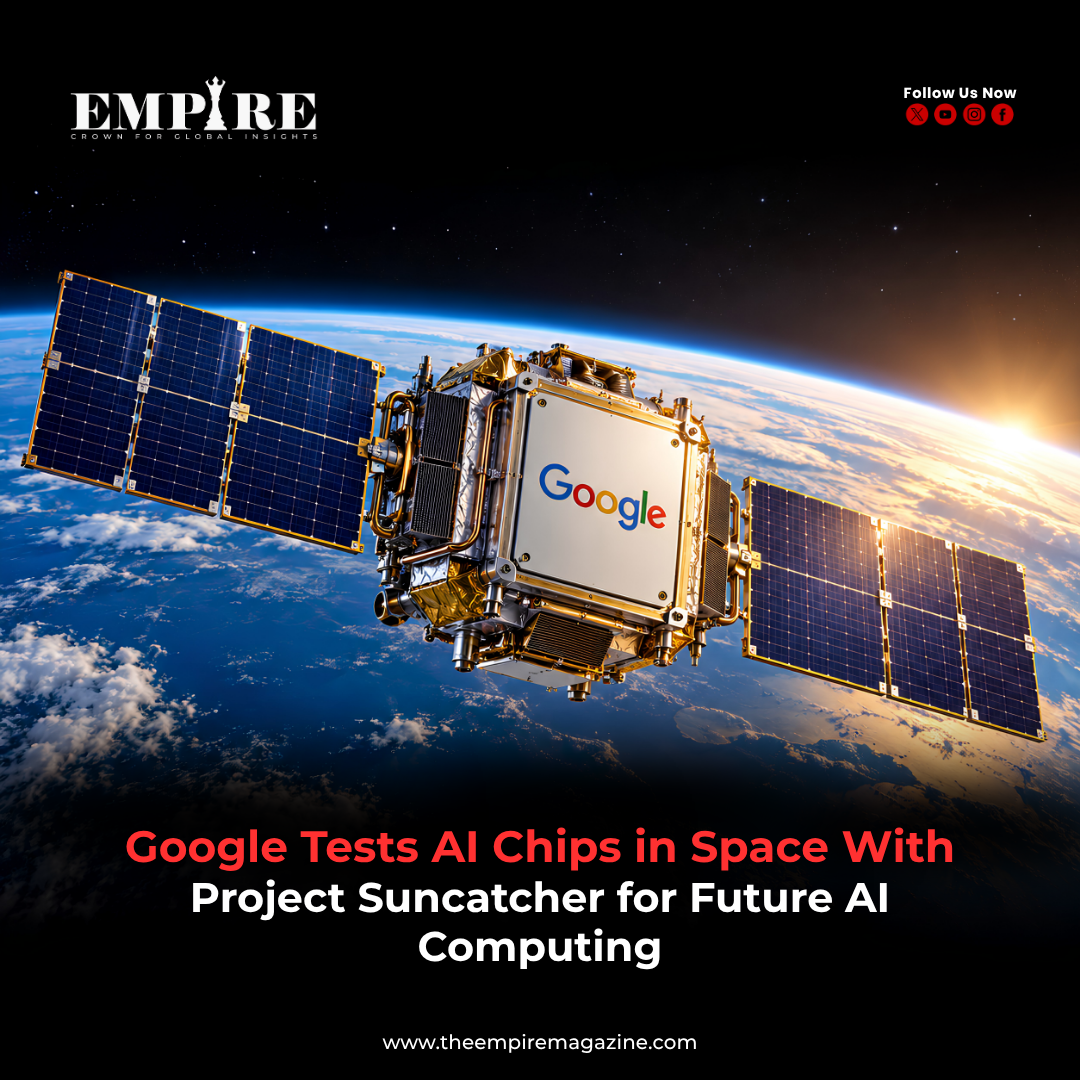
Google’s Project Suncatcher is preparing for its first orbital test of artificial intelligence hardware.
In a September 24, 2026 update, Google said a prototype satellite developed with Planet would carry its Tensor Processing Units, or TPUs, aboard SpaceX’s upcoming Transporter-18 mission.
Table of Contents
- What Is Project Suncatcher?
- Why Google Is Exploring Solar-Powered AI in Space
- What the First Hardware Tests Will Examine
- Why Cooling AI Chips in Space Is Difficult
- Connecting Satellites Into a Computing Network
- Planet Brings Experience With AI in Orbit
- Launch Costs Will Shape Commercial Feasibility
- What Comes Next for Project Suncatcher
What Is Project Suncatcher?
Google introduced Project Suncatcher in November 2025 as a research programme exploring whether interconnected, solar-powered satellites could support large-scale machine learning.
The proposed system brings computing hardware and its electricity supply together in orbit. Satellites would carry AI processors, collect solar energy and communicate with one another to handle workloads across a wider network.
Google describes this as a long-term research effort. Its initial announcement set out work on satellite design, communications and hardware testing, with prototype missions intended to build the evidence needed for future development.
TPUs are Google’s specialised AI accelerators. They support tasks including training models and running inference, the process through which a trained model generates an output.
Google already uses this processor family to power Gemini and services such as Search, Photos and Maps. Moving these capabilities into orbit introduces a different operating environment, where the surrounding spacecraft must provide power, temperature control and dependable communications.
Why Google Is Exploring Solar-Powered AI in Space
The attraction begins with access to sunlight. Google’s proposed architecture uses a dawn–dusk, sun-synchronous orbit, chosen to keep satellites exposed to the Sun for much of their journey around Earth.
The company estimates that, in a suitable orbit, solar panels can be up to eight times more productive than on the ground. Near-continuous generation could also reduce the amount of battery storage required.
This advantage depends on orbital conditions and system design. It describes the potential energy supply; the complete computing system must still deliver useful, reliable performance.
What the First Hardware Tests Will Examine
Google has already subjected the satellite to vibration testing along three axes to simulate launch conditions. The company says the hardware withstood those tests.
The orbital mission will extend that work by gathering information about how the equipment behaves during actual spaceflight.
Radiation testing has also produced encouraging results. Google’s research paper describes exposing Trillium TPUs to a proton beam at the University of California, Davis.
The tested hardware tolerated a cumulative radiation dose exceeding the researchers’ estimated requirement for a shielded five-year mission. However, particle strikes also caused errors, and the paper identifies further work on their effects during model training.
These findings support further experiments while leaving questions about sustained operation.
Why Cooling AI Chips in Space Is Difficult
Spacecraft cannot rely on the surrounding vacuum to carry heat away through airflow. NASA’s thermal-control guidance explains that heat moves through spacecraft materials by conduction and is exchanged with the external environment through radiation.
That makes the route from a hot chip to an external radiator a central design requirement. Engineers must move heat away from concentrated sources and provide enough surface area to release it.
Small satellites face particular constraints because their available surface area, mass and internal space are limited. Solar panels and thermal equipment must also fit within the overall spacecraft design.
Google is testing a combination of heat pipes and radiators. It has used a thermal vacuum chamber to simulate space conditions and plans to refine the design using orbital results.
Connecting Satellites Into a Computing Network
Processing a large AI workload across several spacecraft requires fast communication between them. Google’s technical analysis targets links capable of moving tens of terabits of data per second.
Its proposed approach uses optical connections between satellites flying close together. In a laboratory demonstration, the team achieved 800 gigabits per second in each direction using one transceiver pair.
That result establishes a laboratory benchmark. Maintaining comparable links between moving spacecraft introduces additional demands on positioning and control.
Google plans to launch two satellites in 2027 to test the high-bandwidth laser connections needed for future computing clusters.
Planet Brings Experience With AI in Orbit
The partnership also connects Suncatcher with work already underway on satellite-based processing.
Planet reported in June 2026 that its Pelican-4 spacecraft had used an onboard NVIDIA Jetson platform to identify objects shortly after capturing imagery. The demonstration processed images collected over Alice Springs, Australia, on March 25.
In the same update, Planet identified its Google partnership as part of its effort to expand the use of AI hardware in orbit.
The Pelican demonstration provides a practical example of onboard AI processing. Suncatcher’s broader research goal involves coordinating computing across connected satellites.
Launch Costs Will Shape Commercial Feasibility
Google’s research paper models a scenario in which launch prices could fall below US$200 per kilogram by the mid-2030s, assuming continued improvements in launch economics.
At that level, the researchers suggest that launch expenditure, spread over a spacecraft’s lifetime, could become comparable with terrestrial data-centre energy costs on a per-kilowatt basis.
The authors explicitly describe this as a partial analysis. It does not establish the full cost of a commercial orbital data centre, and the projected launch prices depend on future progress in reusable rockets and launch activity.
For businesses assessing the opportunity, the relevant measure will be the cost of dependable computing delivered over time. A favourable launch price would be one part of that calculation, alongside the expense of building and operating the system.
What Comes Next for Project Suncatcher
Project Suncatcher’s staged approach gives Google a way to test individual assumptions before attempting a larger system. The programme’s value will depend on how effectively prototype results improve subsequent designs.
The next useful evidence will concern successful operation: how consistently the processors run, how effectively heat is removed and how well spacecraft exchange data.
Together, those results should help establish which workloads are practical in orbit and what further engineering is required. For now, Google has outlined an ambitious direction and a sequence of experiments through which to investigate it.
Explore more global business, technology and innovation coverage in The Empire Magazine’s article archive.
Read our related business coverage: spacex-crew-14-nasa-iss-mission
Follow The Empire Magazine for global business, technology, innovation, and leadership insights:
Facebook: The Empire Magazine
Instagram: @the_empire_magazine
The Empire Magazine | Crown For Global Insights