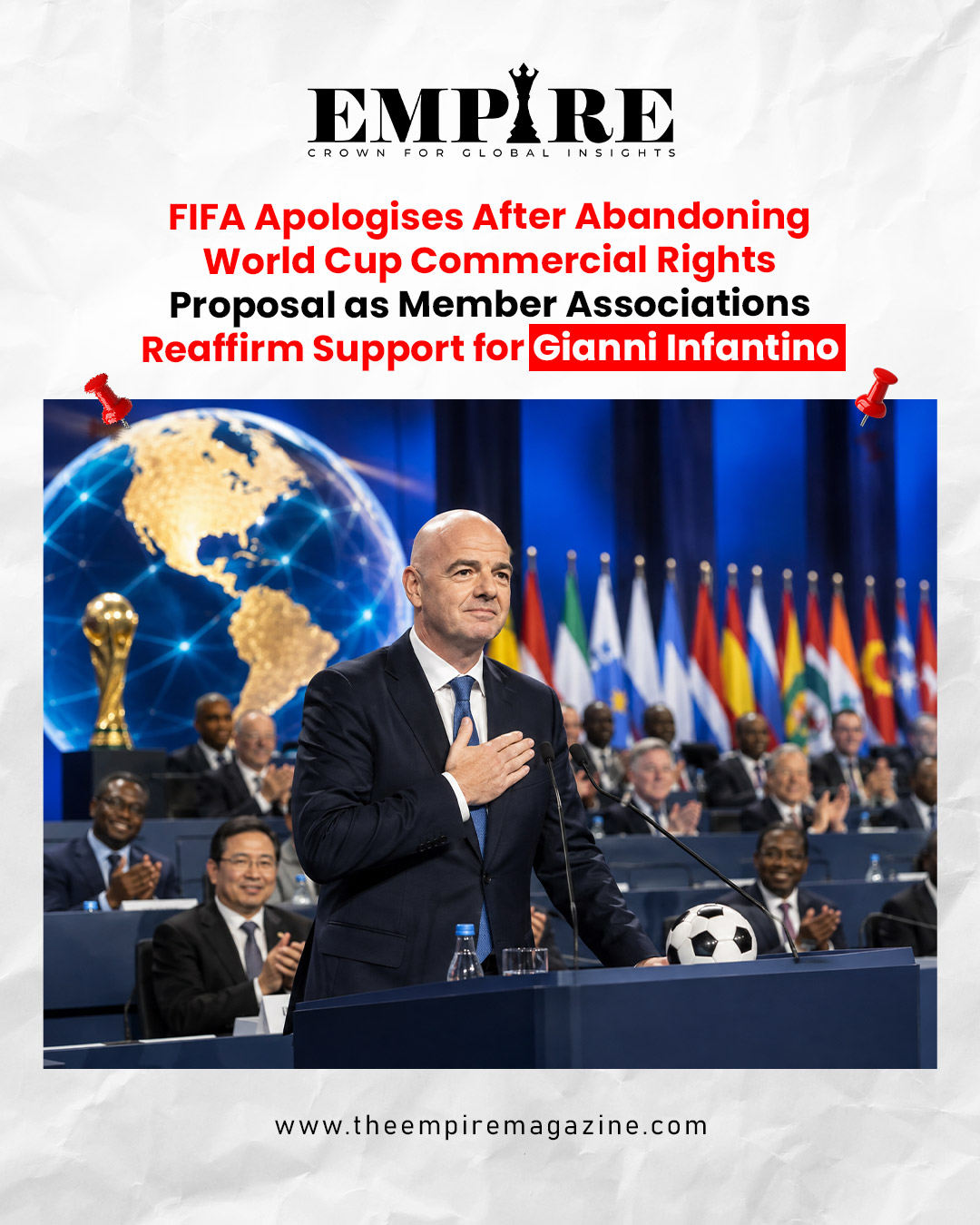
FIFA apologises after withdrawing its World Cup commercial rights proposal while member associations reaffirm support for Gianni Infantino amid governance concerns. FIFA apologises after abandoning its controversial World Cup commercial rights proposal following widespread criticism over governance and transparency. Despite the backlash, FIFA’s member associations have reaffirmed their support for President Gianni Infantino, signalling stability while the organisation pledges reforms and improved decision-making.
FIFA Apologises After World Cup Commercial Rights Proposal Collapse as Member Associations Reaffirm Support for Gianni Infantino
International football governing body FIFA has issued a formal apology following one of the most closely scrutinised governance controversies in recent years. The organisation acknowledged mistakes in the handling of its now-abandoned proposal to restructure the commercial rights of the FIFA World Cup through a new commercial entity, a move that triggered criticism from several football confederations and national associations. Although the proposal was eventually withdrawn, the crisis prompted emergency discussions among FIFA’s leadership and member associations in Morocco, where President Gianni Infantino received renewed backing despite mounting pressure over the governance process.
The episode has once again highlighted the delicate balance between commercial innovation and transparent governance in global sport. While FIFA remains the world’s most influential football organisation, the controversy has reinforced expectations that major strategic decisions involving the sport’s most valuable tournament must be accompanied by broader consultation, accountability, and institutional trust. As football prepares for another transformative decade, FIFA’s response to this controversy could prove just as significant as the proposal that sparked it.
FIFA Apologises After Commercial Rights Proposal Withdrawn
The controversy centred around FIFA’s proposal to create a new commercial entity responsible for managing a significant portion of the FIFA World Cup’s commercial rights. According to reports, the proposal involved selling approximately a 20% stake in the new venture, with the overall valuation estimated at around US$4.2 billion. The objective was reportedly to unlock additional commercial opportunities, attract strategic investment and strengthen FIFA’s long-term financial position. However, the proposal quickly encountered resistance from several continental confederations and national football associations, many of whom argued they had not been adequately consulted before discussions advanced. Critics questioned both the speed of the proposal and the lack of transparency surrounding its development, prompting FIFA to abandon the initiative before implementation. The organisation subsequently acknowledged shortcomings in its consultation process and formally apologised to its 211 member associations, recognising that communication should have been broader and more inclusive before presenting such a transformative commercial plan.
FIFA Apologises Amid Governance Questions
While FIFA’s apology addressed procedural shortcomings, the incident rapidly evolved into a broader conversation about governance within world football. Several influential football bodies expressed concern that decisions affecting the commercial future of the sport’s flagship tournament require greater institutional oversight rather than executive-led negotiations. Observers argued that football’s financial success depends not only on expanding revenues but also on maintaining confidence among stakeholders who collectively govern the global game. The criticism was therefore directed less at the concept of commercial growth and more at the decision-making process itself. Transparency, consultation and accountability have become increasingly important expectations within international sports governance, particularly as commercial values continue to rise. FIFA acknowledged these concerns during internal meetings, emphasising that future strategic proposals would undergo stronger consultation mechanisms designed to improve trust between the governing body and its member associations.
FIFA Apologises as Member Associations Back Gianni Infantino
Despite the controversy, FIFA’s leadership meeting in Rabat produced an important political outcome. Member associations and senior officials ultimately reaffirmed their support for FIFA President Gianni Infantino, signalling that while the handling of the proposal had drawn criticism, confidence in his broader leadership had not entirely disappeared. The statement of support was viewed as an attempt to restore institutional stability following days of intense speculation surrounding FIFA’s future direction. Infantino himself accepted responsibility for mistakes in the consultation process while maintaining that the objective behind the proposal had been to strengthen football’s long-term commercial sustainability. Although some national federations and political figures have questioned aspects of FIFA’s governance, no unified alternative leadership has emerged ahead of the organisation’s next presidential election. Consequently, Infantino continues to retain significant backing across multiple football confederations, particularly outside Europe, where support for ongoing development programmes remains strong.
FIFA Apologises While Football Protects Its Future
The debate surrounding the withdrawn proposal reflects a wider transformation taking place across international sport. Football has become one of the world’s largest commercial industries, with broadcasting, sponsorship, digital media and global partnerships generating billions of dollars in annual revenue. As competitions expand and audiences become increasingly international, governing bodies naturally seek innovative methods of financing future growth. However, football also remains a member-driven institution where national associations expect meaningful participation in decisions affecting the sport’s most prestigious competitions. The World Cup represents more than a commercial property; it is a global sporting institution built upon decades of competitive integrity and international cooperation. That reality explains why governance questions often receive as much attention as financial considerations. FIFA’s withdrawal of the proposal demonstrates that even the most powerful sporting organisations must carefully balance commercial ambition with democratic consultation if they wish to preserve institutional legitimacy.
FIFA Apologises and Faces Governance Reforms
Following the controversy, FIFA indicated that it would review its internal governance processes to ensure similar situations do not arise in the future. Governance experts have argued that stronger oversight mechanisms, greater transparency in commercial negotiations and earlier engagement with confederations could significantly improve confidence in future strategic initiatives. These recommendations align with broader trends across international sport, where accountability has become increasingly important to sponsors, broadcasters, governments and supporters alike. The organisation’s willingness to publicly acknowledge mistakes has been interpreted by some observers as an important first step toward rebuilding trust. Nevertheless, the effectiveness of any reforms will ultimately depend on whether FIFA demonstrates measurable improvements in consultation and decision-making over the coming years. As preparations continue for future World Cups, governance reforms may become just as important as sporting innovations in shaping FIFA’s global reputation.
FIFA Apologises but the Bigger Challenge Continues
Although the immediate controversy appears to have stabilised following the public apology and renewed backing for Gianni Infantino, FIFA continues to face a broader challenge that extends beyond one commercial proposal. Modern football operates in an environment where financial growth, technological innovation and global commercial partnerships are advancing at unprecedented speed. Every major decision is now scrutinised by governments, football associations, players, supporters and commercial stakeholders simultaneously. Consequently, governance standards expected of international sporting organisations have evolved significantly. FIFA’s ability to maintain confidence among its diverse membership will depend not only on delivering successful tournaments but also on ensuring transparency, accountability and collaborative decision-making remain central to its leadership philosophy. The commercial strength of the FIFA World Cup is unlikely to diminish, yet preserving the confidence of football’s global community may ultimately prove the organisation’s most valuable asset. By recognising procedural shortcomings and committing to governance improvements, FIFA has an opportunity to transform a difficult episode into a catalyst for institutional reform that strengthens the organisation for future generations.
FIFA’s decision to apologise after abandoning its World Cup commercial rights proposal represents more than a response to criticism
FIFA’s decision to apologise after abandoning its World Cup commercial rights proposal represents more than a response to criticism, it reflects the growing importance of transparency in modern sports governance. While the organisation faced significant scrutiny over the consultation process, the reaffirmation of support for Gianni Infantino has provided a degree of political stability during a challenging period. Looking ahead, FIFA’s credibility will depend less on commercial innovation alone and more on how effectively it combines financial ambition with inclusive governance. For the world’s governing body of football, maintaining trust among its member associations may prove every bit as important as growing the global game itself.
For more business and retail insights, read more on The Empire Magazine
Previous article: https://theempiremagazine.com/us-food-safety/
Magazine Feautures | Podcasts: Empire Global Talks
Follow The Empire Magazine on Facebook | Instagram | LinkedIn | YouTube
The Empire Magazine | Crown for Global Insights