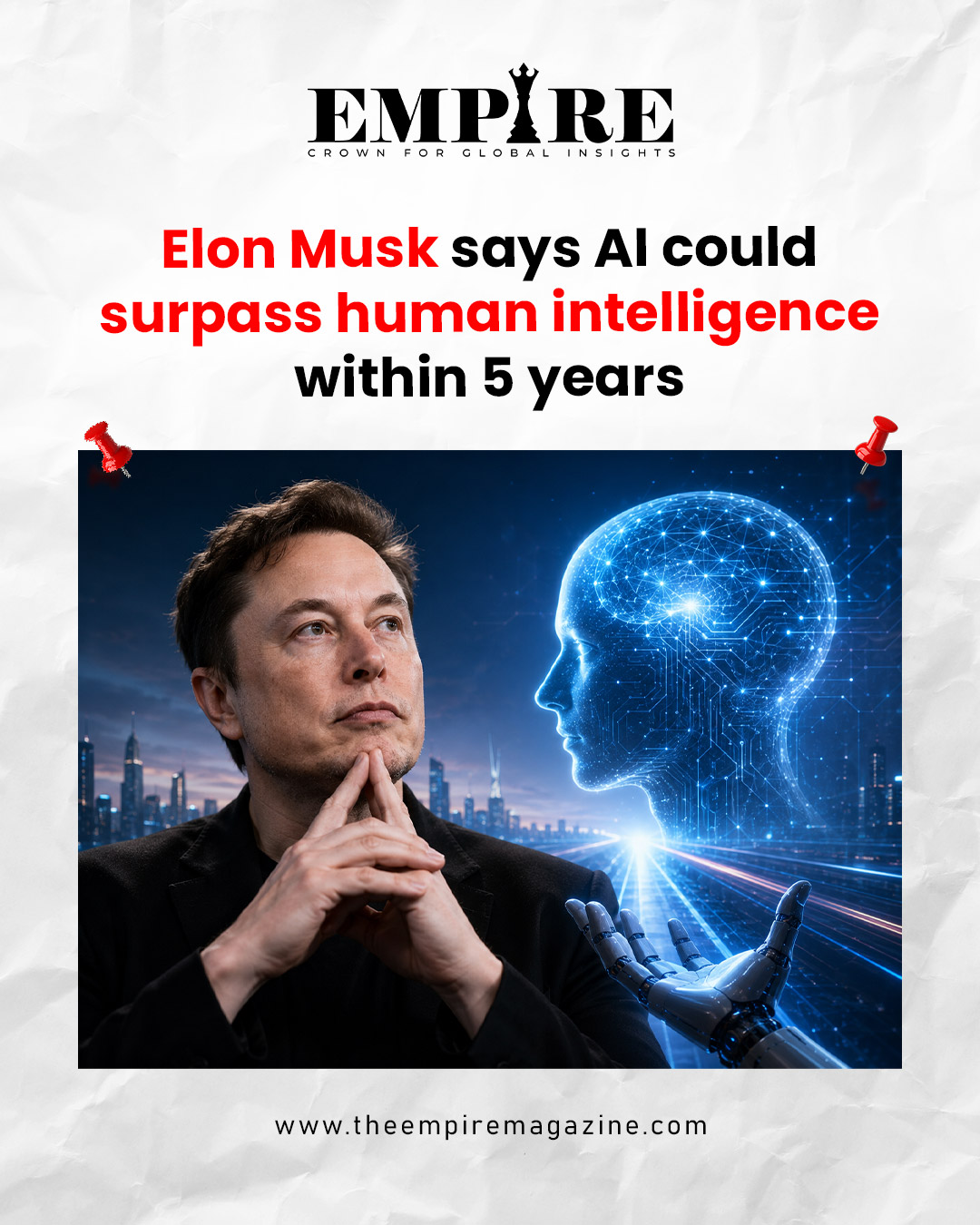
Elon Musk predicts AI could surpass human intelligence within five years. Explore the opportunities, risks, expert opinions, and what this means for businesses and society.
Elon Musk Says AI Could Surpass Human Intelligence Within 5 Years: What It Means for Humanity
Artificial Intelligence is no longer a technology of the future it is rapidly becoming the defining force of the present. Every week brings new breakthroughs, from AI-powered coding assistants and intelligent robots to advanced reasoning models capable of solving complex business and scientific challenges. Amid this extraordinary pace of innovation, one statement has once again captured global attention. Billionaire entrepreneur Elon Musk recently said that Artificial Intelligence could surpass human intelligence within the next five years, a prediction that has reignited debates among technology leaders, policymakers, researchers, and businesses worldwide.
Musk’s comments arrive at a time when AI adoption is accelerating across industries at an unprecedented pace. Companies are investing billions into developing more capable models, governments are introducing AI regulations, and educational institutions are redesigning learning around intelligent systems. While some experts believe Artificial General Intelligence (AGI) remains years away, others argue that the exponential growth of computing power, data availability, and model capabilities makes Musk’s timeline increasingly realistic. Whether one agrees with his prediction or not, the discussion raises important questions about the future of work, innovation, ethics, and humanity itself.
Elon Musk AI Prediction Sparks Global Debate
The latest Elon Musk AI prediction emerged during discussions about the future of Artificial Intelligence, where Musk suggested that AI systems may exceed human intelligence across most cognitive tasks within approximately five years. While Musk has previously warned about the risks associated with advanced AI, his recent remarks highlight how quickly the technology is progressing rather than presenting a distant possibility. His comments resonate because Musk is deeply involved in AI development through ventures such as xAI while simultaneously advocating for responsible AI governance. Around the world, technology leaders have responded with varying perspectives. Some researchers believe AI models are demonstrating reasoning, planning, and problem-solving abilities that were unimaginable only a few years ago, while others argue that current systems still lack true understanding, consciousness, creativity, and emotional intelligence. Nevertheless, the conversation itself reflects an undeniable reality: Artificial Intelligence is advancing faster than almost any previous technological revolution. Governments, enterprises, and investors are increasingly preparing for a future where AI becomes a foundational infrastructure comparable to electricity or the internet. Whether Musk’s five-year prediction proves accurate or slightly optimistic, the accelerating pace of AI innovation makes it a discussion that every business leader, policymaker, educator, and professional can no longer afford to ignore.
Elon Musk AI Reflects Rapid Technological Growth
The foundation behind the Elon Musk AI prediction lies in the extraordinary progress witnessed over the past few years. Large language models have evolved from generating simple text into sophisticated systems capable of coding software, conducting scientific analysis, interpreting medical images, generating videos, designing products, and assisting with legal and financial research. AI models continue improving through larger datasets, more efficient computing architectures, reinforcement learning, and multimodal capabilities that combine text, images, audio, and video into unified intelligence systems. Hardware manufacturers are simultaneously building increasingly powerful AI chips, enabling companies to train larger and more capable models in shorter timeframes. Cloud providers are investing hundreds of billions of dollars into AI infrastructure while startups continue attracting record-breaking funding to develop specialised AI solutions. This combination of computational power, algorithmic improvements, and massive financial investment creates a cycle of continuous acceleration. Unlike previous technological revolutions that required decades to mature, Artificial Intelligence is improving in months rather than years. This rapid evolution explains why many industry leaders now openly discuss Artificial General Intelligence as a realistic long-term objective instead of a purely theoretical concept. Musk’s prediction therefore reflects broader industry momentum rather than an isolated opinion, even as experts continue debating the exact timeline.
Elon Musk AI Could Transform Every Industry
If the Elon Musk AI prediction eventually becomes reality, the implications for industries worldwide would be transformational. Healthcare could witness AI systems diagnosing diseases earlier, discovering new medicines faster, and delivering personalised treatment plans based on genetic information. Manufacturing could become largely autonomous through intelligent robotics capable of adapting to changing production requirements without human intervention. Financial institutions may depend on AI for real-time fraud detection, investment analysis, compliance monitoring, and personalised customer services. Education could shift toward adaptive learning platforms that customise lessons according to each student’s pace, strengths, and weaknesses. Legal professionals may increasingly rely on AI for research, contract analysis, and regulatory compliance, allowing lawyers to focus on strategic advisory work rather than repetitive documentation. Creative industries are also evolving rapidly as AI generates images, music, videos, advertising campaigns, and marketing content within minutes. However, these advancements also raise concerns regarding employment displacement, workforce reskilling, intellectual property rights, and economic inequality. While AI may automate repetitive tasks, entirely new professions centred on AI governance, prompt engineering, model evaluation, cybersecurity, and AI ethics are simultaneously emerging. History suggests that technological revolutions rarely eliminate work altogether; instead, they fundamentally reshape the skills that future economies demand.
Elon Musk AI Raises Ethical and Safety Questions
Beyond technological progress, the Elon Musk AI conversation also centres on safety, ethics, and governance. Musk has repeatedly warned that highly capable AI systems require careful oversight to prevent unintended consequences. Leading AI researchers similarly advocate for responsible development frameworks that prioritise transparency, accountability, fairness, and human control. One major concern involves misinformation, where advanced AI could generate convincing but false content at unprecedented scale, influencing elections, financial markets, and public opinion. Cybersecurity experts also caution that increasingly intelligent AI could assist sophisticated cyberattacks if deployed irresponsibly. Privacy represents another growing challenge as AI systems process enormous volumes of personal and organisational data. International governments are therefore working to establish regulatory frameworks balancing innovation with public safety. The European Union’s AI Act, ongoing regulatory discussions in the United States, and emerging governance initiatives across Asia demonstrate growing recognition that Artificial Intelligence requires coordinated oversight. Businesses adopting AI must likewise establish ethical guidelines covering bias mitigation, explainability, data security, and responsible deployment. As AI capabilities continue expanding, public trust will depend not only on technological performance but also on how responsibly organisations develop and implement intelligent systems across society.
Elon Musk AI Could Redefine Human Potential
While much attention focuses on competition between humans and machines, the broader significance of the Elon Musk AI prediction may actually lie in collaboration rather than replacement. Throughout history, transformative technologies have expanded human capabilities instead of merely substituting human effort. Artificial Intelligence has the potential to become an intellectual partner that accelerates scientific discoveries, enhances education, supports healthcare professionals, improves accessibility for individuals with disabilities, and enables entrepreneurs to innovate more efficiently than ever before. The future may therefore depend less on whether AI surpasses human intelligence and more on how humanity chooses to integrate that intelligence responsibly. Businesses that embrace continuous learning, governments that encourage ethical innovation, and educational institutions that prepare future generations for AI-driven economies will likely gain significant competitive advantages. Musk’s prediction ultimately serves as a reminder that the age of Artificial Intelligence is no longer approaching it is already unfolding. The coming years will determine whether society successfully harnesses AI to solve humanity’s greatest challenges or struggles to keep pace with its rapid evolution. Regardless of the exact timeline, one reality is increasingly clear: Artificial Intelligence will shape the next chapter of civilisation, making informed leadership, responsible governance, and human-centred innovation more important than ever before.
Elon Musk AI prediction has reignited one of the most important technological conversations of our generation.
The Elon Musk AI prediction has reignited one of the most important technological conversations of our generation. While experts remain divided over whether Artificial Intelligence will truly surpass human intelligence within five years, there is broad agreement that AI capabilities are advancing at an extraordinary pace. From healthcare and finance to education and manufacturing, AI is already transforming industries and redefining how people work, learn, and innovate. The challenge ahead is not simply building more powerful AI but ensuring it is developed responsibly, ethically, and for the benefit of society. As governments, businesses, and researchers continue shaping the future of Artificial Intelligence, Musk’s forecast serves as both a warning and an opportunity encouraging the world to prepare for an era where human intelligence and machine intelligence increasingly evolve together.
Elon Musk AI Prediction Comes as Competition Intensifies
The timing of the Elon Musk AI prediction is particularly significant because the global AI race has entered an entirely new phase. Technology giants including OpenAI, Google, Anthropic, Meta, Microsoft, xAI, Amazon, and several emerging startups are investing billions of dollars into developing increasingly capable AI models. Every major breakthrough triggers another wave of innovation as companies compete to improve reasoning abilities, memory, multimodal understanding, coding performance, and autonomous decision-making. This fierce competition has dramatically shortened the innovation cycle, with new AI models being released every few months instead of every few years. As businesses rapidly integrate AI into their products and services, the technology is becoming a strategic advantage rather than just an operational tool. Musk’s statement reflects this unprecedented pace of development, suggesting that if current trends continue, AI capabilities may advance far beyond today’s expectations within the coming decade.
Elon Musk AI Is Reshaping the Global Workforce
One of the biggest implications of the Elon Musk AI prediction is its potential impact on employment and workforce transformation. Artificial Intelligence is already automating repetitive administrative tasks, assisting software developers, supporting customer service operations, generating marketing content, and analysing massive datasets within seconds. While concerns about job displacement remain valid, economists increasingly believe that AI will redefine jobs rather than eliminate them entirely. Employees who understand how to collaborate with AI tools are likely to become significantly more productive than those who resist technological change. Organisations are therefore investing heavily in AI literacy, employee upskilling, and digital transformation initiatives to prepare their workforce for an AI-driven economy. New careers in AI governance, prompt engineering, AI auditing, robotics management, cybersecurity, and machine learning operations are already emerging, highlighting how technological revolutions often create entirely new employment opportunities alongside disruption.
Elon Musk AI Pushes Governments Towards Faster Regulation
The rapid evolution highlighted by the Elon Musk AI discussion is also compelling governments around the world to accelerate AI policymaking. Regulators are increasingly recognising that AI influences critical sectors such as healthcare, banking, defence, education, transportation, and public administration. As a result, countries are working to establish legal frameworks that encourage innovation while protecting citizens from misuse, algorithmic bias, misinformation, privacy breaches, and cybersecurity threats. International cooperation is becoming equally important because AI technologies operate across borders and impact global economies simultaneously. Policymakers face the difficult challenge of creating regulations that remain flexible enough to support innovation while ensuring accountability for increasingly autonomous AI systems. The coming years are likely to witness stronger collaboration between governments, technology companies, academic researchers, and civil society organisations to develop globally accepted standards for responsible Artificial Intelligence development.
Elon Musk AI Highlights the Need for Human Leadership
Despite predictions that Artificial Intelligence could eventually outperform humans across many cognitive tasks, the Elon Musk AI debate also reinforces the continuing importance of human leadership. Strategic thinking, emotional intelligence, ethical judgement, empathy, creativity inspired by lived experiences, and cultural understanding remain uniquely human strengths that AI has yet to fully replicate. Business leaders increasingly recognise that successful AI adoption depends not only on advanced technology but also on visionary leadership capable of making responsible decisions about its implementation. Organisations that combine human expertise with AI-powered efficiency are likely to outperform those relying solely on automation. Rather than viewing Artificial Intelligence as a replacement for people, many experts believe its greatest value lies in augmenting human capabilities, enabling professionals to solve more complex problems, make faster decisions, and focus on innovation instead of repetitive work.
Elon Musk AI Signals a Defining Moment for Society
The Elon Musk AI prediction ultimately represents more than a technological forecast it symbolises a defining moment in human history. Every major technological revolution, from the Industrial Revolution to the rise of the internet, fundamentally changed economies, societies, and daily life. Artificial Intelligence now appears poised to become the next transformative force, influencing nearly every aspect of civilisation. The decisions made today regarding AI investment, regulation, education, ethics, and international collaboration will shape how future generations experience this technology. Whether AI surpasses human intelligence within five years or takes longer, the direction is clear: intelligent systems will continue becoming more capable, more accessible, and more deeply integrated into everyday life. Preparing for that future requires collaboration between innovators, governments, businesses, educators, and citizens to ensure that Artificial Intelligence remains a powerful tool for advancing humanity rather than creating new divisions or risks.
For more business and retail insights, read more on The Empire Magazine
Previous article: https://theempiremagazine.com/instagram/
Magazine Feautures | Podcasts: Empire Global Talks
Follow The Empire Magazine on Facebook | Instagram | LinkedIn | YouTube
The Empire Magazine | Crown for Global Insights