The Ukraine conflict intensifies as large-scale drone attacks target Moscow and critical Russian infrastructure. Explore the latest developments, global reactions, and what it means for the future of the war. Financial markets have also reacted cautiously to renewed military escalation. Investors closely monitor developments in the Ukraine conflict because prolonged instability has the potential to influence global energy prices, commodity markets, food security, and international supply chains. As geopolitical uncertainty grows, governments and businesses worldwide remain focused on the broader economic implications of Europe’s longest-running major armed conflict in decades
Ukraine Conflict Escalates as Massive Drone Attacks Near Moscow Raise Fears of Wider War
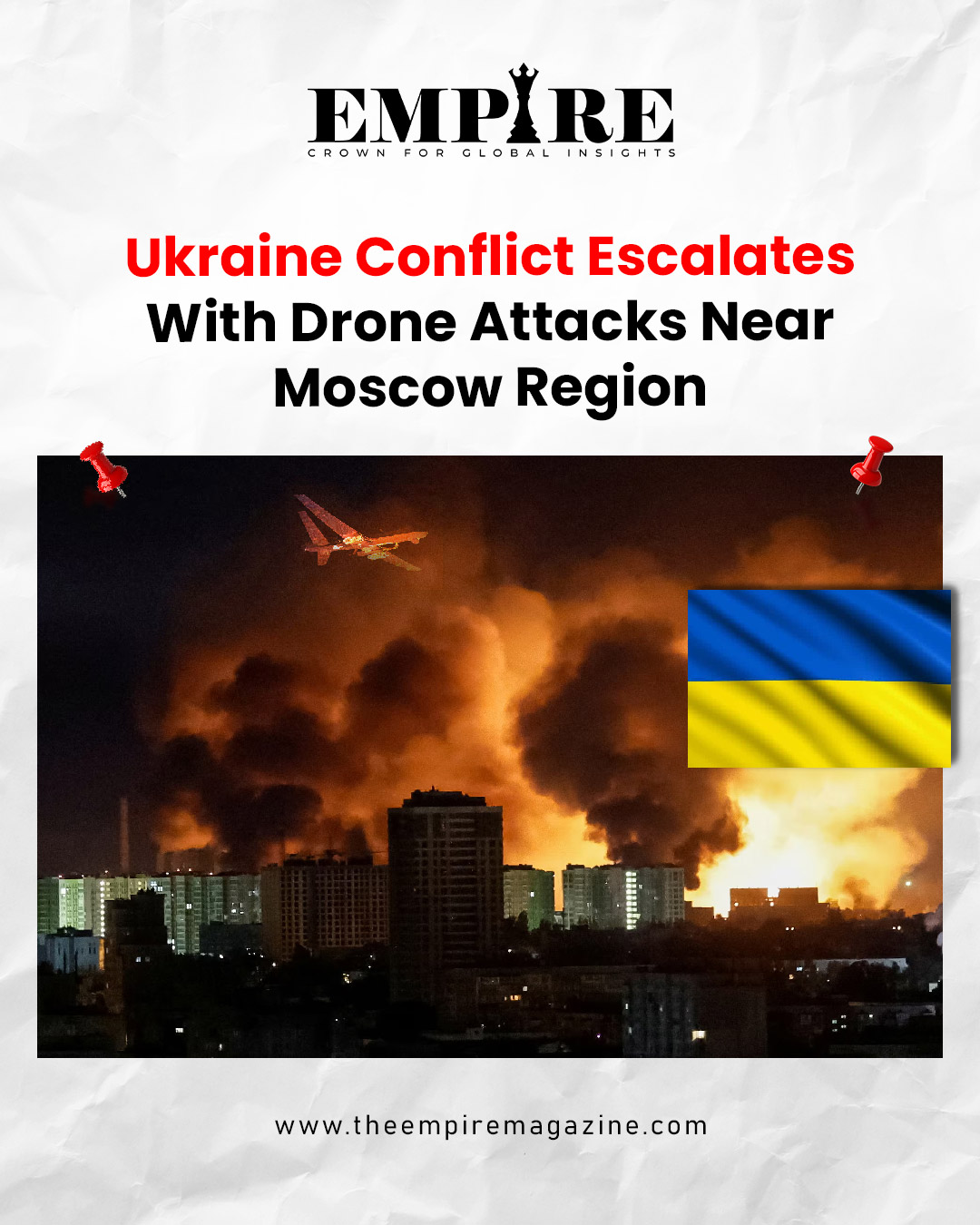
The Ukraine conflict has entered another dangerous phase as Ukraine launched one of its largest and most coordinated drone offensives against Russian territory, targeting areas around Moscow and key strategic infrastructure. The attacks, which disrupted flights, damaged energy facilities, and exposed vulnerabilities in Russia’s air defence systems, underscore how modern warfare is increasingly being shaped by long-range drones rather than conventional battlefield advances. Russian authorities reported intercepting hundreds of drones aimed at Moscow and surrounding regions, while Ukrainian officials maintained that their campaign is focused on degrading Russia’s military logistics and strategic capabilities rather than civilian targets. The escalation comes as Russia continues to launch extensive missile and drone strikes on Ukrainian cities, keeping civilians on both sides under constant threat.
The latest developments have renewed international concerns over the possibility of a broader regional escalation. With both countries investing heavily in drone technology and precision strikes, military analysts believe the conflict has entered a new operational stage where infrastructure, fuel supplies, transportation networks, and air defence systems have become primary targets. As diplomatic efforts continue to struggle, the growing intensity of these attacks raises critical questions about the future trajectory of Europe’s largest military conflict since World War II.
Ukraine Conflict Enters a New Era of Drone Warfare
The latest Ukraine conflict developments demonstrate how unmanned aerial vehicles have become one of the most decisive weapons in modern warfare. According to Russian officials, hundreds of Ukrainian drones were intercepted during overnight attacks directed toward Moscow and nearby regions, making it one of the largest drone offensives since the beginning of the full-scale invasion. While Russia claimed that most of the drones were successfully destroyed by its air defence systems, several attacks still caused disruptions to transportation, energy infrastructure, and commercial operations. Moscow’s major airports temporarily suspended flights, highlighting how even unsuccessful drone attacks can significantly impact civilian infrastructure and economic activity.
Military experts note that Ukraine’s strategy has shifted considerably over the past year. Instead of focusing solely on frontline combat, Kyiv has increasingly targeted oil refineries, logistics hubs, ammunition depots, railway connections, and military airfields located deep inside Russian territory. This approach is designed to weaken Russia’s ability to sustain prolonged military operations while forcing Moscow to divert valuable air defence resources away from the battlefield.
One of the primary objectives behind these operations appears to be psychological as well as strategic. By demonstrating that even the Russian capital is vulnerable to long-range drone attacks, Ukraine is attempting to challenge Moscow’s perception of domestic security. Analysts believe such operations also create political pressure within Russia, where repeated disruptions to airports, energy facilities, and transportation networks have become increasingly difficult to ignore.
Ukraine attacks highlighted the Drone technology
The attacks have also highlighted the rapid evolution of drone technology. Unlike conventional missiles, drones are significantly cheaper to manufacture, can be deployed in large swarms, and often overwhelm sophisticated air defence systems through sheer numbers. Defence analysts say this cost-effective approach is reshaping military doctrines worldwide, making drones a central component of both offensive and defensive operations.
At the same time, Russia has continued its own large-scale drone and missile strikes across Ukrainian cities, targeting residential areas, transport infrastructure, and energy facilities. The result is an increasingly dangerous cycle of retaliation, with neither side showing signs of reducing military pressure. The growing reliance on drone warfare illustrates how the Ukraine conflict is evolving beyond traditional frontlines into a technologically driven contest that affects civilian life far from the battlefield.
Russia Strengthens Air Defences as the Ukraine Conflict Intensifies
The latest wave of drone attacks has prompted Russia to significantly reinforce its air defence network around Moscow and other strategically important regions. While the Russian Ministry of Defence claimed that most incoming drones were intercepted before reaching their intended targets, the repeated attacks have exposed the growing challenge of defending an expansive territory against low-cost, long-range unmanned aerial vehicles. Military experts argue that even highly advanced air defence systems can become overstretched when confronted with large numbers of drones launched simultaneously from multiple directions. Reports of temporary airport closures, flight delays, and disruptions to transportation networks around Moscow further illustrate the operational impact of these attacks, even when interception rates remain high.
The Ukraine conflict has increasingly become a contest of endurance and technological adaptation. Russia has responded by deploying additional electronic warfare systems, strengthening radar coverage, and repositioning air defence batteries around major cities, military bases, and critical infrastructure. However, analysts suggest that protecting every potential target across Russia’s vast territory is virtually impossible. As Ukraine expands the range and sophistication of its domestically developed drones, Moscow faces the difficult task of balancing frontline military operations with homeland security.
Beyond physical damage, the drone campaign also has a psychological dimension. Repeated alerts, airport disruptions, and heightened security measures remind Russian citizens that the war is no longer confined to distant battlefields. Although the Kremlin continues to project confidence in its military capabilities, recurring attacks near the capital have challenged the perception that Russia’s interior remains insulated from the consequences of the war.
Ukraine, meanwhile, has consistently argued that its long-range strikes are aimed at military and logistical assets supporting Russia’s invasion rather than civilian populations. Ukrainian officials contend that targeting fuel depots, military airfields, command centres, and ammunition warehouses weakens Russia’s operational capacity while reducing pressure on Ukrainian forces defending the frontlines. This strategy reflects a broader shift in the Ukraine conflict, where precision strikes deep inside enemy territory are increasingly viewed as an essential component of modern warfare rather than exceptional operations.
Global Concerns Grow as the Ukraine Conflict Raises Fears of Wider Regional Escalation
The intensifying Ukraine conflict has once again drawn international attention, with governments across Europe and North America closely monitoring the implications of the latest drone offensive. While Ukraine continues to receive military and financial assistance from Western allies, many governments remain concerned that expanding attacks deeper into Russian territory could further complicate diplomatic efforts aimed at reducing hostilities. At the same time, Western leaders have reiterated that Russia’s continued missile and drone strikes against Ukrainian cities remain the principal driver of the ongoing escalation.
NATO officials have repeatedly emphasized that the alliance is not a direct participant in the war, yet member states continue to provide Ukraine with air defence systems, intelligence support, and military equipment to strengthen its ability to defend against Russian attacks. Several European countries have also accelerated investments in counter-drone technologies after observing how unmanned aerial systems have transformed the battlefield. Defence experts now describe the Ukraine conflict as one of the world’s most significant testing grounds for next-generation drone warfare, influencing military planning far beyond Eastern Europe.
The humanitarian consequences remain equally alarming. Millions of Ukrainians continue to face displacement, while repeated attacks on energy infrastructure have disrupted electricity, heating, healthcare, and transportation services. International organizations continue to warn that prolonged attacks on civilian infrastructure risk worsening humanitarian conditions, particularly during periods of extreme weather. On the Russian side, residents in regions experiencing drone incursions have also faced travel disruptions, emergency alerts, and growing uncertainty, demonstrating how the conflict increasingly affects civilians on both sides of the border.
Financial markets have also reacted cautiously to renewed military escalation. Investors closely monitor developments in the Ukraine conflict because prolonged instability has the potential to influence global energy prices, commodity markets, food security, and international supply chains. As geopolitical uncertainty grows, governments and businesses worldwide remain focused on the broader economic implications of Europe’s longest-running major armed conflict in decades.
What Lies Ahead for the Ukraine Conflict? Experts Warn of a Prolonged Drone War
As the Ukraine conflict continues to evolve, military experts believe drone warfare will remain at the center of battlefield strategy for both Russia and Ukraine. Unlike conventional missiles, long-range drones are comparatively inexpensive to manufacture, easier to deploy in large numbers, and capable of reaching strategic targets hundreds of kilometers from the frontline. Their increasing effectiveness has transformed the nature of the war, allowing both sides to strike energy facilities, logistics hubs, military airfields, and supply routes without committing large numbers of troops.
Recent attacks indicate that Ukraine is expanding its long-range strike campaign to weaken Russia’s logistics, fuel distribution, and military infrastructure. Russia, meanwhile, continues to launch extensive drone and missile barrages against Ukrainian cities and critical infrastructure, demonstrating that neither side is prepared to reduce military pressure. Defence analysts warn that this cycle of retaliation could further intensify if diplomatic negotiations fail to gain momentum. Recent assessments also indicate that Ukraine’s expanding drone capabilities are placing increasing pressure on Russian logistics and air defence systems, while Russia continues adapting its own strike tactics and drone production.
Beyond the battlefield, the conflict is reshaping global defence strategies. Countries across Europe, North America, and Asia are closely studying the operational use of drones, electronic warfare, and integrated air defence systems. Military planners increasingly view the Ukraine conflict as a defining case study in twenty-first-century warfare, influencing future defence procurement, technological innovation, and national security planning.
At the diplomatic level, international efforts to broker a ceasefire remain challenging. European leaders continue coordinating military assistance, sanctions, and air-defence support for Ukraine, while discussions on long-term security guarantees remain active. Despite these efforts, there is little indication that either Kyiv or Moscow is prepared to compromise on core strategic objectives, suggesting that the conflict could remain prolonged.
How modern warfare is increasingly defined by technology in Ukraine Conflict
The latest escalation in the Ukraine conflict highlights how modern warfare is increasingly defined by technology, precision strikes, and strategic disruption rather than conventional territorial advances alone. Large-scale drone attacks near Moscow and continued Russian missile and drone assaults across Ukraine demonstrate that the war has entered a new operational phase where critical infrastructure, logistics networks, and air defence systems have become primary targets.
While both Russia and Ukraine continue adapting their military strategies, civilians remain the most affected by the prolonged conflict. Damage to infrastructure, repeated air-raid alerts, displacement, and economic uncertainty continue to shape everyday life on both sides of the border. The international community remains focused on preventing a broader regional escalation while supporting diplomatic efforts that could eventually lead to a sustainable resolution.
For now, the Ukraine conflict remains one of the world’s most significant geopolitical crises. As drone technology continues to evolve and military operations expand beyond traditional frontlines, the decisions made in the coming months will influence not only the future of Ukraine and Russia but also the evolution of global security and modern warfare.
How the Ukraine Conflict Is Reshaping Global Security and Defence Policies
The Ukraine conflict is no longer viewed solely as a regional war between Russia and Ukraine. Instead, it has become a defining geopolitical event that is reshaping global security strategies, defence spending, and military modernization across Europe and beyond. NATO member states have significantly increased investments in advanced air defence systems, surveillance technologies, cyber resilience, and drone capabilities in response to the evolving battlefield. Governments are also reassessing national security doctrines, recognizing that unmanned aerial systems, electronic warfare, and artificial intelligence will play a far greater role in future conflicts. The lessons emerging from the Ukraine conflict are influencing defence procurement decisions worldwide, prompting countries to accelerate research into counter-drone technologies, missile interception systems, and autonomous military platforms. As geopolitical tensions continue, defence analysts believe the conflict will remain a key reference point for military planners and policymakers for years to come.
Economic Impact of the Ukraine Conflict on Global Markets
Beyond the battlefield, the Ukraine conflict continues to create significant ripple effects across the global economy. Ongoing military operations and uncertainty have influenced energy prices, agricultural exports, commodity markets, and international supply chains. Ukraine and Russia remain important exporters of grain, fertilizers, metals, and energy resources, meaning disruptions in the region can have worldwide consequences. Businesses, investors, and policymakers closely monitor developments in the Ukraine conflict because renewed escalation often increases market volatility and raises concerns over inflation and trade stability. The conflict has also accelerated Europe’s efforts to diversify energy sources, strengthen critical infrastructure, and reduce dependence on Russian energy supplies. As diplomatic negotiations remain uncertain, economists expect geopolitical risks associated with the Ukraine conflict to continue influencing global financial markets, investment decisions, and international trade throughout the coming months.
For more business and retail insights, read more on The Empire Magazine
Previous article: https://theempiremagazine.com/odyssey-ai/
Magazine Feautures | Podcasts: Empire Global Talks
Follow The Empire Magazine on Facebook | Instagram | LinkedIn | YouTube
The Empire Magazine | Crown for Global Insights