
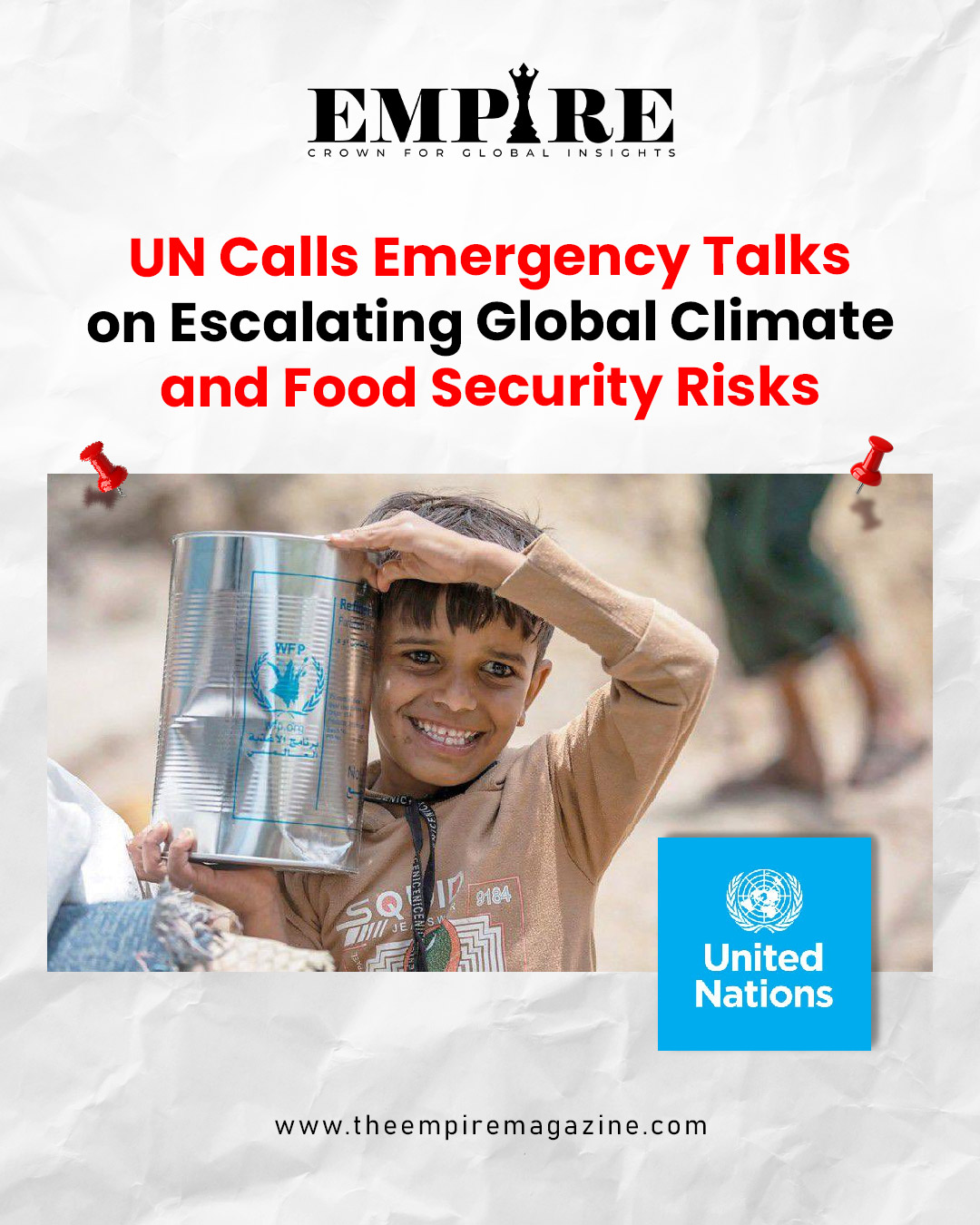
UN climate warning highlights rising food security risks as climate change, extreme heat, conflict, and hunger threaten millions worldwide. Read the latest analysis.
Climate change is no longer a future concern it is now one of the biggest threats to global food security. A series of fresh warnings from United Nations agencies, including the Food and Agriculture Organization (FAO) and the World Food Programme (WFP), paints a worrying picture of rising hunger, declining agricultural productivity, and growing pressure on food systems across continents. The latest reports reveal that millions of people are facing worsening food insecurity due to a combination of climate shocks, conflicts, economic instability, and shrinking humanitarian funding.
The UN Climate Warning: Rising Food Security Risks comes at a critical moment when extreme heat, prolonged droughts, floods, and the possible return of a strong El Niño event threaten crop production and livelihoods in some of the world’s most vulnerable regions. According to FAO and WFP, thirteen countries are now classified as global hunger hotspots, with several already facing catastrophic levels of food insecurity.
As governments prepare for future climate negotiations and food security discussions, experts warn that immediate international cooperation will determine whether the world can prevent a much larger humanitarian crisis.
UN Climate Warning Highlights Growing Risks to Global Food Security
The latest assessment by the FAO and WFP warns that acute food insecurity is expected to worsen significantly between June and November 2026. Countries including Sudan, South Sudan, Yemen, Palestine, Nigeria, and Somalia remain among the most vulnerable due to the combined impact of conflict and climate-related disasters.
According to the report, conflict continues to be the leading driver of hunger. However, climate change has become an equally dangerous multiplier. Repeated droughts, irregular rainfall, devastating floods, heatwaves, and changing weather patterns are reducing agricultural productivity while making food supplies increasingly unpredictable.
The UN also emphasizes that food insecurity today is no longer confined to low-income countries. Climate disruptions have affected global supply chains, increased transportation costs, reduced harvests, and contributed to food inflation worldwide. Nations that depend heavily on imported food are especially vulnerable when climate disasters affect major agricultural exporters.
The warning follows the publication of the FAO-WMO report on extreme heat, which identifies rising temperatures as one of the fastest-growing threats to agriculture. Heat stress damages crops, weakens livestock, reduces water availability, and lowers worker productivity in farming communities.
Researchers estimate that over 1.23 billion people whose livelihoods depend on agriculture face increasing risks as extreme heat becomes more frequent and intense. Unlike sudden disasters, prolonged heat gradually reduces yields across multiple growing seasons, making recovery much more difficult for farmers.
The United Nations argues that protecting global food systems now requires both immediate humanitarian action and long-term climate adaptation strategies.
Climate Change Is Reshaping Agriculture Across the World
Agriculture remains one of the sectors most directly exposed to climate change. Crops rely on predictable rainfall, moderate temperatures, and stable growing seasons. Unfortunately, these conditions are becoming increasingly rare.
The FAO-WMO report explains that rising temperatures are causing soils to dry faster, increasing evaporation rates and reducing water available for irrigation. Heatwaves also affect pollination, shorten crop growth cycles, and lower grain quality in staple crops such as wheat, maize, and rice. Livestock experience declining productivity due to heat stress, while fisheries are affected by warming oceans and marine heatwaves.
Adding to these concerns is the expected return of El Niño, which the World Meteorological Organization says has a high probability of developing during 2026. Historically, El Niño has caused severe droughts across parts of Asia, Southern Africa, and Australia, while triggering floods in parts of the Americas.
UN Secretary-General António Guterres has warned that El Niño could intensify existing climate extremes, further disrupting food production across vulnerable regions. Experts caution that higher global temperatures mean future El Niño events may have even greater impacts than previous cycles.
Climate experts stress that adaptation alone cannot eliminate these risks. While improved irrigation, drought-resistant crops, and early warning systems help communities prepare, reducing greenhouse gas emissions remains essential for protecting future food production.
Hunger Hotspots Face an Escalating Humanitarian Emergency
Beyond environmental challenges, the UN says multiple crises are overlapping in ways that dramatically increase food insecurity.
The latest Hunger Hotspots report identifies 13 countries where millions of people face worsening food shortages over the coming months. Sudan, South Sudan, Yemen, and Palestine remain at the highest level of concern, while Nigeria and Somalia have joined the most critical category due to deteriorating conditions.
Conflict destroys farmland, disrupts markets, limits humanitarian access, and forces millions from their homes. Climate disasters then compound these problems by damaging crops, reducing water supplies, and increasing food prices.
Economic instability further worsens the situation. Inflation, currency depreciation, and rising transportation costs make food unaffordable even where supplies remain available.
Humanitarian organizations are also struggling with reduced funding. The WFP has warned that global food assistance budgets remain under severe pressure, limiting the ability to provide emergency support in countries facing famine risks.
The UN emphasizes that acting early is significantly less expensive than responding after famine conditions emerge. Investments in emergency food assistance, agricultural recovery, and resilience programmes can prevent millions from slipping into catastrophic hunger.
Global Cooperation Is Critical to Prevent a Larger Crisis
The UN’s latest climate warning is ultimately a call for coordinated international action rather than isolated national responses.
FAO and WFP recommend expanding climate-smart agriculture, improving weather forecasting, strengthening early warning systems, protecting vulnerable farmers, and investing in resilient food supply chains. Countries are also encouraged to diversify crops, improve water management, and expand financial support for climate adaptation.
Climate finance will play an increasingly important role, particularly for developing nations that contribute relatively little to global emissions but experience some of the most severe climate impacts.
Experts also argue that stronger international cooperation is needed to stabilize food trade, reduce supply chain disruptions, and ensure humanitarian agencies receive adequate funding before crises escalate.
For consumers worldwide, the consequences extend beyond humanitarian concerns. Reduced agricultural production can increase global food prices, disrupt exports, and affect economic stability even in developed economies.
The UN maintains that protecting food security must become a central pillar of climate policy. As global temperatures continue to rise, the resilience of agriculture will increasingly determine economic stability, public health, and international security.
The UN Climate Warning: Rising Food Security Risks serves as a reminder that climate change is not only an environmental issue; it is a direct challenge to feeding the world’s growing population. The decisions governments make today on emissions reduction, climate adaptation, agricultural investment, and humanitarian cooperation will shape global food security for decades to come. Without urgent collective action, today’s climate warning could become tomorrow’s global food emergency.
Why the UN Climate Warning: Rising Food Security Risks Should Concern Every Nation
The latest UN Climate Warning: Rising Food Security Risks is not only directed at countries already experiencing famine or conflict but also at nations with relatively stable food systems. The interconnected nature of the global economy means that disruptions in one agricultural region can quickly affect food availability and prices across continents. When major grain-producing countries experience droughts or floods, international supply chains become strained, leading to higher costs for consumers and increased inflation.
According to the United Nations, climate change has evolved into a major threat multiplier that amplifies existing vulnerabilities. Rising temperatures, changing rainfall patterns, prolonged dry spells, and increasingly frequent extreme weather events are making agricultural production more uncertain than ever before. As food production declines in vulnerable regions, governments are forced to increase imports, placing additional pressure on international markets.
The UN Climate Warning: Rising Food Security Risks also highlights that climate-related disasters are becoming more frequent and more expensive. In recent years, farmers across Africa, Asia, Europe, and the Americas have faced crop failures due to record-breaking heatwaves, floods, hurricanes, and droughts. These weather extremes have reduced harvests of staple crops such as wheat, rice, maize, and soybeans, affecting both domestic consumption and global exports.
Food insecurity is increasingly becoming a national security concern as well. Countries facing severe shortages often experience migration, political instability, unemployment, and economic slowdown. The United Nations believes that investing in climate resilience today is significantly less costly than responding to humanitarian emergencies after they occur. Strengthening food systems through climate-smart agriculture, better irrigation, resilient infrastructure, and scientific innovation will be essential for ensuring long-term global food security.
UN Climate Warning: Rising Food Security Risks Calls for Immediate Global Climate Investment
One of the strongest messages emerging from the UN Climate Warning: Rising Food Security Risks is the urgent need for greater investment in climate adaptation and sustainable agriculture. While emergency humanitarian assistance remains essential for millions facing acute hunger, experts argue that long-term solutions require transforming global food systems to withstand future climate shocks.
The United Nations is encouraging governments to expand investments in drought-resistant crop varieties, precision farming technologies, water conservation projects, renewable energy for agriculture, and advanced weather forecasting systems. Digital technologies, satellite monitoring, and artificial intelligence are also playing a growing role in helping farmers predict weather changes, optimize irrigation, and improve crop management.
Another priority identified in the UN Climate Warning: Rising Food Security Risks is increasing financial support for developing countries. Many low-income nations contribute only a small share of global greenhouse gas emissions but suffer disproportionately from climate-related disasters. International climate finance, technology transfer, and stronger partnerships between developed and developing countries will therefore be crucial in reducing future food insecurity.
The warning also reinforces the importance of achieving the United Nations Sustainable Development Goals, particularly SDG 2 (Zero Hunger) and SDG 13 (Climate Action). Without coordinated international action, the world risks reversing decades of progress in reducing hunger and poverty. As climate impacts continue to intensify, governments, businesses, financial institutions, and international organizations will need to work together to build food systems that are resilient, sustainable, and capable of feeding a growing global population.
For more business and retail insights, read more on The Empire Magazine
Previous article: https://theempiremagazine.com/germany-coal-electricity/
Magazine Feautures | Podcasts: Empire Global Talks
Follow The Empire Magazine on Facebook | Instagram | LinkedIn | YouTube
The Empire Magazine | Crown for Global Insights