The aviation industry has entered one of the most important transitions in its history. While commercial aviation has connected economies, enabled global tourism, and accelerated international trade for decades, it has also become one of the world’s fastest-growing sources of transport-related carbon emissions. Governments, regulators, investors, and passengers now expect airlines to reduce their environmental footprint without compromising safety, reliability, or operational efficiency. That expectation has created a difficult question for the sector: how can aviation significantly cut emissions today when revolutionary technologies like electric aircraft remain years away from widespread commercial adoption?
For most industry experts, the answer is becoming increasingly clear. Sustainable Aviation Fuel (SAF) has emerged as the most practical pathway for reducing aviation emissions over the next two decades. Unlike experimental propulsion systems that require entirely new aircraft designs and airport infrastructure, SAF works with existing aircraft engines and fuel distribution networks. Airlines can reduce lifecycle greenhouse gas emissions while continuing to operate the fleets that already serve millions of passengers every day.
This practical advantage explains why airlines, aircraft manufacturers, airports, fuel producers, and governments are investing heavily in expanding SAF production. Major aviation companies increasingly view SAF not as a temporary solution but as the bridge that allows the industry to continue growing while cleaner propulsion technologies mature. Electric aviation may eventually transform regional travel, but for long-haul international flights—the backbone of global aviation, Sustainable Aviation Fuel is becoming the technology that matters most today.
Aviation’s Net-Zero Challenge Begins Today
Commercial aviation contributes roughly two to three percent of global carbon dioxide emissions, a relatively modest figure compared with some industries but one that continues to grow as passenger demand increases worldwide. Unlike road transport, aviation cannot easily switch to batteries because aircraft require enormous amounts of energy while keeping overall weight as low as possible. Current battery technology simply cannot deliver the energy density needed for long-distance commercial flights carrying hundreds of passengers.
This technological limitation means airlines cannot wait for electric aircraft to become commercially viable before addressing sustainability. Most modern passenger aircraft remain in service for 20 to 30 years, making fleet replacement an extremely gradual process. Even if electric commercial jets become technically feasible during the next decade, replacing thousands of aircraft across the global fleet would take many additional years.
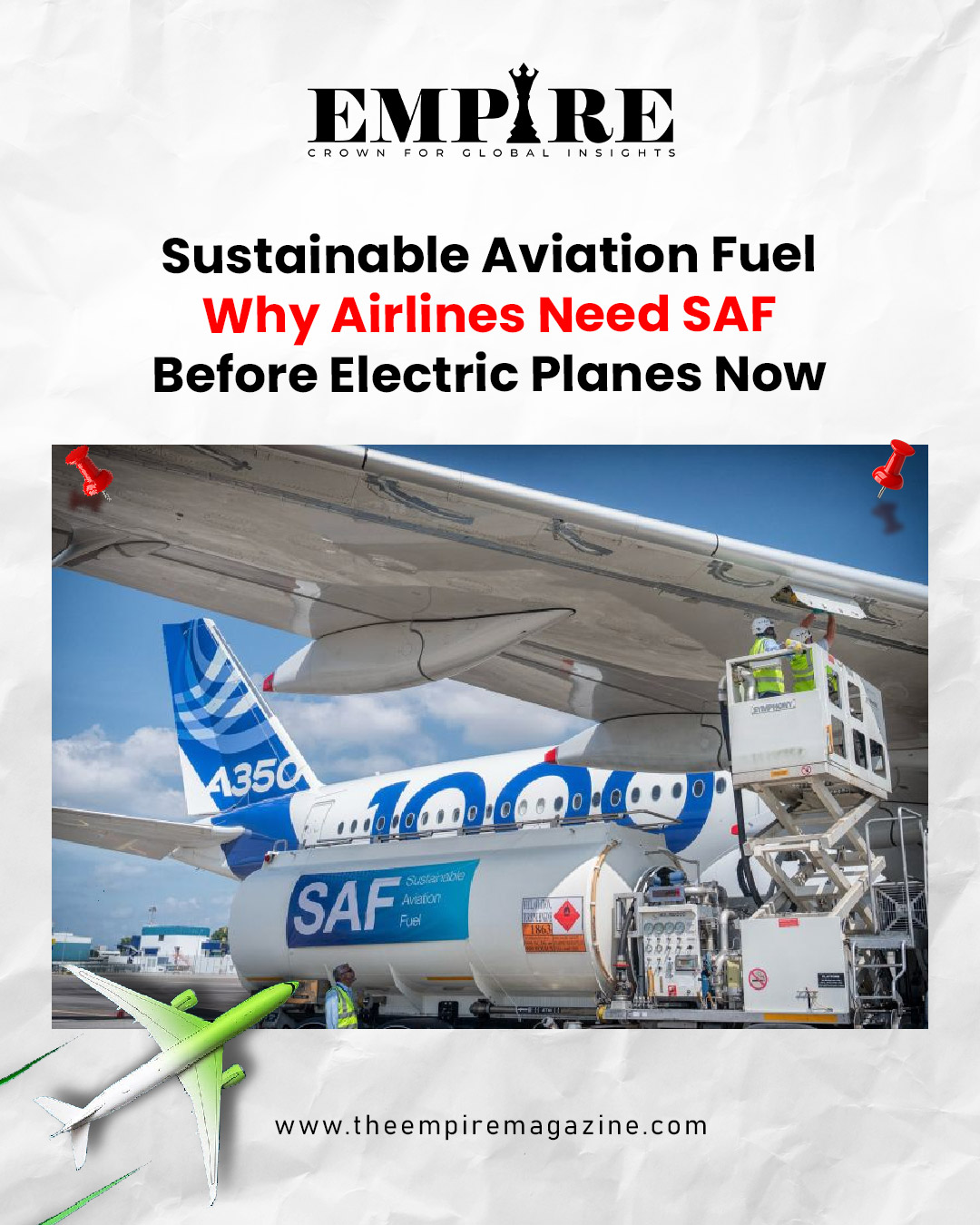
Sustainable Aviation Fuel offers a realistic solution because it can be blended with conventional jet fuel and used in existing engines without major modifications. Produced from renewable feedstocks such as used cooking oil, agricultural waste, municipal solid waste, and increasingly through synthetic processes using renewable electricity, SAF can significantly reduce lifecycle greenhouse gas emissions compared with traditional fossil-based jet fuel. This compatibility allows airlines to begin reducing emissions immediately rather than waiting for entirely new aircraft technologies to reach commercial maturity. For an industry under growing pressure to meet net-zero commitments by 2050, that immediate impact has become one of SAF’s greatest advantages.
Why Electric Aircraft Cannot Replace Commercial Jets Yet
Electric aviation continues to generate excitement across the aerospace industry, with numerous startups and established manufacturers developing battery-powered and hybrid-electric aircraft for regional routes. These innovations represent meaningful progress, particularly for short-distance travel involving fewer passengers and relatively limited flight times. However, the technological reality remains far more complex than public enthusiasm often suggests.
The greatest challenge lies in battery energy density. Jet fuel stores dramatically more usable energy per kilogram than today’s most advanced batteries. As aircraft become larger and flight distances increase, battery weight grows to impractical levels, reducing passenger capacity and operational efficiency. This makes purely electric propulsion unsuitable for medium- and long-haul commercial flights that connect continents and generate much of the aviation industry’s revenue.
Infrastructure presents another obstacle. Airports around the world would require extensive investments in charging systems, power distribution, maintenance facilities, and operational procedures before large-scale electric aviation becomes practical. Airlines would also need entirely new fleets designed around electric propulsion rather than conventional turbine engines. These investments represent decades of coordinated technological and financial transformation.
Because of these realities, industry leaders increasingly view electric aircraft and Sustainable Aviation Fuel as complementary rather than competing solutions. Electric propulsion may reshape regional aviation over time, while SAF provides the immediate emissions reductions necessary for today’s commercial fleets. Instead of waiting for a single breakthrough technology, airlines are adopting a portfolio approach that balances long-term innovation with practical decarbonization strategies already available.
Sustainable Aviation Fuel Is Becoming Aviation’s Practical Solution
The rapid growth of Sustainable Aviation Fuel reflects changing priorities across the global aviation ecosystem. Airlines are signing long-term purchasing agreements with fuel producers, aircraft manufacturers continue expanding SAF certification for higher blending ratios, and governments are introducing mandates designed to accelerate production. These developments are transforming SAF from a niche environmental initiative into an increasingly important component of commercial aviation strategy.
One of SAF’s greatest strengths is operational compatibility. Existing aircraft, airport infrastructure, storage facilities, pipelines, and fueling systems require minimal modification because SAF functions as a drop-in fuel. This dramatically lowers implementation barriers compared with alternative propulsion technologies and allows airlines to integrate sustainable fuel gradually as supply expands.
The environmental benefits extend beyond operational convenience. Depending on production methods and feedstocks, Sustainable Aviation Fuel can reduce lifecycle carbon emissions by up to 80 percent compared with conventional jet fuel. New generations of synthetic fuels produced using renewable electricity and captured carbon dioxide could deliver even greater reductions while reducing dependence on limited biological feedstocks.
Major airlines increasingly recognize that sustainability is also becoming a competitive advantage. Corporate customers now include aviation emissions within broader ESG commitments, while investors continue evaluating airlines based on long-term climate strategies. Demonstrating measurable progress toward emissions reduction has therefore become an important factor in maintaining market credibility, attracting environmentally conscious travelers, and strengthening relationships with institutional investors. SAF allows airlines to show tangible progress today rather than relying solely on future technological promises.
Production, Policy and Cost Remain the Biggest Challenges
Despite growing momentum, Sustainable Aviation Fuel still faces significant obstacles before it can become a mainstream aviation fuel. Global production currently represents only a small fraction of total jet fuel demand, creating intense competition for available supplies and keeping prices substantially higher than conventional aviation fuel.
Scaling production requires billions of dollars in new refining facilities, feedstock supply chains, renewable energy infrastructure, and advanced manufacturing technologies. At the same time, policymakers must balance incentives that encourage investment while ensuring sustainability standards remain rigorous enough to deliver meaningful environmental benefits. Not every alternative fuel automatically produces the same climate outcomes, making lifecycle emissions verification increasingly important.
Government policies are beginning to play a decisive role in accelerating adoption. Blending mandates, tax credits, production subsidies, and international carbon reduction frameworks are providing greater certainty for investors willing to finance new SAF production capacity. As manufacturing scales and technology improves, industry analysts expect production costs to gradually decline, making Sustainable Aviation Fuel increasingly competitive over the coming decade.
Collaboration across the aviation ecosystem will ultimately determine how quickly this transition occurs. Airlines alone cannot solve the challenge without fuel producers expanding supply, airports supporting distribution infrastructure, aircraft manufacturers continuing certification efforts, and governments maintaining long-term policy stability. Decarbonizing aviation is no longer the responsibility of a single industry segment, it has become a coordinated global effort.
The Future of Aviation Will Combine SAF With New Technologies
The future of sustainable aviation is unlikely to be defined by a single breakthrough. Instead, it will emerge through the combination of multiple technologies working together over several decades. Sustainable Aviation Fuel will reduce emissions from today’s aircraft, electric propulsion will reshape shorter routes where batteries become practical, hydrogen-powered aircraft may eventually transform selected segments of commercial aviation, and continuous improvements in aircraft design and operational efficiency will further reduce fuel consumption.
For now, however, the aviation industry cannot afford to wait for technologies that remain years from widespread commercial deployment. Climate commitments require measurable action today, and Sustainable Aviation Fuel offers the fastest, most practical path toward meaningful emissions reduction without disrupting global air travel.
As passenger demand continues rising and governments tighten environmental regulations, SAF is rapidly evolving from an alternative fuel into a strategic necessity. Airlines that invest early in sustainable fuel partnerships, long-term supply agreements, and decarbonization strategies will likely be better positioned for a future where environmental performance becomes as important as operational excellence.
Electric aircraft may eventually redefine aviation’s next era, but the industry’s journey toward lower-carbon flight has already begun. At this stage of aviation’s transformation, Sustainable Aviation Fuel is not simply filling the gap before electric planes arrive, it is providing the essential foundation upon which the future of cleaner global aviation is being built.
For more business and retail insights, read more on The Empire Magazine
Previous article: John Deere: Autonomous Farming
Magazine Feautures | Podcasts: Empire Global Talks
Follow The Empire Magazine on Facebook | Instagram | LinkedIn
The Empire Magazine | Crown for Global Insights