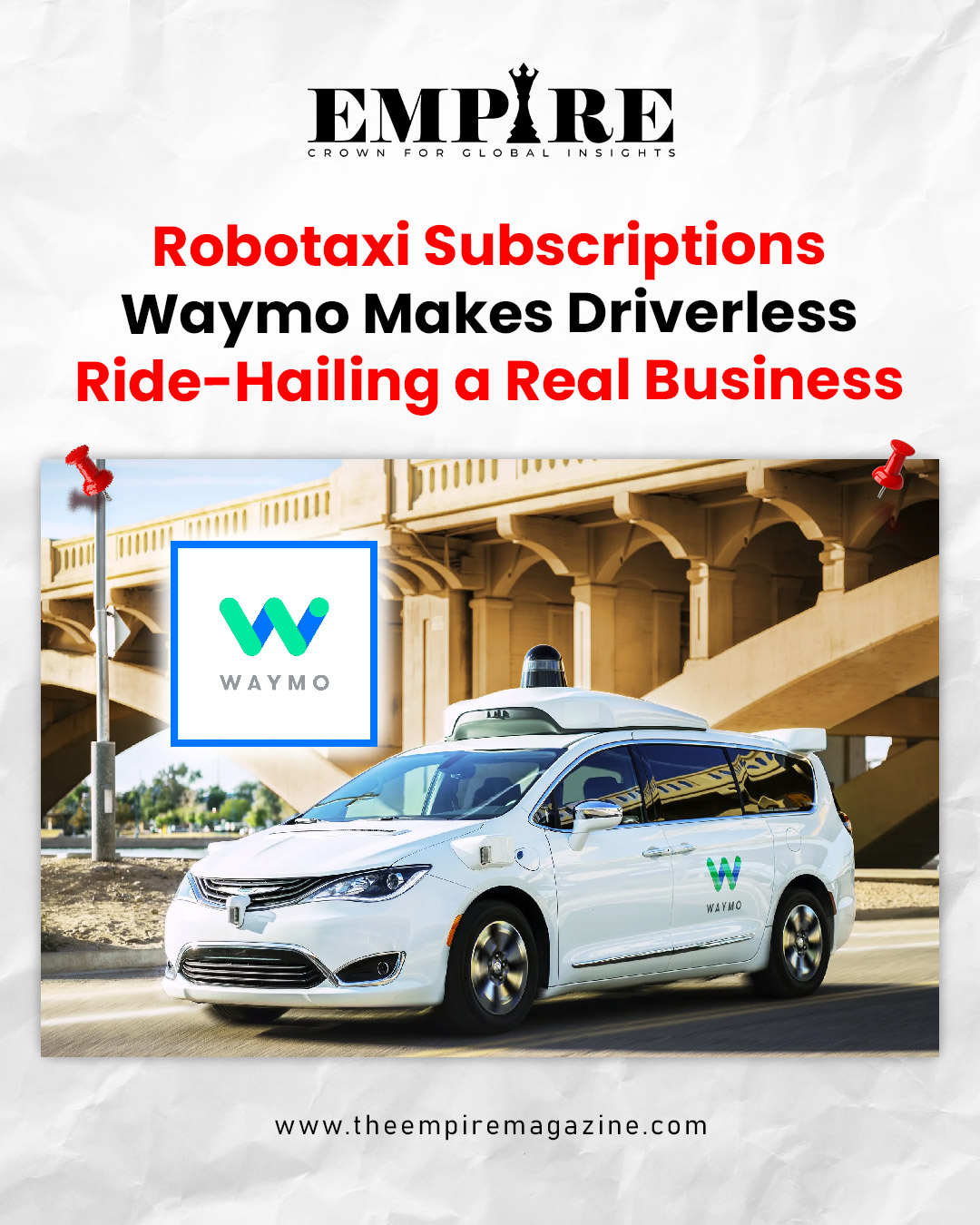
Robotaxi Move Beyond the Experiment Phase
For years, autonomous vehicles represented one of Silicon Valley’s most ambitious promises. Companies invested billions of dollars in artificial intelligence, sensors, mapping technology and advanced computing, hoping that self-driving cars would eventually redefine personal transportation. Yet despite impressive technological progress, turning that innovation into a profitable business proved far more difficult than developing the software itself.
Today, the conversation is beginning to change. Instead of asking whether autonomous vehicles can operate safely on public roads, investors and industry leaders are increasingly asking a different question: can robotaxis become a viable long-term business?
Few companies are closer to answering that question than Waymo. Backed by Alphabet, the autonomous driving company has gradually transformed from an experimental research project into one of the world’s largest commercial robotaxi operators. With fully driverless rides already available in multiple U.S. cities and expansion plans continuing, Waymo is no longer simply demonstrating technology, it is building an operating transportation network.
As urban mobility evolves, the company’s growing focus on subscriptions, recurring users and scalable ride-hailing services reflects a broader shift across the industry. Success may no longer depend solely on building the smartest autonomous vehicle. It may depend on creating a transportation service that people choose to use every day.
Why Autonomous Driving Alone Was Never Enough
Developing reliable self-driving technology has taken significantly longer than many early forecasts suggested. Unexpected road conditions, complex urban environments and strict regulatory oversight slowed commercialization across the industry.
Several competitors either scaled back ambitions or exited the autonomous vehicle race altogether after discovering that technical breakthroughs alone could not guarantee commercial success.
The challenge has always extended beyond engineering. Operating a transportation network requires continuous fleet maintenance, insurance, customer support, charging infrastructure, software updates and vehicle utilization rates that justify the enormous upfront investment. Unlike consumer technology products, autonomous vehicles generate value only when they remain on the road carrying passengers.
This reality has gradually shifted attention toward business models rather than technology demonstrations. Instead of measuring progress through miles driven autonomously, companies are increasingly focused on ride frequency, customer retention, operational efficiency and recurring revenue. That transition marks an important milestone for the autonomous mobility industry.
Waymo Is Expanding Its Commercial Footprint
Waymo’s strategy reflects years of measured deployment rather than rapid expansion. The company first introduced limited public ride-hailing services before progressively removing safety drivers as confidence in its autonomous driving system improved. Today, fully autonomous rides operate across large parts of cities including Phoenix, San Francisco, Los Angeles and Austin, with additional market expansion planned.
Unlike many technology launches that prioritize rapid scaling, Waymo has generally expanded city by city, carefully mapping operational zones and collecting enormous amounts of real-world driving data before increasing service availability. This measured approach has helped the company establish one of the largest collections of autonomous driving experience accumulated under commercial operations.
For customers, the experience increasingly resembles conventional ride-hailing. Requests are placed through a mobile application, arrival times are estimated digitally, and vehicles navigate passengers without a human driver behind the wheel.
Behind that seemingly simple experience lies a sophisticated combination of artificial intelligence, lidar sensors, radar systems, cameras, high-definition mapping and real-time decision-making software working simultaneously throughout every journey. More importantly, Waymo is beginning to demonstrate that autonomous transportation can operate at commercial scale rather than remaining confined to controlled pilot programs.
Why Subscription Models Could Become the Industry’s Next Growth Driver
Ride-hailing platforms have traditionally depended on individual trip payments. Every journey generates revenue independently, making customer loyalty important but difficult to predict.
Subscription models introduce a different economic dynamic. Instead of relying entirely on single rides, transportation companies can generate recurring monthly revenue while encouraging customers to make autonomous transportation part of their regular commuting habits. Although robotaxi subscriptions remain an evolving concept, industry analysts increasingly view recurring membership plans as a logical next step for autonomous mobility.
Such programs could include discounted fares for frequent riders, bundled airport transfers, commuter packages, priority vehicle access during peak hours or monthly travel credits.
This model offers advantages for both consumers and operators. Passengers receive greater pricing certainty, while service providers gain improved demand forecasting and steadier revenue streams. Predictable usage also allows companies to optimize fleet deployment more efficiently throughout the day.
For businesses managing expensive autonomous fleets, maximizing vehicle utilization remains essential. Every additional hour that a robotaxi spends transporting passengers instead of remaining idle contributes toward recovering significant hardware and operational costs. Subscription-based transportation therefore becomes more than a pricing strategy, it becomes an operational tool that helps improve the economics of autonomous mobility.
The Economics of Driverless Ride-Hailing Are Beginning to Shift
Removing the human driver changes one of the largest cost structures in ride-hailing. Traditional ride-sharing platforms allocate a substantial share of each fare to driver compensation. Autonomous fleets replace that recurring labour expense with technology investment, software maintenance, fleet management and infrastructure costs. Initially, autonomous vehicles require enormous capital expenditure.
Advanced sensor suites, powerful onboard computing systems and extensive validation testing make every vehicle significantly more expensive than conventional passenger cars. However, those costs can gradually decline as production scales and technology matures.
At the same time, vehicles operating almost continuously throughout the day create opportunities to improve overall asset utilization. Unlike privately owned cars, which often remain parked for most of the day, commercial robotaxis can potentially complete dozens of trips daily, increasing revenue generated from every vehicle in the fleet.
This operating model resembles airlines more than traditional automobile ownership. Profitability depends not only on the quality of the product but also on maximizing utilization, managing operating costs and maintaining customer demand.
Waymo’s growing commercial network suggests that the company is increasingly focused on refining these business fundamentals rather than simply proving that autonomous driving works.
Competition Is Intensifying Across the Autonomous Mobility Industry
Waymo may currently be the most visible commercial robotaxi operator in the United States, but it is far from the only company pursuing the autonomous mobility opportunity. The race has shifted from proving that self-driving technology works to determining who can build the most sustainable business around it.
Companies ranging from established automakers to technology firms continue to invest heavily in autonomous transportation. Some are developing proprietary software platforms, while others are partnering with ride-hailing companies to accelerate deployment. The market is also seeing increasing collaboration between vehicle manufacturers, AI developers and fleet operators, reflecting the complexity of bringing autonomous transportation to scale.
For Waymo, competition is no longer defined solely by the sophistication of its technology. The company must also demonstrate that it can expand into new cities efficiently, maintain high service reliability and create an experience that encourages repeat usage.
This is where subscriptions and customer loyalty could become increasingly important. If users begin treating robotaxis as a regular part of their daily commute rather than an occasional novelty, recurring revenue could provide operators with greater financial stability while strengthening customer relationships.
At the same time, pricing will remain a critical factor. Autonomous rides must eventually compete not only with traditional ride-hailing services but also with personal vehicle ownership, public transportation and emerging mobility solutions such as shared electric vehicles.
The companies that succeed are likely to be those that balance technological innovation with operational discipline, customer convenience and sustainable economics.
Public Trust Remains the Industry’s Biggest Challenge
Despite rapid technological progress, widespread adoption of autonomous vehicles still depends on public confidence.
Many first-time passengers approach a driverless ride with curiosity mixed with caution. Sitting inside a vehicle that navigates traffic without anyone behind the steering wheel remains an unfamiliar experience for much of the public.
Building trust requires far more than marketing campaigns. Every successful ride contributes to confidence in the technology, while every incident regardless of severity attracts significant public attention and regulatory scrutiny. Autonomous vehicle companies therefore operate under higher expectations than many other technology businesses.
Waymo has sought to address this challenge through gradual deployment, extensive real-world testing and continuous refinement of its autonomous driving system. Operating within carefully mapped service areas has allowed the company to collect valuable data while reducing exposure to unnecessary risk.
Transparency also plays an important role. Regulators, city authorities and the public increasingly expect autonomous vehicle companies to share safety information and demonstrate how their systems respond to complex driving scenarios. As the industry grows, maintaining public trust will remain just as important as advancing artificial intelligence.
Regulation Will Shape the Pace of Expansion
Unlike many digital businesses that can expand globally with relatively few physical constraints, autonomous transportation operates within highly regulated environments.
Every city presents a unique combination of traffic laws, infrastructure requirements, weather conditions and local government approvals. Companies must work closely with transportation authorities before launching commercial services, often adapting their operations to meet local requirements. This regulatory complexity partly explains why robotaxi expansion has progressed more gradually than many early industry forecasts predicted.
Cities also have legitimate concerns regarding traffic management, emergency response coordination, cybersecurity and liability. Policymakers are increasingly focused on ensuring that autonomous vehicles integrate safely into existing transportation systems without creating additional challenges for residents.
For operators like Waymo, regulatory engagement has become a core business function rather than an administrative requirement. Successful expansion depends not only on engineering capabilities but also on collaboration with local governments and public agencies.
As more jurisdictions establish clearer frameworks for autonomous mobility, companies with operational experience are likely to benefit from a stronger competitive position.
Subscriptions Could Redefine How Cities Think About Mobility
The emergence of subscription-based robotaxi services could influence transportation habits in ways that extend beyond ride-hailing. For decades, urban mobility has largely revolved around private vehicle ownership. Cars spend much of their time parked, yet owners continue to bear the costs of financing, insurance, maintenance and depreciation.
A reliable robotaxi subscription could offer an alternative for certain groups of consumers, particularly those living in densely populated cities where owning a vehicle is becoming increasingly expensive and less practical.
Rather than purchasing a car, some commuters may choose predictable monthly transportation plans that combine autonomous rides with public transit or other forms of shared mobility.
Businesses could also become significant customers. Companies managing employee travel may find subscription packages more efficient than maintaining dedicated vehicle fleets, while hotels, airports and corporate campuses could integrate autonomous transportation into broader mobility services.
Although such models are still developing, they reflect a broader shift from vehicle ownership toward transportation as an on-demand service. This evolution mirrors changes already seen in industries such as entertainment and software, where subscriptions have replaced one-time purchases with recurring customer relationships.
The Business of AI Is Moving Onto the Streets
Waymo’s progress illustrates a broader transformation taking place across the artificial intelligence industry.
For much of the past decade, AI companies focused on developing increasingly capable algorithms. Today, investors are placing greater emphasis on commercial applications that generate measurable business value.
Robotaxis represent one of the clearest examples of this shift. Here, artificial intelligence is not simply powering a digital assistant or automating office tasks, it is operating physical assets, coordinating transportation networks and delivering a real-world service to paying customers.
This combination of AI, robotics and mobility creates opportunities that extend well beyond passenger transportation. Autonomous delivery, logistics, public transit support and commercial fleet management could all benefit from similar technological foundations in the years ahead.
For Alphabet, Waymo also represents an important diversification strategy. While the company remains best known for search and digital advertising, autonomous mobility offers exposure to a potentially significant long-term market where software, infrastructure and transportation increasingly converge.
Whether robotaxis become a mainstream mode of transportation will depend on continued technological improvements, regulatory support and customer adoption. Yet the industry has already moved beyond the stage where autonomous driving is viewed solely as a research experiment.
It is becoming a commercial business with real customers, recurring operations and growing economic significance.
Waymo’s Journey
Waymo’s journey reflects the evolution of autonomous vehicles from ambitious engineering projects into commercially viable transportation services. The conversation is no longer centred solely on whether driverless cars can navigate city streets. Increasingly, it is about whether autonomous mobility can deliver a reliable, scalable and financially sustainable business.
Subscription models, expanding commercial fleets and improving operational efficiency suggest that the industry is entering a more mature phase. While significant challenges remain including regulation, infrastructure development and public acceptance the foundations of a new transportation economy are beginning to take shape.
The road ahead is unlikely to be defined by rapid disruption alone. Instead, progress will probably come through gradual expansion, consistent operational performance and business models that encourage long-term customer relationships.
If Waymo continues to execute on that strategy, it may not only shape the future of autonomous transportation but also demonstrate how artificial intelligence can move beyond software to become an everyday public utility.
For more business and retail insights, read more on The Empire Magazine
Previous article: AI Beauty Tech
Magazine Feautures | Podcasts: Empire Global Talks
Follow The Empire Magazine on Facebook | Instagram | LinkedIn
The Empire Magazine | Crown for Global Insights