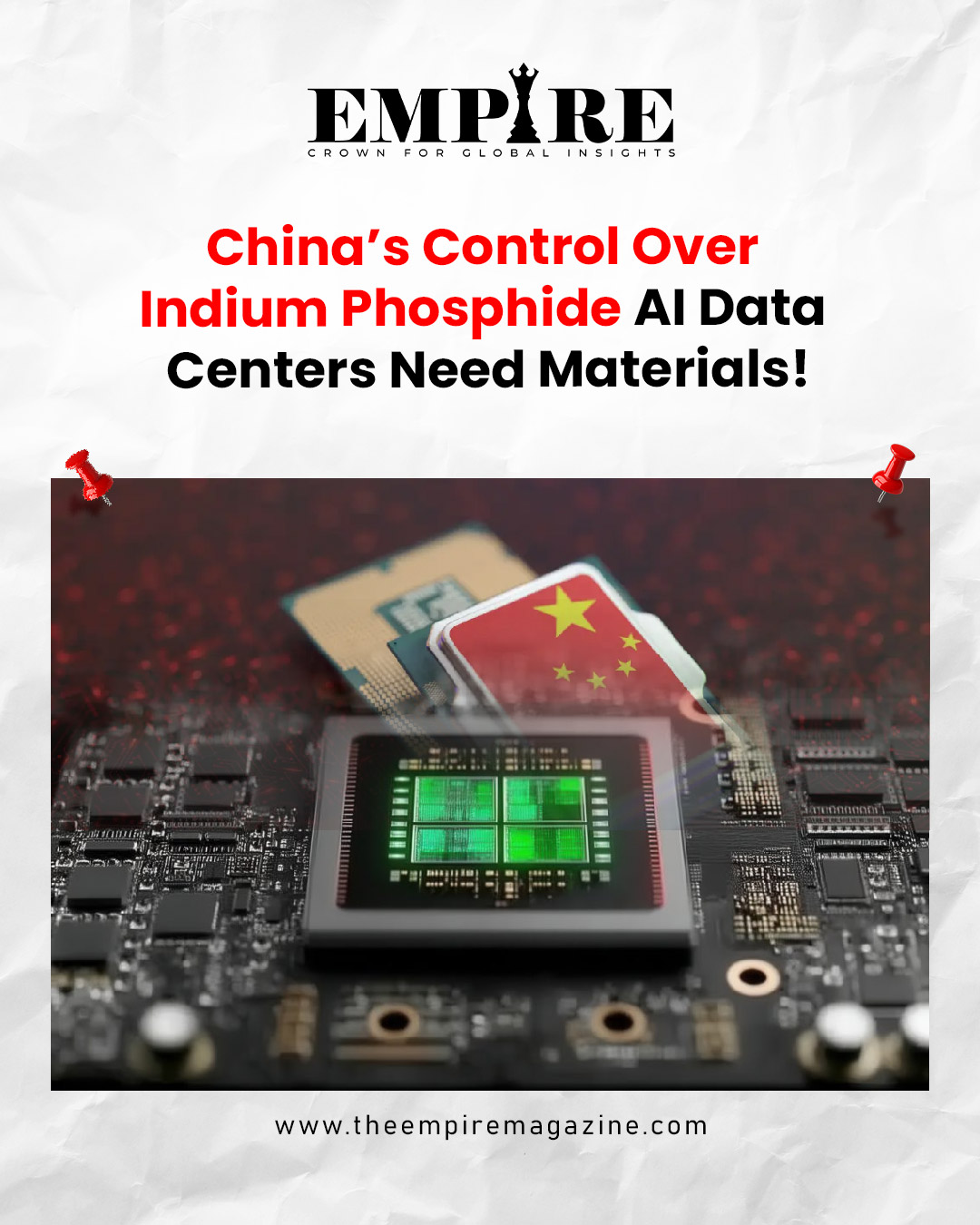
China’s Control Over Indium Phosphide has become a serious concern for the global AI infrastructure race. Artificial intelligence is often discussed through chips, software models, cloud platforms, and data centers, but the physical materials behind that infrastructure are just as important. One of those materials is indium phosphide, commonly known as InP.
Indium phosphide is a compound semiconductor made from indium and phosphorus. It is highly valuable in photonics, optical communication, high-speed data transmission, lasers, photodetectors, and advanced networking systems. These technologies are increasingly important because AI data centers need extremely fast and efficient communication between chips, servers, racks, and facilities.
AI infrastructure depends on more than graphics processors and cloud software. Large AI models require thousands of processors working together. These processors need to move huge amounts of data with low latency and low power consumption. Traditional copper connections face limits as speed and distance increase. Optical links, photonic chips, and transceivers help solve this problem by sending data through light.
This is why China’s control over indium phosphide matters. When one country holds strong influence over a critical upstream material, the entire technology supply chain becomes vulnerable. The issue is not only about one material. It is about how rare and specialized inputs can shape the future of AI data centers, cloud computing, and advanced semiconductors.
China’s Control Over Indium Phosphide and What InP Does
China’s Control Over Indium Phosphide matters because InP plays a special role in optical technology. Silicon is the foundation of modern computing, but silicon is not the best material for every optical function. Indium phosphide is especially useful because it can generate, detect, and modulate light efficiently.
This makes InP important for lasers and photonic integrated circuits. In data centers, optical components are used to move information at very high speeds. As AI models grow larger, data movement becomes one of the biggest bottlenecks. It is not enough to have powerful processors if they cannot communicate quickly.
Indium phosphide can support optical transceivers, high-speed lasers, photodetectors, and other components used in advanced networking. These parts help connect AI servers inside data centers and across cloud infrastructure.
China’s Control Over Indium Phosphide and Photonics
China’s Control Over Indium Phosphide is closely linked to the rise of photonics. Photonics uses light to transmit, process, and detect information. In AI data centers, photonics can help reduce energy consumption and improve bandwidth compared with some electrical connections.
This matters because AI data centers are becoming power-hungry. Training and running large AI models requires enormous computing capacity. The more data that moves between processors, the more important networking efficiency becomes.
Photonic chips and optical interconnects are not just optional upgrades. They are becoming strategic infrastructure. If AI companies cannot secure enough optical components, data-center expansion can slow. That makes InP supply a business and geopolitical issue.
China’s Control Over Indium Phosphide and Export Restrictions
China’s Control Over Indium Phosphide became more urgent after China tightened export controls on InP-related materials. These restrictions have raised concerns among chip suppliers, optical component makers, cloud infrastructure companies, and AI data-center operators.
Export controls do not always mean a full ban. They can require licenses, approvals, end-user checks, and government review. However, even licensing delays can create serious problems for industries that depend on precise production schedules and long-term supply planning.
AI infrastructure companies plan data-center builds months or years in advance. They need reliable supplies of chips, optics, networking gear, power equipment, cooling systems, and construction materials. If a critical input becomes uncertain, the entire project timeline can be affected.
China’s Control Over Indium Phosphide and Supply Chain Leverage
China’s Control Over Indium Phosphide gives Beijing supply chain leverage. Critical materials are increasingly being used as strategic tools in global trade tensions. Governments understand that control over minerals, wafers, substrates, and advanced materials can influence technology competition.
The United States has restricted China’s access to advanced AI chips and semiconductor manufacturing tools. China has responded in several areas by tightening controls on strategic materials. Indium phosphide fits into this wider pattern.
The important lesson is that technology leadership is not only about designing the best chip. It is also about securing the raw materials and specialized supply chains needed to manufacture and deploy technology at scale.
China’s Control Over Indium Phosphide and AI Data Centers
China’s Control Over Indium Phosphide affects AI data centers because modern AI workloads need massive bandwidth. AI training clusters often include thousands of GPUs or accelerators connected through high-speed networks. These systems must act almost like one giant computer.
When data moves slowly, processors wait. When processors wait, expensive AI hardware is underused. This reduces efficiency and increases cost. Optical networking helps reduce these bottlenecks by enabling faster and more efficient data movement.
Indium phosphide-based components are used in some of the optical systems that support these networks. If supply becomes limited, companies may face higher prices, longer lead times, or production delays for optical modules and photonic components.
China’s Control Over Indium Phosphide and AI Scaling
China’s Control Over Indium Phosphide matters because AI scaling depends on physical infrastructure. Many discussions about AI focus on models and applications, but the real challenge is building enough data-center capacity.
AI data centers need land, electricity, water or cooling systems, transformers, chips, networking equipment, storage, and optical communication. A shortage in any critical layer can slow growth.
InP is a small part of the overall infrastructure stack, but it can still become a bottleneck. This is common in advanced technology supply chains. A tiny component or rare material can delay a billion-dollar project if it is unavailable.
China’s Control Over Indium Phosphide and Indium Supply
China’s Control Over Indium Phosphide is stronger because China is a major producer of indium. Indium is not usually mined as a primary metal. It is mostly produced as a byproduct from zinc refining and other metal processing. This makes supply difficult to expand quickly.
When demand rises, producers cannot simply open a large indium mine in the same way they might expand some other commodities. Indium output depends partly on zinc production, refining capacity, recovery rates, and economics. This makes the supply chain less flexible.
The U.S. Geological Survey tracks indium as a mineral commodity because it is used in high-technology applications. Its uses include indium tin oxide for displays and touchscreens, solders, alloys, semiconductors, and other specialized applications.
China’s Control Over Indium Phosphide and Byproduct Risk
China’s Control Over Indium Phosphide highlights a major byproduct risk. When a critical material is produced as a byproduct, supply is not controlled only by demand for that material. It is also connected to the economics of the main metal.
If indium demand rises because of AI data centers, that does not automatically create enough new indium supply. Producers need the right feedstock, refining systems, and commercial incentives to recover more of the material.
This is one reason rare materials can become strategic. Their supply chains are narrow, technically complex, and slow to expand. Governments and companies must plan years ahead to reduce vulnerability.
China’s Control Over Indium Phosphide and Optical Chipmakers
China’s Control Over Indium Phosphide is especially important for optical chipmakers and component suppliers. Companies that manufacture lasers, photodetectors, optical modules, and photonic integrated circuits may rely on InP substrates or related materials.
These suppliers serve data-center customers, telecom networks, cloud platforms, and advanced computing companies. As AI demand grows, optical networking demand also grows. That puts more pressure on upstream material supply.
Some companies may try to diversify by sourcing from Japan, Europe, Taiwan, or domestic suppliers. Others may invest in recycling, alternative materials, or different photonic architectures. However, qualification in semiconductor and photonics supply chains can take time. Customers need reliability, consistency, and performance.
China’s Control Over Indium Phosphide and Production Delays
China’s Control Over Indium Phosphide can create production delays if export licenses are slow or uncertain. Semiconductor and photonics companies operate with carefully managed inventories and production schedules. A delay in substrates or materials can affect wafer production, component assembly, customer delivery, and data-center deployment.
Price increases are also possible when supply becomes tight. If buyers compete for limited InP supply, costs may rise. This can increase the price of optical components used in AI infrastructure.
For large cloud providers, higher prices may be manageable. For smaller suppliers and startups, material shortages can be more damaging. They may not have the purchasing power or inventory buffers that major companies have.
China’s Control Over Indium Phosphide and the Geopolitics of AI
China’s Control Over Indium Phosphide shows that AI is now part of geopolitics. The AI race is not only about which company builds the most powerful model. It is also about which countries control the materials, chips, energy systems, factories, and networks behind the technology.
The United States, China, Europe, Japan, South Korea, and Taiwan all play important roles in the AI hardware ecosystem. However, each country has different strengths. The U.S. leads in many AI chip designs and cloud platforms. Taiwan is central to advanced chip manufacturing. Japan has strengths in semiconductor materials and equipment. China has major control over several critical minerals and materials.
This creates interdependence but also risk. When trade tensions rise, supply chains can become strategic pressure points.
China’s Control Over Indium Phosphide and Technology Sovereignty
China’s Control Over Indium Phosphide is part of the larger debate around technology sovereignty. Countries want secure access to critical inputs for semiconductors, defense, clean energy, telecommunications, and artificial intelligence.
Technology sovereignty does not mean complete independence. Modern supply chains are too complex for one country to make everything alone. But it does mean reducing dangerous dependence on one supplier or one geopolitical rival.
For AI data centers, this means companies and governments may need stronger supply chain mapping. They must understand where optical materials, substrates, chips, modules, and networking components come from before shortages appear.
China’s Control Over Indium Phosphide and Data Center Energy Efficiency
China’s Control Over Indium Phosphide also matters for data-center energy efficiency. AI data centers consume large amounts of electricity. Every layer of the system must become more efficient, including processors, cooling, storage, and networking.
Optical communication can help reduce energy loss in data movement. As AI clusters grow, networking power becomes a larger issue. Moving data efficiently is critical because AI workloads involve constant communication between processors.
InP-based photonics can support high-speed, low-power optical systems. If supply becomes constrained, it may slow the rollout of more efficient optical networking equipment.
China’s Control Over Indium Phosphide and Bandwidth Demand
China’s Control Over Indium Phosphide is tied to rising bandwidth demand. Generative AI, cloud computing, streaming, enterprise software, robotics, and scientific computing all require more data movement.
AI training is especially bandwidth-intensive. Large models need many accelerators working together, and the network must handle constant communication. This makes optical bandwidth a key part of AI infrastructure.
As data centers move toward 800G, 1.6T, and future optical networking standards, demand for advanced optical components is expected to remain strong. InP supply concerns may therefore become more important, not less.
China’s Control Over Indium Phosphide and Alternatives
China’s Control Over Indium Phosphide is pushing companies to study alternatives. Silicon photonics is one important area. Silicon photonics uses semiconductor manufacturing techniques to integrate optical functions on silicon-based platforms. However, silicon does not naturally emit light efficiently, so InP or other compound semiconductors may still be needed for lasers and certain active optical functions.
Companies may also explore gallium arsenide, indium gallium arsenide, silicon nitride, lithium niobate, and other photonic platforms depending on the application. But replacing a material in advanced photonics is not simple. Performance, cost, yield, reliability, manufacturing tools, and customer qualification all matter.
Material substitution can take years. Even if an alternative exists technically, it may not be ready for high-volume AI data-center deployment.
China’s Control Over Indium Phosphide and Recycling
China’s Control Over Indium Phosphide may also increase interest in recycling and recovery. Indium is already recovered as part of certain industrial processes, but recycling from finished products can be difficult because the material is often used in small quantities.
Better recovery from manufacturing waste, used electronics, displays, and semiconductor processes could help supply over time. However, recycling alone may not solve near-term shortages if AI demand rises quickly.
Still, recycling can become part of a broader resilience strategy. Companies may need to combine recycling, supplier diversification, stockpiling, alternative materials, and long-term purchase agreements.
China’s Control Over Indium Phosphide and Corporate Strategy
China’s Control Over Indium Phosphide is forcing companies to rethink procurement strategy. In the past, some technology companies focused heavily on cost efficiency and just-in-time supply chains. Now, resilience is becoming just as important as cost.
AI infrastructure companies may need to secure multi-year supply agreements, qualify multiple suppliers, invest in domestic production, or support upstream material projects. Cloud providers may also need to work more closely with optical component suppliers to understand material risk.
This is a major shift. Big Tech companies are no longer only software businesses. They are becoming infrastructure companies that depend on energy, minerals, real estate, construction, and industrial supply chains.
China’s Control Over Indium Phosphide and Investor Attention
China’s Control Over Indium Phosphide may also draw investor attention to critical materials. Investors are already watching AI chips, data centers, power grids, and cloud infrastructure. Materials like indium phosphide show that the AI value chain goes even deeper.
Companies involved in photonics, compound semiconductors, optical modules, substrates, and rare material refining may become more strategically important. However, these sectors can be volatile because they depend on regulation, trade policy, customer demand, and production complexity.
Investors may increasingly ask technology companies how they manage critical material exposure. Supply chain transparency could become an important part of AI infrastructure strategy.
China’s Control Over Indium Phosphide and Future AI Infrastructure
China’s Control Over Indium Phosphide shows that the future of AI infrastructure will depend on rare materials as much as algorithms. AI data centers are physical systems. They require chips, optics, cables, power equipment, cooling systems, construction materials, and minerals.
Indium phosphide is important because it supports high-speed optical communication, which is becoming essential for AI-scale computing. If supply is restricted, expensive AI hardware may face networking bottlenecks or delayed deployment.
The lesson for the technology industry is clear. AI leadership requires secure supply chains from the mine and refinery to the wafer, module, server, and data center. Rare materials are no longer background inputs. They are strategic assets in the global AI race.
For more technology and business insights, read more on The Empire Magazine.
Follow The Empire Magazine on Facebook and Instagram.
– The Empire Magazine
Crown For Global Insights