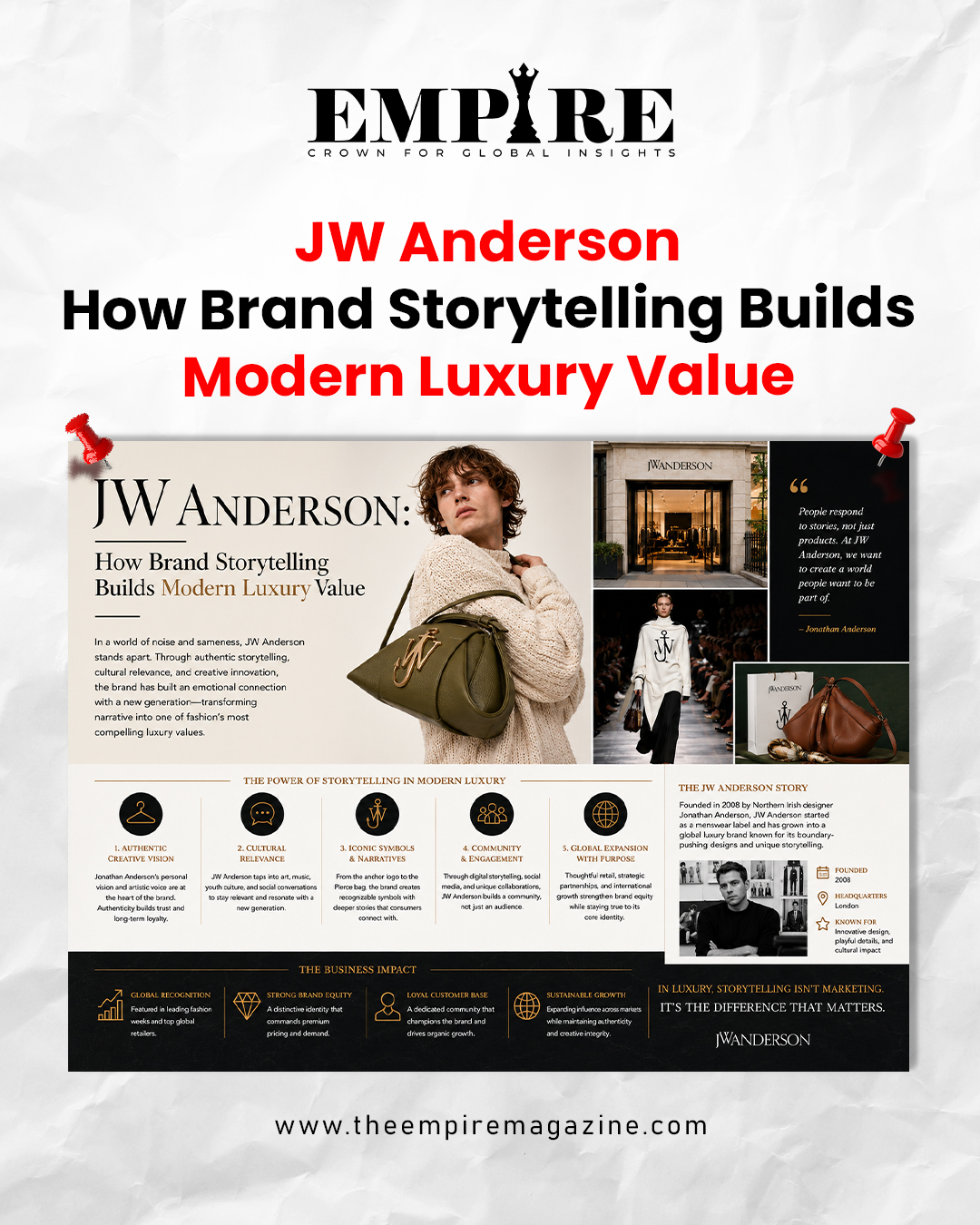
JW Anderson has become one of the most important modern fashion labels because it understands that luxury value is not built only through price, product, or heritage. It is also built through storytelling. Founded by Northern Irish designer Jonathan Anderson in London in 2008, the brand has grown from an experimental menswear label into a globally recognized name known for creativity, craft, cultural references, and modern luxury identity.
JW Anderson’s success comes from its ability to turn clothing, accessories, collaborations, and campaigns into stories that feel distinctive. The brand does not only sell fashion pieces. It creates a world where British craft, Irish identity, gender-fluid design, art references, humour, and youth culture all become part of the brand language.
In today’s luxury market, storytelling matters more than ever. Consumers are not only looking for expensive products. They are looking for meaning, emotion, identity, and cultural connection. JW Anderson shows how a designer-led brand can create modern luxury value by making every product feel connected to a larger creative idea.
JW Anderson and the Power of Brand Storytelling
JW Anderson began as a menswear brand in 2008 before expanding into womenswear in 2010. From the beginning, the label was known for challenging traditional fashion categories. Jonathan Anderson’s work often explored the relationship between masculinity and femininity, structure and softness, classic craft and contemporary culture.
This storytelling approach helped the brand stand out in a crowded luxury market. Instead of depending only on traditional glamour, JW Anderson built its value through creative tension. Its collections often feel intellectual, playful, and emotionally layered.
The brand became known for designs that made people talk. A sweater, a bag, a shoe, or a runway look could become more than a product. It could become a cultural object. This is one reason JW Anderson has been able to build strong recognition even while remaining more niche than giant luxury houses.
Why Modern Luxury Needs Storytelling
Modern luxury has changed. In the past, luxury value was often defined by old heritage, rare materials, and exclusivity. These factors still matter, but younger shoppers also want brands that feel culturally alive. They want a reason to connect with a label beyond the logo.
JW Anderson understands this shift. Its storytelling is not built around one fixed message. Instead, the brand creates value through creativity, curiosity, and surprise. It can move from minimal tailoring to humorous accessories, from craft-led collections to high-street collaborations, while still feeling consistent.
Storytelling also helps a brand build emotional memory. A customer may forget a simple product description, but they remember a strong idea. They remember the viral cardigan, the pigeon-shaped clutch, the frog-inspired shoes, or the unexpected collaboration. These objects create conversation, and conversation creates brand value.
Product as a Cultural Message
One of JW Anderson’s strengths is turning products into cultural messages. The brand’s accessories often become talking points because they carry humour, personality, or unusual design references.
The pigeon clutch is a strong example. Instead of presenting luxury as serious and distant, JW Anderson used an everyday city bird as the basis for a handbag. The result was playful, strange, and memorable. It showed that luxury could be creative and witty while still being desirable.
This type of product storytelling helps the brand stand apart from more traditional luxury labels. It also gives customers something to share, discuss, and remember. In the social media age, this matters because visual identity and cultural conversation can increase brand visibility very quickly.
The Role of Jonathan Anderson
Jonathan Anderson is central to the JW Anderson story. His personal creative identity gives the brand a strong designer-led voice. He has built a reputation for combining art, craft, fashion history, and popular culture in ways that feel fresh.
His work at Loewe also strengthened his global reputation. After LVMH took a minority stake in JW Anderson in 2013, Anderson became creative director of Loewe. During his time there, Loewe became one of the most influential luxury fashion houses, known for craft, leather goods, art partnerships, and highly desirable accessories.
This success helped reinforce the value of JW Anderson. When a designer becomes respected across both an independent label and a major luxury house, the name gains authority. Anderson’s move to Dior in 2025 further showed his importance in the luxury industry.
Designer Identity and Brand Trust
In luxury fashion, a strong designer identity can build trust. Customers may follow a designer because they believe in the vision, not only because they want one product. JW Anderson benefits from this because Jonathan Anderson’s creative approach is recognizable.
His storytelling is not random. It often comes from craft, cultural memory, art objects, British and Irish references, and a strong understanding of fashion history. This gives the brand depth.
Luxury shoppers often look for products that feel special and thoughtful. A strong creative director can make a brand feel more personal and more meaningful. JW Anderson uses this advantage well by keeping the designer’s voice close to the brand identity.
Collaboration as a Storytelling Strategy
JW Anderson has also built value through collaborations. The brand’s long-running partnership with Uniqlo is one of the clearest examples. The Uniqlo and JW Anderson collaboration brings Jonathan Anderson’s design language to a wider audience through accessible fashion.
This strategy works because it does not weaken the luxury brand. Instead, it expands its cultural reach. Many consumers who cannot buy high-end JW Anderson runway pieces can still experience part of the brand through Uniqlo.
Collaborations also help tell a broader story. JW Anderson’s work with Uniqlo often reflects British classics, everyday dressing, knitwear, outerwear, and casual style. It shows that good design can move between luxury and everyday life.
For a modern luxury brand, this is powerful. Exclusivity still matters, but cultural reach also matters. JW Anderson has shown that a brand can remain creative while speaking to both luxury consumers and a wider global audience.
Viral Moments and Digital Luxury Value
Modern luxury is shaped by digital culture. A product can gain value when it becomes part of an online conversation. JW Anderson has benefited from this through several viral fashion moments.
One of the most famous examples is the JW Anderson patchwork cardigan worn by Harry Styles. The cardigan became widely shared online and inspired many people to recreate it. The Victoria and Albert Museum later acquired the cardigan, showing how a fashion item could move from celebrity style to digital culture and then into a museum context.
This type of moment is extremely valuable. It shows that brand storytelling can travel across fashion media, social media, celebrity culture, craft communities, and cultural institutions.
Why Virality Works for JW Anderson
Virality works for JW Anderson because the brand already has a strong creative identity. When a product becomes popular online, it still feels connected to the brand’s larger world.
Some brands chase viral attention without building long-term value. JW Anderson is different because its viral moments often come from products with real design character. The cardigan, the pigeon clutch, and other recognizable pieces are memorable because they feel original.
This helps the brand build modern luxury value. A viral product can bring attention, but a strong story keeps people interested after the trend fades.
Craft, Art, and Cultural References
JW Anderson’s storytelling is also built through craft and art. The brand often uses references that feel connected to objects, sculpture, interiors, and traditional making. This gives its fashion a deeper cultural layer.
Modern luxury consumers are increasingly interested in craftsmanship and authenticity. They want to understand why something matters. JW Anderson responds to this by making collections feel connected to ideas, not only seasonal trends.
This craft-focused direction also connects with Jonathan Anderson’s wider work in luxury. At Loewe, he became known for placing craft at the center of brand identity. That same respect for making, material, and cultural storytelling also supports the JW Anderson brand.
Building Luxury Value Without Old Heritage
Many luxury houses rely on long histories that go back more than a century. JW Anderson does not have that kind of old heritage. It is a young brand compared with names like Dior, Chanel, Hermès, or Louis Vuitton.
However, modern luxury value can be built in other ways. JW Anderson creates heritage in real time through memorable products, strong design codes, collaborations, cultural influence, and a clear creative voice.
The brand proves that younger luxury labels can compete by building meaning quickly. Instead of relying on age, they can rely on originality, storytelling, and cultural relevance.
This is especially important for new generations of shoppers. Younger luxury consumers often care about creativity, identity, and emotional connection. JW Anderson’s brand world speaks to these values.
How JW Anderson Shapes Modern Luxury
JW Anderson shows that modern luxury is no longer only about status. It is also about story, imagination, and cultural participation. A product becomes more valuable when it carries an idea people want to understand, wear, photograph, and talk about.
The brand’s growth also shows how independent labels can become influential by developing a strong point of view. JW Anderson’s world is not built around one single product category. It includes fashion, accessories, collaborations, craft references, art influence, and digital culture.
This gives the brand flexibility. It can create a runway collection, a viral bag, a high-street collaboration, or a museum-worthy fashion object while still keeping its identity clear.
Readers can also explore more technology and innovation insights through this related article: Apple Vision Pro: The Future of Spatial Computing Beyond Smartphones.
For more updates from The Empire Magazine, follow us on Facebook and Instagram.
– The Empire Magazine
Crown For Global Insights