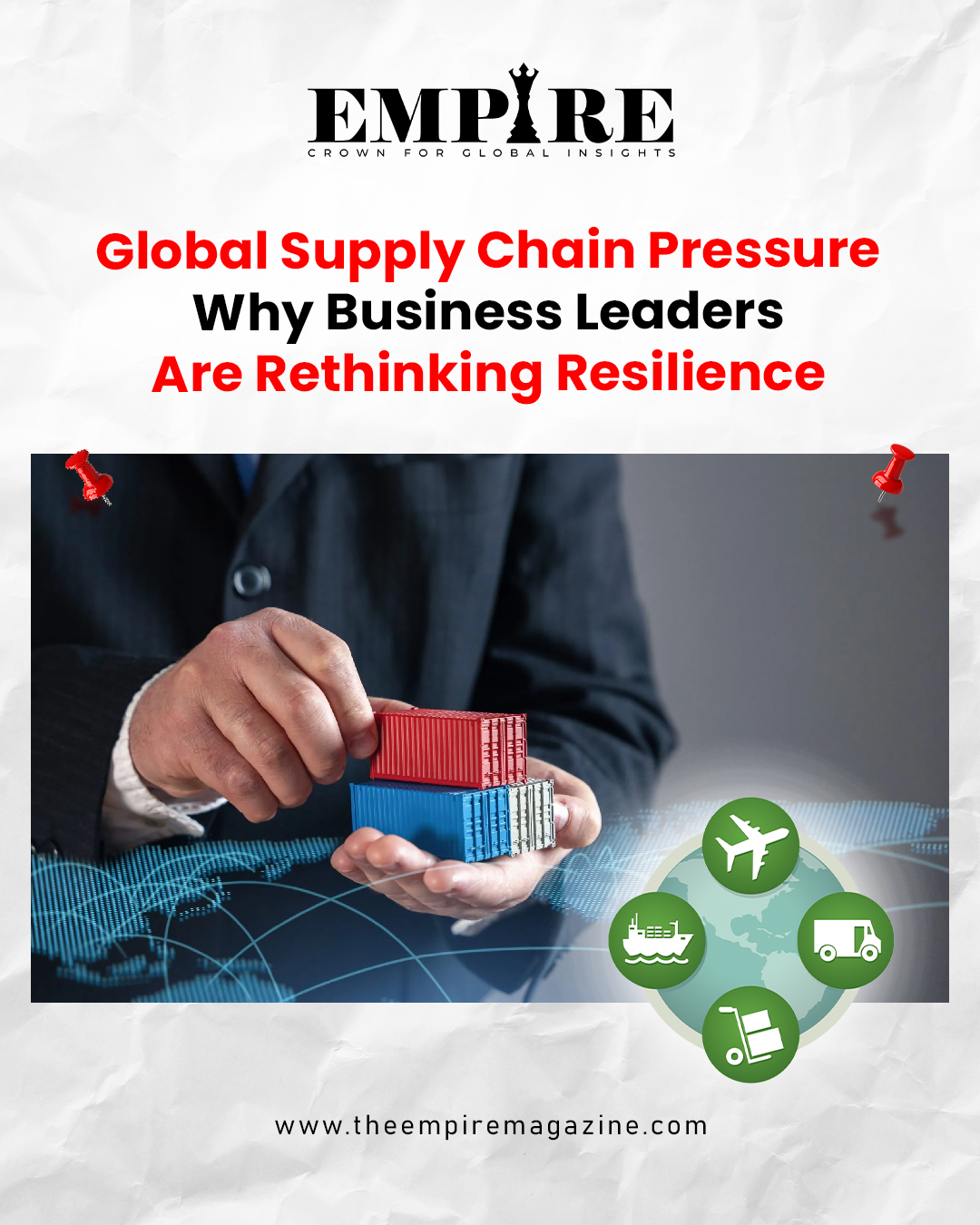
Global Supply Chain Pressure is once again becoming a major concern for business leaders, manufacturers, retailers, logistics companies, and policymakers. After years of disruption caused by the pandemic, shipping delays, geopolitical tensions, energy shocks, and changing trade rules, companies are realizing that supply chain resilience is no longer optional. It has become a core business strategy.
In 2026, global supply chains are facing pressure from several directions at the same time. Shipping routes remain vulnerable to geopolitical conflict, energy prices are sensitive to instability in major transit regions, tariffs are creating uncertainty, and companies are still trying to balance cost efficiency with reliability. These pressures are forcing business leaders to rethink where they source materials, how much inventory they hold, and how quickly they can respond when disruption hits.
For many years, companies focused heavily on lean supply chains. The goal was to reduce inventory, lower costs, and deliver products just in time. That model worked well when global trade was stable. However, repeated disruptions have shown that the cheapest supply chain is not always the strongest one.
Global Supply Chain Pressure and the New Business Reality
Global Supply Chain Pressure is changing how executives think about risk. A company may have strong sales, good products, and loyal customers, but if it cannot get raw materials, components, packaging, or finished goods on time, the business can quickly face serious problems.
Recent global disruptions have shown that supply chains are deeply connected. A shipping delay in one region can affect factories in another. A shortage of semiconductors can slow car production. Higher fuel prices can increase transportation costs. Tariffs can change sourcing decisions. A port delay can affect retailers before major shopping seasons.
This interconnected system creates both opportunity and risk. Globalization helped companies access lower-cost production, larger supplier networks, and international markets. But it also created complex supply chains that are harder to control when something goes wrong.
Business leaders are now asking a different question. Instead of only asking, “How can we make the supply chain cheaper?” they are asking, “How can we make the supply chain stronger?”
Why Resilience Matters More Than Ever
Supply chain resilience means the ability to absorb disruption, recover quickly, and continue serving customers. It does not mean eliminating every risk. That is impossible. Instead, resilience means building systems that can respond when risk becomes reality.
Companies that lack resilience may face empty shelves, delayed production, higher costs, missed revenue, and damaged customer trust. In industries such as healthcare, automotive, food, energy, and electronics, supply chain weakness can have serious effects on both businesses and consumers.
Resilience also matters because disruptions are becoming more frequent and more complex. Companies must now prepare for climate events, cyberattacks, geopolitical tensions, trade restrictions, labor shortages, and transportation bottlenecks. A single backup plan is no longer enough.
From Just-in-Time to Just-in-Case
For decades, many companies used just-in-time inventory systems. This approach reduced storage costs by keeping inventory low and relying on suppliers to deliver parts or goods exactly when needed. It helped businesses become efficient, but it also created vulnerability.
When supply chains are disrupted, low inventory can become a major weakness. A factory may stop production because one small component is missing. A retailer may lose sales because popular items are delayed. A hospital may struggle if medical supplies are not available on time.
This is why many companies are moving toward a more balanced model. They still want efficiency, but they also want backup inventory, alternative suppliers, and better visibility. This approach is often called just-in-case planning. It adds cost, but it can protect the business during disruption.
Shipping Disruptions and Rising Costs
Shipping remains one of the biggest pressure points in global supply chains. Ocean freight, air cargo, ports, canals, and major trade routes all play a critical role in moving goods around the world.
Recent disruptions in key regions have forced companies to reroute cargo, pay higher freight costs, and manage longer delivery times. When ships avoid certain routes, transit times increase. Longer transit times raise fuel costs, insurance costs, working capital needs, and inventory planning challenges.
For importers and retailers, even a few extra days can matter. Seasonal products, fashion items, electronics, food ingredients, and promotional goods often depend on tight delivery schedules. Delays can mean missed sales windows or higher costs for emergency air freight.
The Impact on Manufacturers
Manufacturers are especially exposed to supply chain pressure because they depend on steady flows of raw materials and components. A factory may need metals, plastics, chemicals, semiconductors, packaging, machinery parts, and energy supplies. If one input becomes unavailable or too expensive, production can slow.
Rising input costs also affect profitability. If raw materials, freight, labor, and energy all become more expensive at the same time, manufacturers must decide whether to absorb the cost or raise prices for customers.
In competitive markets, raising prices can be difficult. Customers may delay purchases or switch suppliers. This puts business leaders in a difficult position: protect margins or protect market share.
Tariffs and Trade Policy Uncertainty
Tariffs are another major reason business leaders are rethinking resilience. Changes in trade policy can quickly alter the cost of importing goods. A supplier that looked affordable one year may become expensive after new duties are introduced.
Tariff uncertainty also makes long-term planning harder. Companies may hesitate to sign supplier contracts, expand production, or enter new markets if they do not know how trade rules will change. This creates more complexity for procurement teams and finance leaders.
Some companies are responding by diversifying production across multiple countries. Others are exploring nearshoring, which means moving production closer to key markets. For U.S. companies, this may include more sourcing from Mexico or domestic suppliers. For European companies, it may mean more regional production within Europe or nearby markets.
Supplier Diversification
Supplier diversification is one of the most important resilience strategies. Relying on one supplier or one country can reduce cost, but it can also increase risk. If that supplier faces disruption, the entire business may be affected.
Business leaders are now mapping their supplier networks more carefully. They want to know not only their direct suppliers, but also the suppliers behind those suppliers. This is important because hidden risks often exist deeper in the supply chain.
For example, a company may buy finished parts from one supplier, but that supplier may depend on a single factory for a key material. If that material becomes unavailable, the buyer may face disruption even if its direct supplier seems reliable.
Technology and Supply Chain Visibility
Technology is becoming central to supply chain resilience. Companies need better visibility into inventory, supplier performance, transport routes, demand signals, and risk events.
Digital supply chain tools can help companies track shipments, forecast demand, monitor supplier risk, and respond faster when problems appear. Data analytics can help leaders understand where vulnerabilities exist. Automation can improve warehouse efficiency. Real-time tracking can help logistics teams make better decisions.
However, technology alone does not solve the problem. A company also needs strong processes, trained teams, good supplier relationships, and clear decision-making. Visibility is useful only when leaders are ready to act on the information.
Cybersecurity as a Supply Chain Risk
Modern supply chains are digital, which means cybersecurity is also part of resilience. A cyberattack on a supplier, logistics provider, warehouse system, or software platform can disrupt operations.
Companies now depend on digital systems for procurement, payments, inventory, shipping documents, customs clearance, and customer orders. If those systems fail, goods may not move even if physical inventory is available.
This is why supply chain resilience must include cybersecurity planning. Business leaders need to assess not only physical risks but also digital risks across their supplier ecosystem.
Why Retailers Are Rethinking Inventory
Retailers are under strong pressure because they face both supply-side and demand-side uncertainty. They must keep products available while avoiding too much unsold inventory. This is difficult when shipping delays, consumer demand shifts, and price increases happen at the same time.
During periods of supply chain pressure, retailers may increase inventory for critical products. However, holding more inventory raises storage costs and ties up capital. If demand changes, retailers can be left with excess stock.
This is why many retailers are investing in better forecasting and more flexible sourcing. They want to respond faster to demand changes while reducing the risk of empty shelves.
Reshoring and Nearshoring Strategies
Reshoring and nearshoring are becoming more common as companies rethink global dependency. Reshoring means bringing production back to the company’s home country. Nearshoring means moving production closer to the main customer market.
These strategies can reduce transport risk and improve response time. They can also help companies manage tariffs and geopolitical uncertainty. However, they are not simple. Moving production can be expensive, and some regions may not have the same supplier base, labor availability, or cost structure.
For many companies, the future will not be fully domestic or fully global. It will be a hybrid model. Businesses may keep some global suppliers for cost efficiency while adding regional suppliers for resilience.
Building Resilience Without Losing Efficiency
The biggest challenge for business leaders is balancing resilience and efficiency. Too much focus on cost can make a supply chain fragile. Too much focus on redundancy can make it expensive.
The strongest companies are building flexible supply chains. They identify the most critical products, materials, and suppliers. They create backup options where failure would be costly. They use data to improve planning. They work closely with logistics partners. They prepare for disruption before it happens.
Resilience is now becoming a competitive advantage. Companies that can deliver reliably during uncertainty can win customer trust, protect revenue, and respond faster than competitors.
The Future of Supply Chain Leadership
Global Supply Chain Pressure is changing the role of supply chain leaders. In the past, supply chain teams were often seen mainly as cost managers. Today, they are strategic decision-makers who influence growth, risk, customer experience, and profitability.
CEOs and boards are paying more attention to supply chain resilience because disruptions can affect the entire business. Supply chain decisions now connect to finance, sustainability, technology, operations, pricing, and brand reputation.
The companies that perform best in this environment will be those that treat resilience as part of long-term strategy. They will not wait for the next crisis before acting. They will build stronger networks, smarter systems, and more flexible operating models before pressure becomes disruption.
Readers can also explore more technology and business insights through this related article: Zipline Drone Delivery: How Healthcare Logistics Is Changing Worldwide.
For more updates from The Empire Magazine, follow us on Facebook and Instagram.
– The Empire Magazine
Crown For Global Insights