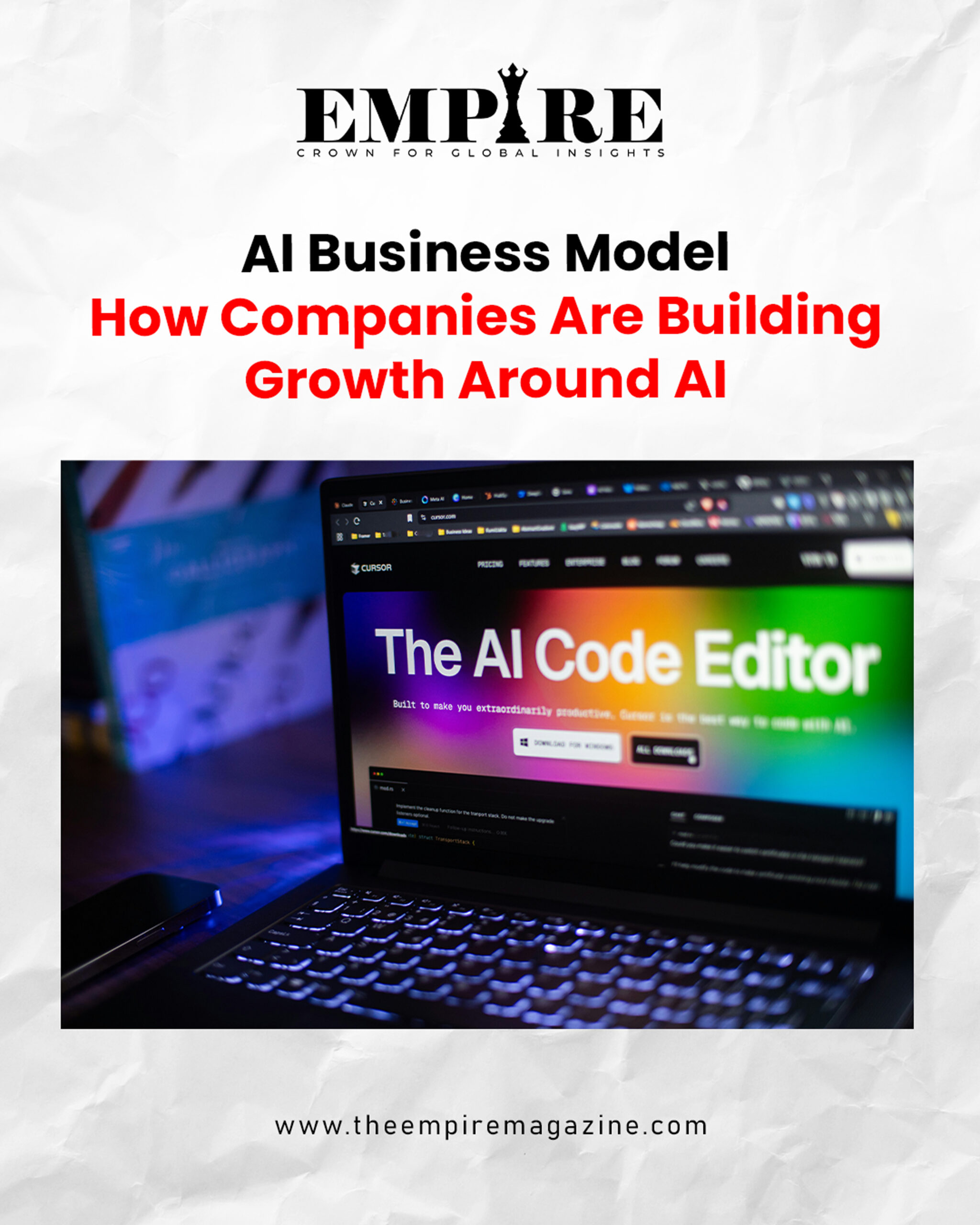
AI Business Model Is Now the Center of Modern Business
AI Business Model is no longer a futuristic idea discussed only in technology conferences. It has become a practical way for companies to create products, reduce costs, improve customer experience, and build new revenue streams. Across industries such as finance, healthcare, retail, manufacturing, education, media, and agriculture, artificial intelligence is now part of daily business operations.
Earlier, AI was mostly used as a support tool. Companies used it for automation, data analysis, customer support, and recommendation systems. Today, the role of AI has changed. Businesses are designing entire models around AI, where the technology supports decision-making, product development, marketing, sales, logistics, and customer engagement.
This shift shows one important reality: AI is not only changing how businesses work; it is changing how businesses make money.
Why AI Is Becoming a Business Model
The growth of AI adoption is connected to three major business needs: speed, scale, and efficiency. Modern companies operate in competitive markets where customers expect faster service, personalized experiences, and better value. AI helps companies respond to these expectations with data-driven systems.
For example, e-commerce platforms use AI to recommend products based on customer behavior. Banks use AI to detect fraud and assess risk. Healthcare companies use AI tools to support diagnostics, patient management, and drug research. Media companies use AI to improve content planning, audience analysis, and advertising performance.
The key point is that AI is no longer limited to one department. It is becoming part of the business structure itself.
From Automation to Revenue Creation
Automation was one of the first major business uses of AI. Companies used AI to reduce repetitive manual tasks. Chatbots, automated reports, workflow tools, and predictive analytics helped teams save time.
Now, AI is moving beyond automation. It is helping companies create revenue. Software firms are adding AI features to subscription products. Consulting firms are offering AI transformation services. Startups are launching AI-first platforms in legal tech, education, finance, agriculture, and marketing.
This means AI is not just reducing expenses; it is becoming a direct source of income.
Real Business Examples of AI-Driven Growth
Global companies are already showing how AI can become a business model. Microsoft has integrated AI across products such as cloud services, workplace tools, and developer platforms. Google uses AI in search, advertising, cloud computing, and productivity products. Amazon applies AI in logistics, recommendation engines, voice assistants, and cloud AI services.
In the startup ecosystem, AI-first companies are building tools for writing, coding, design, customer service, analytics, cybersecurity, and enterprise automation. These businesses do not treat AI as an add-on feature. Their main product value depends on AI performance.
The same pattern is visible in traditional industries. Agriculture platforms use AI and data to help farmers improve productivity, pricing access, supply chain planning, and market connections. A strong example of technology-led business transformation can be seen in this feature on Shashank Kumar and DeHaat, where digital systems are linked with agricultural growth and rural business impact.
How AI Changes the Customer Experience
Customer experience is one of the biggest areas where AI creates business value. Companies can now understand customer behavior in real time. AI tools can analyze browsing patterns, purchase history, feedback, location trends, and support queries.
This helps businesses deliver personalized recommendations, faster responses, and better service quality. Instead of offering the same message to every customer, AI allows companies to create individual-level communication.
Personalization as a Growth Engine
Personalization has become a powerful business model because customers are more likely to engage with products and services that match their needs. Streaming platforms recommend content. Online stores suggest products. Financial apps offer personalized insights. Learning platforms adjust lessons based on student performance.
In each case, AI improves engagement. Higher engagement often leads to better retention, stronger brand loyalty, and increased revenue.
AI in Decision-Making and Strategy
A strong AI Business Model depends on data. Businesses collect large amounts of information, but data has limited value unless it supports better decisions. AI helps companies identify patterns, predict demand, manage risk, and improve planning.
Retailers can forecast inventory needs. Manufacturers can predict machine maintenance. Insurance companies can evaluate claims more efficiently. Marketing teams can test campaigns faster. Leadership teams can use AI dashboards to understand market movement and customer demand.
The Rise of Agentic AI
Agentic AI is becoming an important development in business technology. These systems are designed to perform tasks, follow goals, and support workflows with less human input. In business, agentic AI may help with research, customer support, coding, operations, reporting, and sales processes.
However, businesses also need governance, security, human supervision, and clear performance measurement. AI works best when companies combine technology with responsible management.
Challenges in Building an AI Business Model
AI adoption also brings challenges. Companies need quality data, trained teams, cybersecurity systems, ethical guidelines, and clear business goals. Without these foundations, AI projects may fail to deliver value.
High implementation costs, unclear return on investment, data privacy risks, and lack of skilled talent can slow progress. Businesses must avoid using AI only because it is trending. AI must solve a real business problem.
Responsible AI Is a Business Requirement
Responsible AI is now important for brand trust. Companies must ensure fairness, transparency, privacy, and accountability. Customers and regulators are paying closer attention to how businesses use data and automated decisions.
A successful AI Business Model is not only about speed and profit. It must also protect users, follow laws, and maintain trust.
Future of AI as a Business Model
The future of business will likely include more AI-native companies. These companies will build products, operations, marketing, and customer service around intelligent systems from the beginning. Traditional companies will also continue transforming their models by adding AI into core operations.
AI will influence pricing models, product design, workforce planning, customer service, supply chains, and global competition. Businesses that understand AI as a strategic model, not just a software tool, will be better positioned for long-term growth.
Follow The Empire Magazine on Instagram and Facebook.
– The Empire Magazine
Crown For Global Insights