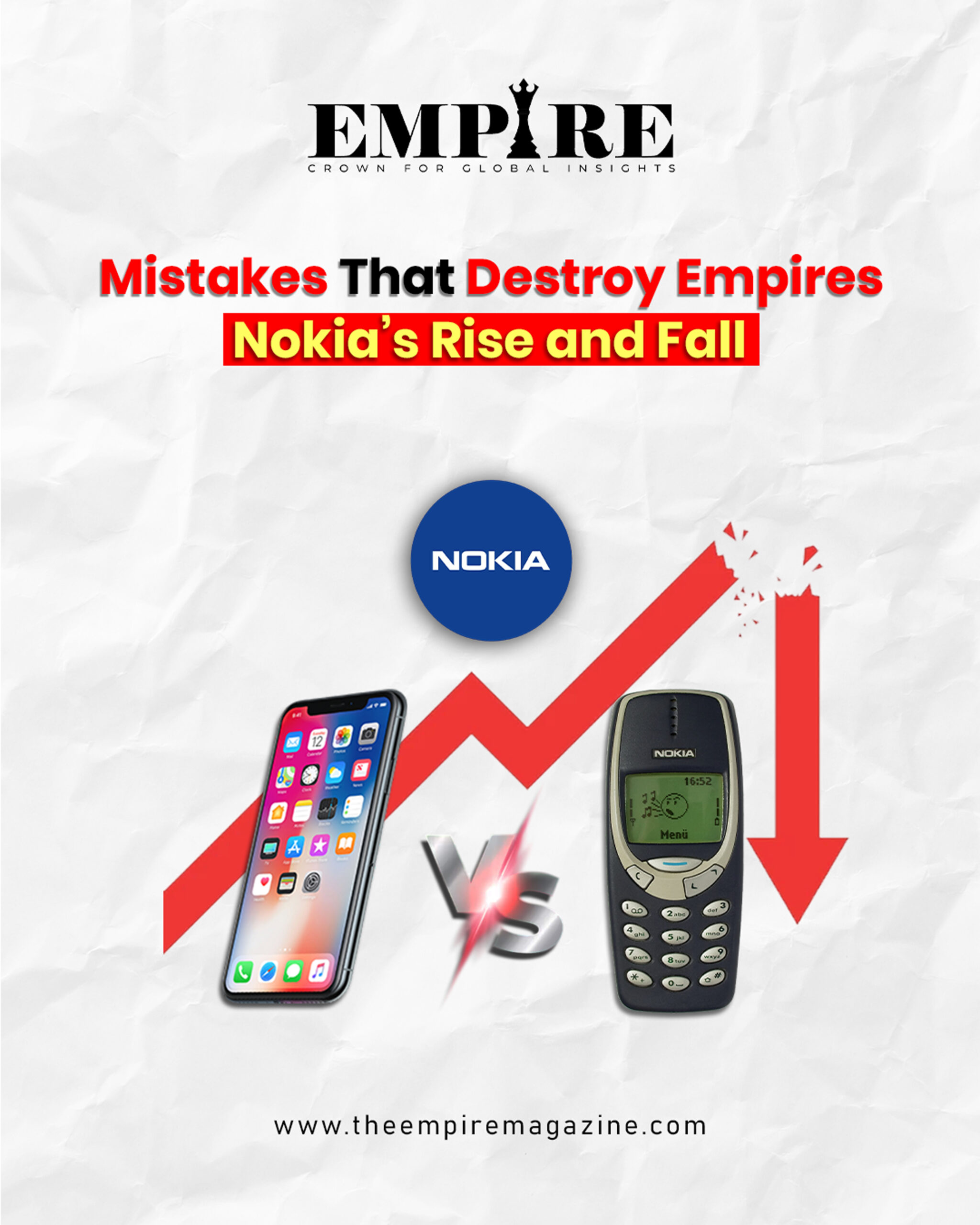
Mistakes That Destroy Empires are often not sudden failures but slow, unnoticed decisions that weaken even the strongest companies. Nokia is one of the most powerful examples of this reality. Once the undisputed king of mobile phones, Nokia dominated global markets, shaped communication habits, and became a symbol of reliability. Yet within less than a decade, it fell from dominance to near irrelevance.
Understanding Nokia’s rise and fall is not just a history lesson—it is a blueprint of what businesses must avoid if they want to survive in a rapidly changing world.
The Rise of a Global Giant
Before exploring the downfall, it is important to understand how powerful Nokia truly was. The company began in the 19th century as a paper mill and gradually evolved into a diversified industrial giant. Over time, it entered sectors like rubber, cables, and electronics before finally focusing on telecommunications.
By the 1990s and early 2000s, Nokia had become the world leader in mobile phones. Its devices were known for durability, simplicity, and mass appeal. Phones like the Nokia 3310 became cultural icons. At its peak, Nokia controlled a massive share of the global mobile market, reaching nearly 30% worldwide.
What made Nokia special was its ability to connect with users. It did not just sell phones—it defined the mobile experience. From simple games to user-friendly design, Nokia built a strong emotional connection with customers. For many people, their first phone was a Nokia.
The Beginning of the Fall
Despite its dominance, the seeds of decline were already being planted. One of the biggest mistakes that destroy empires is complacency. Nokia began to believe that its leadership position was unshakable.
Then came a turning point—the arrival of smartphones. When touchscreen devices and app-based ecosystems entered the market, consumer expectations changed rapidly. The focus shifted from hardware to software, from durability to user experience.
Nokia failed to fully recognize this shift.
Failure to Adapt to Innovation
One of the most critical reasons behind Nokia’s fall was its inability to adapt to new technology trends. While competitors moved toward advanced operating systems and app ecosystems, Nokia continued to rely on its traditional approach.
Instead of embracing emerging platforms, Nokia attempted to build its own system. Unfortunately, it lacked the flexibility, developer support, and user experience needed to compete with modern operating systems.
By the time Nokia realized the importance of software, it was already too late. Competitors had captured the market, and customer expectations had permanently changed.
Overconfidence in Brand Power
Another major mistake that destroys empires is overestimating brand strength. Nokia believed that its reputation alone would be enough to retain customers.
However, markets do not reward legacy—they reward value. Consumers quickly shifted toward better-performing devices, even if they came from newer or less established brands. Loyalty could not compensate for inferior technology.
Nokia underestimated how quickly customers would abandon familiarity for innovation.
Internal Fear and Leadership Challenges
Behind the scenes, Nokia faced internal challenges that further accelerated its decline. Organizational fear played a significant role. Middle management hesitated to share honest feedback, while top leadership struggled to accept the reality of declining competitiveness.
When communication within a company breaks down, decision-making suffers. In Nokia’s case, critical issues were ignored or delayed because employees feared consequences, and leadership was not aligned with the technical realities of the market.
In addition, frequent leadership changes created instability. Different visions, strategies, and priorities made it difficult for the company to maintain a clear direction.
Poor Strategic Decisions
Another key factor in Nokia’s downfall was its strategic missteps. Instead of building a strong independent ecosystem or fully embracing widely adopted platforms, the company entered partnerships that limited its flexibility.
This decision reduced Nokia’s ability to innovate independently and tied its success to external systems that were not competitive enough in the market.
When a company loses control over its core strategy, it also loses its ability to shape its future.
Weak Marketing and Positioning
Marketing also played a role in Nokia’s decline. While competitors focused on building strong flagship identities and emotional connections with consumers, Nokia struggled to maintain a clear and modern brand image.
The company’s messaging did not evolve with the changing market. It failed to create excitement around its new products, and its communication did not match the expectations of a new generation of users.
Strong products need strong positioning. Without it, even good innovations can fail.
The Cost of Constant Restructuring
Frequent restructuring within Nokia created confusion and instability. Changing leadership, shifting strategies, and internal disagreements slowed down decision-making and innovation.
When a company is constantly reorganizing, it often loses focus. Employees become uncertain, priorities shift repeatedly, and execution weakens. For Nokia, this internal instability became another factor in its downfall.
Lessons from Nokia’s Downfall
The story of Nokia offers powerful lessons for businesses of all sizes. The mistakes that destroy empires are often avoidable if leaders remain aware, adaptable, and open to change.
Key lessons include:
- Never ignore technological shifts
- Prioritize software and user experience, not just hardware
- Avoid complacency, even at peak success
- Encourage transparent communication within teams
- Stay aligned with market trends and customer expectations
- Build flexible and future-ready strategies
Success is not permanent. Companies must continuously evolve to remain relevant.
Reinvention and Moving Forward
Despite its fall in the mobile phone market, Nokia did not disappear entirely. The company shifted its focus toward telecommunications infrastructure, network technology, and innovation in areas like 5G.
This ability to reinvent itself highlights another important lesson: failure in one area does not mean the end of a company. Adaptation and transformation can create new opportunities.
Final Thoughts
Mistakes That Destroy Empires are rarely dramatic in the beginning. They often start with small decisions—ignoring trends, delaying innovation, or overestimating success. Over time, these decisions compound and lead to decline.
Nokia’s story is a reminder that even the strongest empires can fall if they fail to adapt. But it is also a reminder that businesses can learn, evolve, and rebuild.
In today’s fast-changing world, the real strength of a company lies not in its past success but in its ability to embrace the future.
Read more here:
https://theempiremagazine.com/?p=5635&preview=true
Follow us on social media:
Instagram: https://www.instagram.com/the_empire_magazine/
Facebook: https://www.facebook.com/profile.php?id=61573749076160
– The Empire Magazine
Crown For Global Insights