Zipline Drone Delivery is changing how healthcare products, blood supplies, vaccines, medicines, lab samples, and urgent medical materials move between hospitals, health centers, pharmacies, and patients. The company has become one of the most important names in autonomous logistics because it uses drones to deliver essential items quickly, especially in places where road transport can be slow, expensive, or unreliable.
Zipline began with a healthcare-focused mission and became widely known for delivering blood and medical products in Rwanda. Since then, it has expanded across several countries and now supports healthcare, retail, food, and consumer deliveries. However, healthcare logistics remains one of the clearest examples of why drone delivery matters.
In healthcare, delivery speed can directly affect patient care. A delayed blood unit, medicine, vaccine, or lab sample can create serious problems for hospitals and clinics. Zipline’s model is built around the idea that urgent medical logistics should not depend only on road traffic, long distances, poor infrastructure, or slow supply chains.
Zipline Drone Delivery and the Healthcare Logistics Problem
Healthcare logistics is often more difficult than normal delivery. Medical products may be time-sensitive, temperature-sensitive, expensive, or needed urgently. Hospitals and clinics must manage stock levels carefully because running out of critical supplies can affect treatment.
In many rural or hard-to-reach areas, roads can be difficult, weather can delay transport, and health centers may be far from central warehouses. This creates a challenge: keeping every health facility fully stocked is expensive, but waiting for emergency deliveries by road can take too long.
Zipline Drone Delivery offers a different approach. Instead of sending every item by truck, motorcycle, or van, health systems can use drones to move specific products on demand. A clinic can request blood, vaccines, medicines, or supplies when needed, and a drone can deliver them directly from a distribution center.
This model can reduce waste because hospitals do not always need to hold large amounts of inventory. It can also improve access because remote facilities can receive products faster.
How Zipline Started With Medical Deliveries
Zipline was founded in 2014 and became globally recognized after launching medical drone deliveries in Rwanda in 2016. Rwanda was an important early market because the country’s geography and road conditions made fast medical delivery difficult in some areas.
The early Zipline model focused on delivering blood products to hospitals and health centers. Blood delivery is a strong use case because blood is critical, perishable, and often needed in emergencies such as childbirth complications, trauma, and surgery.
The company later expanded its healthcare delivery work to countries including Ghana, Nigeria, Côte d’Ivoire, Kenya, and Japan. It also entered the United States, where drone delivery is being used for retail, food, healthcare, and hospital logistics.
Zipline’s growth shows that drone delivery is no longer only an experimental idea. It is becoming part of real supply chains for governments, hospitals, health systems, and commercial partners.
From Blood Delivery to Broader Medical Logistics
The most powerful part of Zipline’s healthcare story is its expansion from blood delivery into broader medical logistics. In different markets, Zipline has delivered vaccines, medicines, IV fluids, personal protective equipment, prescriptions, and medical supplies.
This matters because healthcare systems need flexible logistics. A hospital may need blood in one emergency, vaccines for a rural clinic, or lab samples moved quickly between facilities. Drone networks can support many types of delivery if the system is properly designed.
Zipline’s work in Ghana became especially important because the country used drone delivery for vaccines and essential medical products at national scale. These programs showed that drone logistics can support public health systems, not just individual hospitals.
Why Drone Delivery Matters in Healthcare
Drone delivery matters in healthcare because it can reduce time between need and treatment. Traditional delivery depends on roads, drivers, fuel, traffic, and distance. Drones can fly more direct routes, avoid road congestion, and reach difficult areas faster.
For emergency medicine, speed matters. If a hospital needs a rare blood type or a medicine that is not available on site, faster delivery can improve the care process. For lab samples, faster transport can help doctors receive results sooner and make treatment decisions faster.
Drone delivery can also support healthcare equity. Patients in rural or remote communities often face slower access to care and medical supplies. A drone network can help reduce that gap by making supply delivery less dependent on location.
Reducing Waste and Improving Inventory
Another important benefit is inventory management. Health facilities often need to balance availability and waste. If they stock too much of a perishable medical product, it may expire before use. If they stock too little, they may not have enough during emergencies.
Zipline’s on-demand model can help reduce this problem. Instead of keeping every possible product at every facility, health systems can centralize inventory and deliver specific items when needed. This can lower waste and improve availability at the same time.
This is especially important for blood products, vaccines, and other sensitive medical supplies. Better logistics can make health systems more efficient and more responsive.
Zipline’s Drone Technology
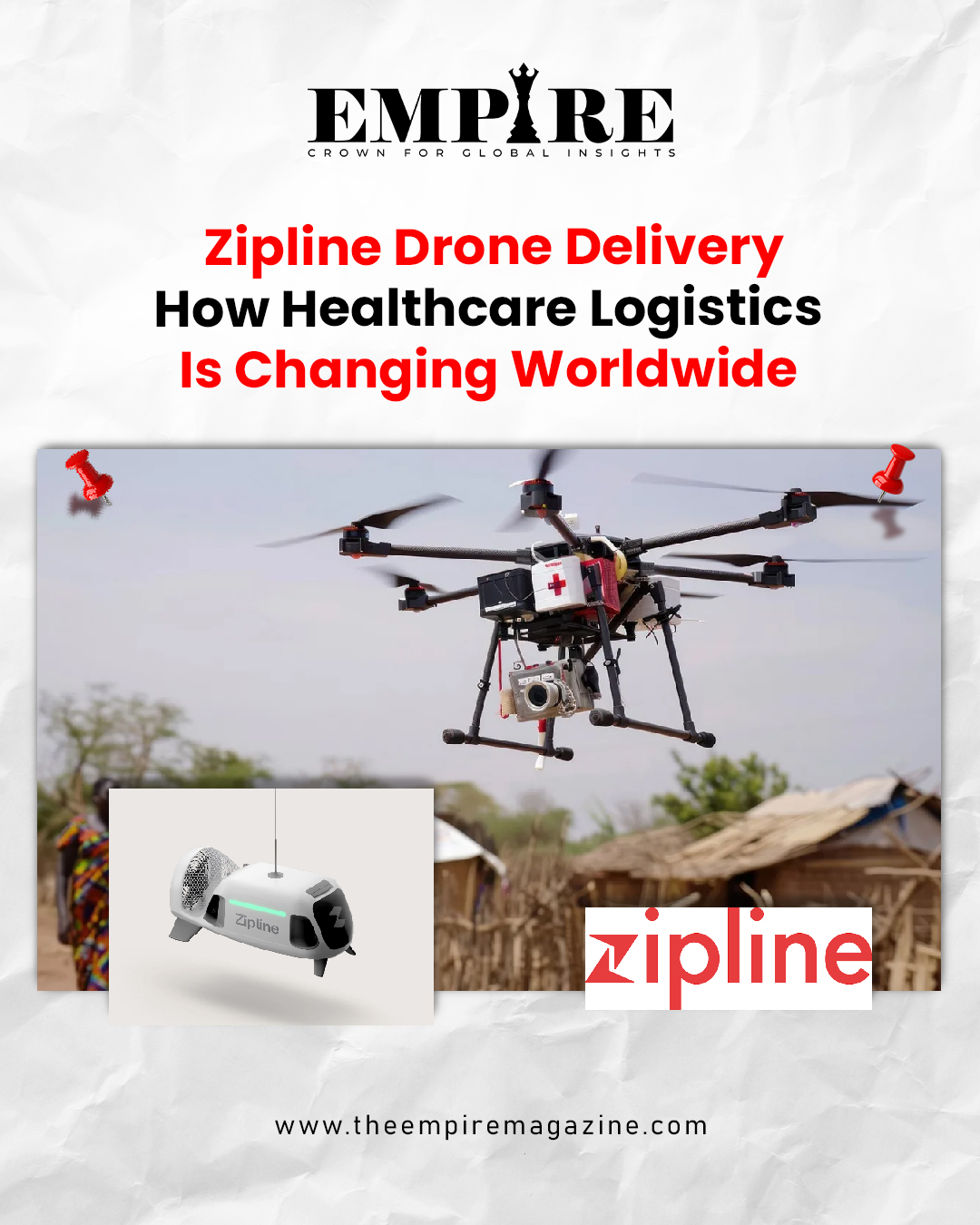
Zipline uses autonomous aircraft designed for fast and reliable delivery. Its earlier Platform 1 system is a fixed-wing drone model used for longer-distance deliveries. These drones can carry packages from distribution centers to health facilities and drop them by parachute into a designated area.
The company later developed Platform 2, a newer system designed for more precise urban and suburban delivery. Platform 2 uses a drone and a smaller delivery droid that lowers packages to specific locations. This system is especially useful for home delivery, retail delivery, and areas where packages need to arrive with high precision.
Both systems reflect Zipline’s larger strategy: build autonomous logistics that can work across different environments. Rural medical delivery, hospital networks, city delivery, and consumer services may all require different drone designs and workflows.
Zero-Emission Delivery and Sustainability
Zipline promotes its aircraft as zero-emission delivery vehicles during operation. This is important because logistics is a major source of emissions when it depends heavily on cars, vans, trucks, and fuel-based transport.
In healthcare, sustainability may not be the first priority during emergencies, but it still matters. A delivery system that reduces road trips can help lower emissions while also improving speed.
For hospitals and health systems that are trying to reduce environmental impact, drone logistics can become part of a broader sustainability strategy.
Zipline’s Global Scale
Zipline says it now operates on four continents and serves more than 5,000 hospitals and health facilities. The company has also surpassed 2 million commercial deliveries and more than 125 million autonomous commercial miles flown.
This scale is important because many drone delivery companies have tested small pilots, but only a few have built large operational networks. Zipline’s experience gives it a strong position in the drone logistics industry.
The company’s delivery network is also expanding beyond healthcare. In the United States, Zipline has worked with retail and food partners, while still building healthcare relationships. This mixed model can help the company grow because drone networks become more useful when they serve multiple types of demand.
Healthcare Partnerships in the United States
Zipline’s healthcare role in the United States is growing. Advocate Health announced in 2026 that it plans to launch what it described as the nation’s largest hospital-based drone delivery network with Zipline. The program is expected to support delivery of medications, supplies, and lab samples across several U.S. markets.
This is important because U.S. healthcare logistics has its own challenges. Hospitals need to move supplies between facilities, deliver prescriptions to patients, and transport lab samples quickly. Traffic, distance, staffing shortages, and rising costs can all slow down care delivery.
Drone delivery can help health systems rethink how they serve patients at home. Instead of asking patients to travel for certain items or wait for traditional delivery, hospitals may use drones to bring medical products directly to homes or move samples between care sites.
Lab Samples and Faster Results
One of the most interesting healthcare uses is lab sample transport. When samples move faster between clinics and laboratories, patients may receive results sooner. Faster results can help doctors make earlier decisions about treatment, follow-up care, or additional testing.
This is especially valuable in large health systems where facilities are spread across different locations. Drone delivery can create a faster link between hospitals, clinics, labs, and patients.
For patients, this can improve convenience. For doctors, it can improve workflow. For health systems, it can reduce delays and support better care coordination.
Challenges Facing Drone Delivery
Zipline has strong momentum, but drone delivery still faces challenges. Regulation is one of the biggest barriers. Each country has its own aviation rules, safety requirements, airspace restrictions, and approval processes. Drone companies must prove that their systems are safe and reliable.
Weather is another factor. Drones must operate safely in different conditions, including wind, rain, heat, and changing visibility. Healthcare delivery also requires careful handling, especially for temperature-sensitive products.
Public acceptance is also important. Communities need to feel comfortable with drones flying nearby. Noise, privacy, safety, and reliability are all concerns that companies must address.
Why Zipline Matters for the Future of Healthcare Logistics
Zipline matters because it shows that healthcare logistics can be faster, more flexible, and more technology-driven. The company started with a real healthcare problem: how to get critical medical supplies to people who need them quickly. That mission helped prove that drone delivery can be useful beyond futuristic demonstrations.
The future of healthcare logistics may combine drones, electric vehicles, traditional delivery, digital inventory systems, and hospital networks. Drones will not replace every delivery method, but they can become powerful for urgent, lightweight, high-value, and time-sensitive products.
Zipline Drone Delivery also shows how logistics can become part of healthcare innovation. Better delivery can support better treatment, better inventory, faster results, and improved access for patients in both rural and urban areas.
Readers can also explore more technology and business insights through this related article: Memory Chip Shortage: How Automakers and Retailers Are Facing New Price Pressure.
For more updates from The Empire Magazine, follow us on Facebook and Instagram.
– The Empire Magazine
Crown For Global Insights