
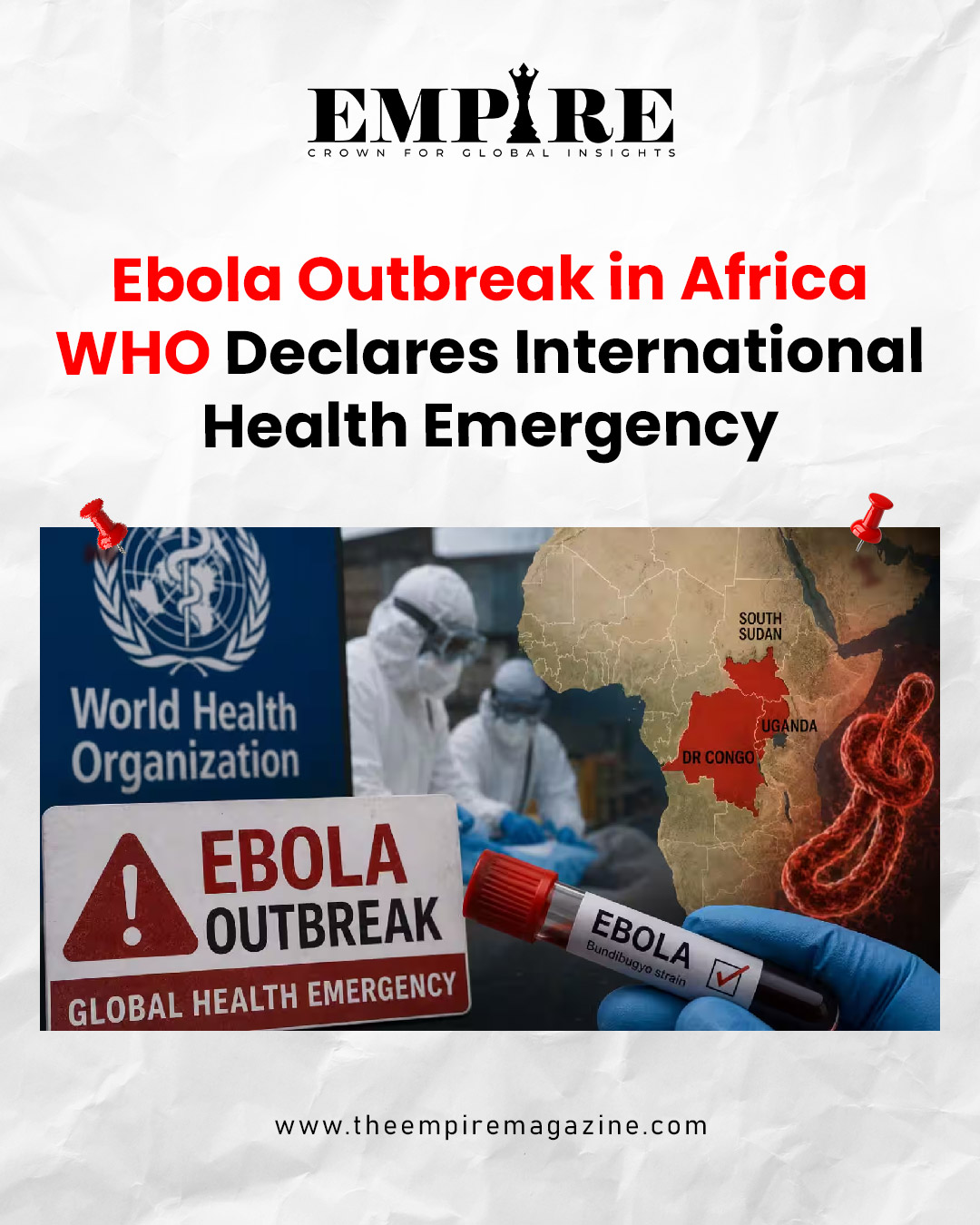
The World Health Organization (WHO) has declared the Ebola outbreak in the Democratic Republic of the Congo and Uganda a Public Health Emergency of International Concern (PHEIC). The decision reflects concerns over cross-border transmission, healthcare challenges, and the spread of the rare Bundibugyo strain, prompting a coordinated international response to contain the outbreak.
A Renewed Ebola Threat Has Put Global Health Authorities on Alert
More than a decade after the devastating Ebola epidemic in West Africa captured global attention, the virus has once again become a serious public health concern. This time, the outbreak is centred in the Democratic Republic of the Congo (DRC), with linked cases reported in Uganda and an imported case detected in France. The situation has prompted the World Health Organization (WHO) to issue its highest level of international health alert a Public Health Emergency of International Concern (PHEIC).
Unlike a pandemic declaration, a PHEIC is designed to mobilise international cooperation when a disease poses a risk beyond national borders. It encourages governments, health agencies, and research institutions to strengthen surveillance, improve healthcare preparedness, accelerate scientific research, and coordinate resources before the outbreak escalates further.
The declaration highlights that the world is better prepared than it was during previous Ebola crises, but it also serves as a reminder that infectious diseases continue to challenge healthcare systems, particularly in regions affected by conflict, limited medical infrastructure, and population movement.
Why the Ebola Outbreak in Africa Prompted WHO’s Highest Health Alert
The WHO’s decision was not based solely on the number of infections. Instead, it reflected several interconnected risks that together increased the likelihood of wider regional spread.
One of the biggest concerns is that the outbreak involves the Bundibugyo strain of the Ebola virus. Unlike the more familiar Zaire strain, this variant currently has no licensed vaccineandno approved targeted therapy, making outbreak management more difficult. Although supportive medical care improves survival, scientists are still evaluating experimental treatments specifically for this strain.
The outbreak has also spread across borders. Uganda reported imported infections linked to the DRC, with limited secondary transmission among contacts and healthcare workers. France later confirmed an imported case in a doctor returning from eastern Congo, demonstrating how international travel can occasionally carry infections beyond the affected region.
Equally concerning is the humanitarian situation in eastern DRC. Parts of the region continue to face insecurity, armed conflict, and displacement, making surveillance, contact tracing, and medical response significantly more challenging.
Understanding the Bundibugyo Ebola Virus
When people hear the term “Ebola,” they often assume every outbreak involves the same virus. In reality, several species of Ebola viruses exist, each with different characteristics.
The current outbreak is caused by the Bundibugyo virus, first identified in Uganda in 2007. It is considered rarer than the Zaire Ebola virus, which caused the major West African epidemic between 2014 and 2016.
One of the reasons scientists are paying close attention is that much of the medical research conducted over the past decade has focused on the Zaire strain. As a result, vaccines and antibody treatments developed for previous outbreaks cannot automatically be assumed to provide protection against Bundibugyo Ebola.
This has accelerated international efforts to study experimental medicines, improve diagnostics, and expand laboratory capacity in affected regions.
How Ebola Spreads and Why Early Detection Matters
Although Ebola is one of the world’s deadliest infectious diseases, it is often misunderstood.
The virus doesnot spread through the airlike influenza or COVID-19. Instead, transmission occurs through direct contact with the blood or other body fluids of an infected person, contaminated medical equipment, or infected animals. Unsafe burial practices involving direct contact with deceased victims have historically contributed to outbreaks.
Symptoms usually appear between two and 21 days after exposure and often begin with fever, severe headache, muscle pain, fatigue, and sore throat. As the illness progresses, patients may develop vomiting, diarrhoea, abdominal pain, and, in severe cases, internal or external bleeding.
Because early symptoms resemble many other tropical diseases, prompt laboratory testing is essential. WHO has recently supported the deployment of improved molecular diagnostic tools and rapid testing initiatives to shorten the time between symptom onset and confirmation, helping health teams isolate patients and trace contacts more quickly.
Why Containing the Outbreak Is So Challenging
Stopping an Ebola outbreak requires much more than treating patients. Health officials must identify cases quickly, isolate infected individuals, trace every close contact, monitor those contacts for 21 days, educate communities, and maintain strict infection-control measures in healthcare facilities.
In eastern DRC, these efforts are complicated by conflict, population displacement, and difficult terrain. Some communities remain hard to reach, while movement between towns and across national borders continues to create opportunities for the virus to spread. WHO has also highlighted shortages of protective equipment, pressure on treatment centres, and the impact of healthcare worker strikes on outbreak response.
Another challenge is public trust. During previous Ebola outbreaks, misinformation and fear discouraged some people from seeking medical care or cooperating with contact tracing. Public health experts now emphasise that community engagement is just as important as medical treatment in controlling transmission.
The Global Response to the Ebola Outbreak in Africa Is Already Underway
The WHO’s declaration of a Public Health Emergency of International Concern (PHEIC) has triggered a coordinated international response involving governments, public health agencies, humanitarian organisations, and research institutions.
Rather than waiting for the outbreak to spread further, health authorities are focusing on rapid containment. Emergency response teams have been deployed to affected regions, treatment centres have been strengthened, and surveillance systems have been expanded to detect new infections as early as possible.
Neighbouring countries have also increased screening measures at border crossings, airports, and healthcare facilities. Training programmes for healthcare workers, improvements in laboratory testing, and public awareness campaigns are being scaled up to reduce the risk of further transmission.
International organisations are supporting local governments with funding, medical supplies, protective equipment, and technical expertise. The goal is clear: contain the outbreak at its source while preventing wider regional or international spread.
Public health experts emphasise that global cooperation remains one of the strongest tools against infectious diseases. The quicker countries share information and coordinate their response, the greater the chances of limiting the outbreak.
Scientists Are Racing to Develop Better Treatments and Vaccines
One of the biggest challenges during the current outbreak is the absence of a licensed vaccine specifically designed for the Bundibugyo strain of the Ebola virus.
Over the past decade, vaccines developed against the Zaire strain have significantly improved outbreak response in several African countries. However, these vaccines are not specifically approved for the Bundibugyo variant, making the current situation more complex.
Researchers are therefore accelerating clinical studies to evaluate experimental vaccines and antiviral therapies that may help improve survival rates.
At the same time, pharmaceutical companies and international research organisations are working together to develop broader Ebola vaccines capable of protecting against multiple virus strains.
Advances in genomic sequencing, biotechnology, and artificial intelligence are also helping scientists better understand how the virus behaves, allowing researchers to identify potential treatment options more quickly than in previous outbreaks.
While these developments offer hope, experts caution that scientific research takes time. Public health measures such as surveillance, contact tracing, infection prevention, and community awareness remain the most effective tools for controlling the outbreak today.
The Economic and Social Impact Extends Beyond Healthcare
An Ebola outbreak affects far more than hospitals. Communities in affected regions often experience disruptions to education, agriculture, trade, tourism, and local businesses. Fear of infection can discourage travel, reduce economic activity, and place additional pressure on already vulnerable healthcare systems.
Healthcare resources are frequently redirected toward outbreak response, which may delay routine medical services such as maternal healthcare, childhood immunisation programmes, and treatment for chronic diseases.
Families also face emotional and financial hardships. Patients often require isolation, while quarantine measures may temporarily affect livelihoods and access to essential services.
For countries already dealing with economic challenges, conflict, or humanitarian crises, the outbreak can further strain public resources and slow development efforts.
These broader impacts demonstrate why Ebola is not only a medical emergency but also a humanitarian and economic concern requiring international support.
Should the World Be Worried About Another Global Pandemic?
The WHO’s emergency declaration has naturally raised questions about whether Ebola could become another COVID-19-style pandemic.nPublic health experts say the answer is no, based on current evidence.
Unlike respiratory viruses such as COVID-19, Ebola spreads through direct contact with infected bodily fluids rather than through the air. This makes transmission easier to interrupt when cases are identified quickly and appropriate infection-control measures are implemented. However, experts also warn against complacency.
Any infectious disease that crosses international borders deserves close monitoring, particularly when healthcare systems are under pressure or when no approved vaccine exists for the circulating strain.
The WHO has repeatedly stressed that the current declaration is intended to strengthen preparedness and not to create panic. The organisation has not recommended general travel or trade restrictions, instead encouraging countries to enhance surveillance, improve healthcare readiness, and support affected regions.
The situation highlights an important lesson from recent years: responding early is often far more effective than reacting after an outbreak has expanded.
Lessons From COVID-19 Are Shaping the Ebola Response
The COVID-19 pandemic transformed how the world approaches infectious disease outbreaks. Today, international health agencies are acting faster, sharing information more openly, and coordinating research more effectively than in previous decades.
Digital disease surveillance, genomic sequencing, improved laboratory networks, and stronger international collaboration are helping identify outbreaks earlier and respond more rapidly.
Healthcare workers are also better trained in infection prevention and control, while many countries have strengthened emergency preparedness plans developed during the COVID-19 pandemic.
Community engagement has become another major priority. Authorities recognise that controlling an outbreak depends not only on medical treatment but also on public trust, transparent communication, and cooperation with local communities.
These lessons are expected to play a crucial role in limiting the impact of the current Ebola outbreak.
What the Ebola Outbreak Means for Global Health Security
The current Ebola outbreak serves as a reminder that infectious diseases remain one of the world’s most significant public health challenges.
Increasing international travel, climate change, urbanisation, population displacement, and conflict continue to create conditions where infectious diseases can emerge and spread more rapidly than before.
For governments, the outbreak reinforces the importance of investing in public health infrastructure, disease surveillance, laboratory capacity, and emergency response systems.
For researchers, it highlights the urgent need for continued investment in vaccines, diagnostics, and treatments that can protect against multiple Ebola strains.
For the global healthcare community, it demonstrates that preparedness is not a one-time effort but an ongoing responsibility requiring sustained collaboration across borders.
A Global Reminder That Preparedness Saves Lives
The Ebola outbreak in Africais more than a regional health emergency—it is a reminder that infectious diseases can quickly become international concerns if left unchecked.
The WHO’s decision to declare a Public Health Emergency of International Concern is not a prediction of a global pandemic but a call for swift, coordinated action. By issuing the highest level of international public health alert, the organisation aims to mobilise resources, strengthen surveillance, accelerate scientific research, and support affected countries before the outbreak escalates further.
Although significant challenges remain, the global response today is far stronger than during earlier Ebola outbreaks. Advances in diagnostics, international cooperation, healthcare preparedness, and scientific research provide reasons for cautious optimism.
Ultimately, the current outbreak underscores a critical lesson for the world: investing in strong healthcare systems, transparent communication, and rapid international collaboration is essential not only for responding to today’s health emergencies but also for protecting future generations from emerging infectious diseases.
As researchers continue working toward better vaccines and treatments, and health authorities strengthen containment efforts, the coming months will be crucial in determining how effectively this outbreak can be brought under control. For the global community, the focus remains clear stay informed, support science, and prioritise preparedness over panic.
For more insights, navigate on The Empire Magazine
Previous article: 3D Bioprinting: Revolutionary innovation in healthcare
Magazine Feautures | Podcasts: Empire Global Talks
Follow The Empire Magazine on Facebook | Instagram | LinkedIn
The Empire Magazine | Crown for Global Insights