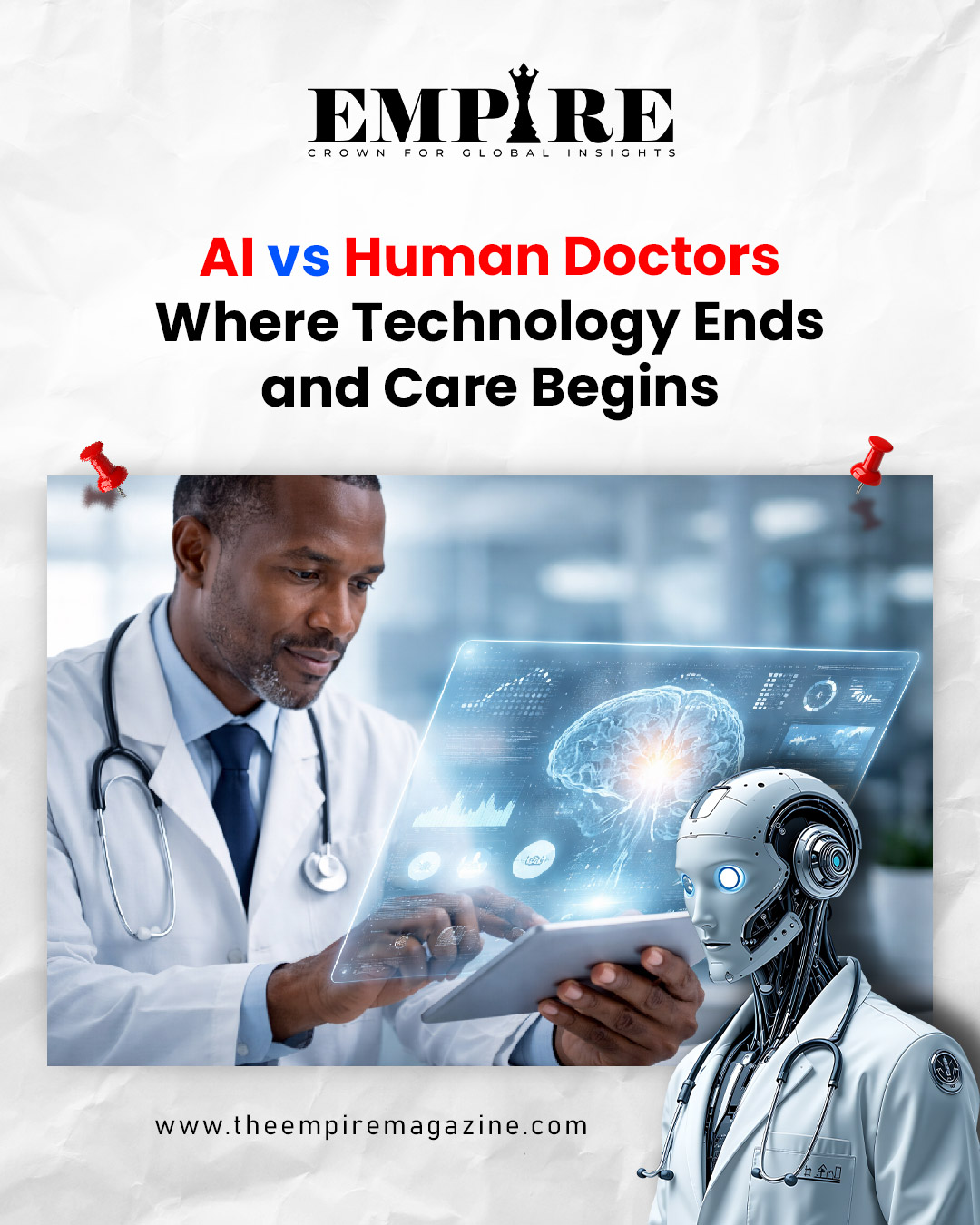
The answer, according to current evidence and healthcare experts, is more nuanced than a simple yes or no. While AI is becoming increasingly accurate at analysing vast amounts of medical data, healthcare remains deeply human. Compassion, ethical judgement, communication, and trust are qualities that machines have yet to replicate.
As healthcare systems worldwide struggle with rising patient volumes, physician shortages, and increasing costs, understanding where AI excels and where human expertise remains irreplaceable is becoming more important than ever.
Why the AI vs Human Doctors Debate Has Intensified
The conversation around AI vs Human Doctors has accelerated dramatically over the past few years due to breakthroughs in generative AI, machine learning, and large language models.
Healthcare organisations are increasingly deploying AI-powered systems to assist with:
- Medical image interpretation
- Early disease detection
- Clinical documentation
- Drug discovery
- Virtual patient support
- Predictive analytics
- Hospital workflow optimisation
According to global consulting firms and healthcare research organisations, AI could significantly improve productivity while reducing unnecessary healthcare costs over the coming decade.
Governments across the world; including India, the United States, the United Kingdom, and several European nations are also investing heavily in AI-driven healthcare infrastructure. However, regulators continue to emphasise that AI should assist clinicians rather than function as an independent decision-maker.
AI vs Human Doctors in Medical Diagnosis
Perhaps the most visible success of AI vs Human Doctors is in diagnostic medicine.
Modern AI systems can analyse thousands of medical images within minutes, identifying patterns that might be difficult for the human eye to detect consistently. AI-assisted imaging is now being used in radiology, dermatology, ophthalmology, cardiology, and pathology.
For example, AI tools have demonstrated impressive performance in identifying:
- Breast cancer from mammograms
- Lung nodules in CT scans
- Diabetic retinopathy through retinal imaging
- Skin cancer from dermatological photographs
- Brain abnormalities in MRI scans
Several peer-reviewed studies have shown that AI can match and in highly specialised settings occasionally exceed the diagnostic accuracy of experienced clinicians for specific image-based tasks.
However, medical diagnosis involves much more than recognising patterns. Human doctors combine imaging results with patient history, physical examination, family background, lifestyle factors, laboratory findings, and clinical intuition before making treatment decisions.
This broader clinical reasoning remains one of the biggest differences in the AI vs Human Doctors comparison.
Why Human Doctors Continue to Lead Patient Care
Although AI is exceptionally skilled at processing data, healthcare is fundamentally centred on people rather than algorithms.
Every patient arrives with unique circumstances that extend beyond laboratory reports or imaging scans. Anxiety, financial limitations, cultural beliefs, family dynamics, previous medical experiences, and emotional wellbeing all influence treatment decisions.
Human doctors continuously adapt their communication styles depending on each patient’s needs.
They can:
- Deliver difficult diagnoses compassionately
- Explain complex treatment options clearly
- Recognise emotional distress
- Build long-term trust
- Encourage treatment adherence
- Respond to unexpected complications during consultations
These interpersonal skills remain impossible to replicate through artificial intelligence alone.
Medical ethics further strengthens the role of physicians. Decisions surrounding end-of-life care, organ transplantation, pregnancy complications, informed consent, or balancing treatment risks require ethical reasoning that extends beyond data analysis.
This is where AI vs Human Doctors becomes less of a competition and more of a partnership.
Artificial Intelligence Is Becoming the Doctor’s Most Powerful Assistant
Rather than replacing clinicians, AI is increasingly becoming a sophisticated clinical support system.
Many hospitals already use AI to reduce routine administrative work, allowing doctors to spend more time interacting with patients.
AI can rapidly summarise electronic medical records, generate consultation notes, recommend evidence-based guidelines, prioritise emergency cases, identify medication interactions, and monitor patient deterioration in intensive care units.
In pharmaceutical research, AI has dramatically accelerated drug discovery by analysing enormous biological datasets that would take researchers years to evaluate manually.
Healthcare administrators also benefit from AI-powered scheduling systems, resource allocation, fraud detection, and predictive planning, improving overall hospital efficiency.
In practical terms, the future of AI vs Human Doctors is increasingly becoming AI with human doctors.
The Risks That Limit AI vs Human Doctors
Despite extraordinary progress, AI continues to face significant limitations.
One major concern is algorithmic bias. AI systems learn from historical medical datasets, and if those datasets underrepresent certain ethnic groups, age categories, or rare diseases, diagnostic performance may vary across populations.
Privacy remains another challenge.
Healthcare AI relies on enormous quantities of sensitive patient information. Ensuring secure storage, responsible data sharing, and compliance with privacy regulations remains essential for maintaining public trust.
AI systems may also produce incorrect or fabricated information, particularly generative AI models that are not specifically trained for clinical use. This phenomenon sometimes called “hallucination” highlights why AI-generated recommendations always require physician review.
Cybersecurity risks further complicate widespread adoption, as hospitals increasingly become targets for ransomware attacks capable of disrupting AI-enabled healthcare infrastructure.
Consequently, regulatory authorities worldwide continue to require human oversight for clinical decision-making involving AI.
AI vs Human Doctors in India’s Healthcare Future
India presents one of the most promising opportunities for AI-powered healthcare.
With a population exceeding 1.4 billion and a persistent shortage of healthcare professionals in many rural regions, AI has the potential to expand access to quality medical services.
Government initiatives promoting digital health records, telemedicine, and the National Digital Health Mission are creating a stronger technological foundation for AI integration.
AI can support India’s healthcare system through:
- Rural diagnostic assistance
- Telemedicine consultations
- Early disease screening
- Tuberculosis detection
- Maternal healthcare monitoring
- Predictive public health surveillance
- Hospital resource management
Indian technology companies and healthcare startups are also developing AI solutions tailored to local languages and regional healthcare challenges.
Nevertheless, experts consistently stress that AI should strengthen—not replace—the country’s medical workforce.
Doctors, nurses, and community health workers remain central to delivering safe and equitable healthcare.
AI vs Human Doctors: Building Trust Through Responsible Healthcare
Patient trust remains one of healthcare’s most valuable assets.
Many patients are comfortable with AI analysing scans or assisting with paperwork but still prefer receiving diagnoses, discussing treatment options, and making life-changing medical decisions with qualified physicians.
Healthcare professionals similarly recognise AI’s enormous value while emphasising that accountability must always rest with licensed medical practitioners.
Leading medical organisations advocate a “human-in-the-loop” approach, where AI supports decision-making but clinicians retain final authority over diagnosis and treatment.
This collaborative model balances technological efficiency with professional responsibility.
The Future of AI vs Human Doctors Is Collaboration, Not Competition
The future of AI vs Human Doctors is unlikely to be defined by replacement. Instead, healthcare is moving toward a hybrid model where artificial intelligence enhances the capabilities of medical professionals.
AI will continue becoming faster, more accurate, and more accessible. It will analyse complex datasets in seconds, identify hidden clinical patterns, assist personalised medicine, and automate repetitive tasks that currently consume valuable physician time.
Meanwhile, human doctors will remain responsible for empathy, ethical judgement, complex decision-making, patient relationships, and personalised care qualities that technology cannot authentically reproduce.
Rather than asking whether AI will replace doctors, the more relevant question is how doctors who effectively use AI will redefine healthcare itself.
The hospitals of the future are expected to combine advanced algorithms with experienced clinicians, creating a healthcare system that is not only more efficient but also more accurate, accessible, and patient-centred.
In the evolving story of AI vs Human Doctors, technology may transform medicine, but compassion, trust, and human connection will continue to define healthcare. Those are qualities no algorithm has yet mastered, and they remain the foundation of truly exceptional patient care.
For more insights, navigate on The Empire Magazine
Previous article: K-12 Education Crisis
Magazine Feautures | Podcasts: Empire Global Talks
Follow The Empire Magazine on Facebook | Instagram | LinkedIn
The Empire Magazine | Crown for Global Insights