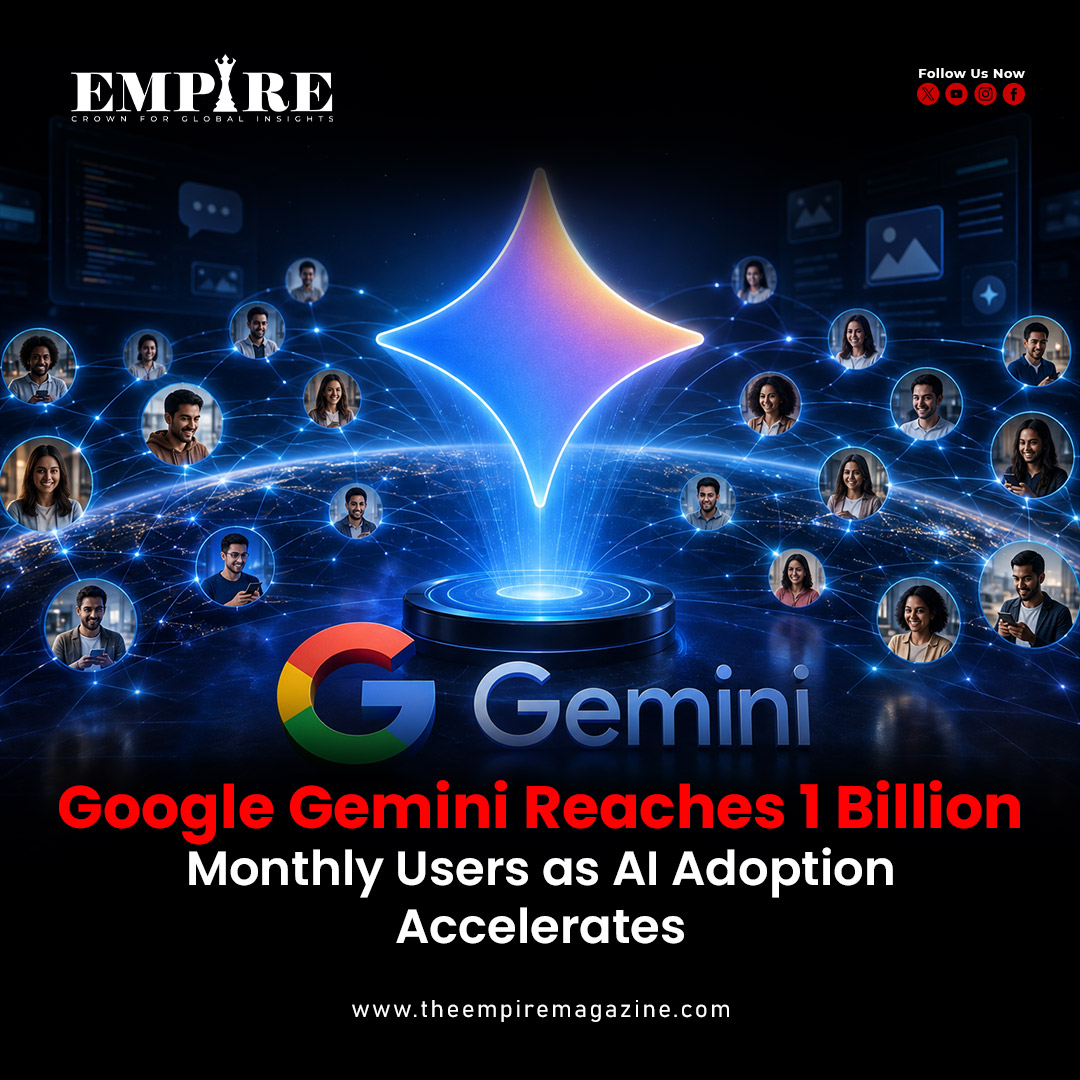
The milestone of Google Gemini 1 Billion Monthly Users marks a defining moment in the global adoption of artificial intelligence. Google’s Gemini app has crossed 1 billion monthly active users, establishing itself as one of the fastest-growing products in the company’s history and reinforcing the speed at which generative AI is moving from an emerging technology into an everyday digital utility. Announced by Google CEO Sundar Pichai in August 2026, the milestone places Gemini among a small group of technology products that have achieved extraordinary global reach.
The significance of this achievement extends well beyond the headline number. It demonstrates that consumers, professionals, students, entrepreneurs and organisations are increasingly comfortable turning to AI for information, productivity, creativity, research, communication and decision support. What began as a competitive response in the generative AI market has developed into a broad ecosystem integrated across Google’s enormous product infrastructure.
Gemini’s growth also reflects a fundamental change in how people interact with technology. Instead of navigating multiple applications and manually completing individual tasks, users are increasingly expecting digital platforms to understand context, interpret information and help them complete complex activities. The rise of Gemini is therefore not simply a story about an AI chatbot. It is a story about the transformation of the digital experience itself.
Google Gemini 1 Billion Monthly Users Signals a New AI Adoption Era
The achievement of Google Gemini 1 Billion Monthly Users illustrates how rapidly artificial intelligence has entered mainstream digital behaviour. Google had already reported that the Gemini app had surpassed 900 million monthly users earlier in 2026, more than doubling its user base in a year. Reaching 1 billion monthly active users only months later demonstrates the extraordinary pace of adoption.
For Google, the milestone carries particular importance because the company has spent decades building some of the world’s most widely used digital services. Search, Gmail, YouTube, Maps, Android and other products have created an enormous distribution network. Gemini benefits from this ecosystem because artificial intelligence can be introduced within products that billions of people already use.
This gives Google an important advantage in the AI race. Users do not necessarily have to discover an entirely new technology platform. Instead, AI capabilities can become part of familiar workflows.
A professional preparing a presentation can use AI to organise information. A student can ask for an explanation of a difficult subject. A business owner can use AI to develop ideas, analyse information or prepare communications. A researcher can use AI to explore large volumes of material. A consumer can use Gemini for planning, writing and everyday questions.
This breadth of applications helps explain why AI adoption is expanding beyond technology enthusiasts. The technology is increasingly becoming useful because it is connected to activities people already perform.
The milestone also highlights an important distinction between experimentation and adoption. Millions of people may try a new technology once, but reaching 1 billion monthly active users suggests recurring engagement at an extraordinary scale. Gemini is becoming part of the regular digital routines of a global audience.
Google Gemini 1 Billion Monthly Users Strengthens Google’s AI Ecosystem
The rise of Gemini cannot be separated from Google’s broader AI strategy. Google has been embedding Gemini capabilities across its product portfolio, allowing artificial intelligence to become increasingly present throughout the company’s ecosystem.
Gemini has been incorporated into services such as Gmail and Google Drive, where AI can assist with tasks including summarisation and information management. It is also playing an increasingly important role in Google Search, where AI-powered experiences are changing how users discover and interact with information.
Google’s approach is significant because it treats AI not merely as an independent application but as an underlying layer across its digital infrastructure.
This strategy could have long-term implications for how software is designed. Traditionally, users moved from application to application to complete different tasks. AI increasingly allows those tasks to be connected through a common interface.
For example, a user may begin with an email, move to a document, research information through Search and then prepare a presentation. As AI becomes more deeply integrated across these environments, the boundaries between individual applications can become less important.
Google’s own AI and Economy ATLAS initiative provides another indication of the scale of this transformation. The company says its first dataset was built from 15 million aggregated and de-identified human-AI interactions across the Gemini App, AI Mode and Gemini API, which together are used by more than 1 billion people monthly.
This ecosystem approach gives Google the opportunity to understand how people are using AI across different contexts and to develop products around real-world behaviour.
The next stage of competition may therefore not be determined solely by which company produces the most powerful model. Distribution, usability, ecosystem integration, infrastructure and the ability to make AI useful in everyday situations could become equally important.
Google Gemini 1 Billion Monthly Users Changes the Competitive AI Landscape
The Google Gemini 1 Billion Monthly Users milestone also intensifies competition across the global artificial intelligence industry.
The AI market has evolved rapidly since generative AI entered mainstream consciousness. Companies are competing not only to develop increasingly capable models but also to build platforms that can become essential to consumers and businesses.
Google enters this competition with several structural advantages. It has a global consumer ecosystem, enormous computing infrastructure, extensive research capabilities and access to products that already reach billions of people.
At the same time, the AI industry remains highly competitive. OpenAI, Anthropic, Meta and a growing number of specialised AI companies are developing increasingly sophisticated models and applications. The competitive environment is shifting from a simple race to produce a better chatbot toward a broader contest over AI platforms, agents, enterprise applications and digital ecosystems.
This evolution is particularly important for businesses.
Companies are increasingly evaluating AI based on measurable outcomes rather than novelty. Productivity improvements, customer service, research efficiency, software development, marketing, analytics and automation are becoming central areas of interest.
Google’s recent expansion of Gemini Enterprise reflects this transition toward business applications. The company is increasingly positioning Gemini as a platform capable of supporting specialised organisational workflows rather than simply answering consumer questions.
The enterprise opportunity could become one of the most important chapters in Gemini’s growth story. Consumer adoption creates familiarity, while enterprise adoption can create deeper and more commercially valuable use cases.
From AI Assistant to Everyday Digital Infrastructure
The achievement of Google Gemini 1 Billion Monthly Users raises a larger question: what happens when artificial intelligence becomes a normal part of digital life?
The answer may be visible in the way people are already changing their expectations of software.
Users increasingly want technology that understands intent rather than requiring precise instructions. They expect systems to summarise information, generate content, analyse data, provide recommendations and complete multi-step tasks.
This represents a major shift in human-computer interaction.
For decades, people adapted themselves to software by learning menus, commands and workflows. Generative AI is beginning to reverse that relationship. Software is increasingly expected to adapt to the user’s language and intent.
The implications extend across industries.
In education, AI can support personalised learning and research. In healthcare, it can assist professionals with information processing and administrative workflows. In finance, AI can support analysis and customer interactions. In manufacturing, it can contribute to optimisation and predictive processes. In marketing, it can accelerate content development and audience analysis.
However, rapid adoption also brings significant responsibilities.
The more people depend on AI systems, the more important accuracy, privacy, security and transparency become. AI-generated information can be incorrect, incomplete or misleading. Organisations must therefore develop appropriate governance frameworks while users need to maintain critical judgment.
The scale of Gemini’s audience makes these considerations particularly important. A system used by 1 billion people has an influence that extends far beyond technology.
The question is no longer whether AI will become mainstream. The more important question is how responsibly and effectively society will integrate it.
What the Gemini Milestone Means for the Future
The achievement of 1 billion monthly users represents more than a growth statistic for Google. It is a signal that artificial intelligence has entered a new stage of maturity.
The first phase of generative AI was characterised by curiosity and experimentation. Users explored what AI could create, understand and automate. The next phase is defined by integration. AI is becoming embedded into search, productivity tools, communication platforms, enterprise systems and everyday workflows.
Gemini’s rapid growth illustrates this transition.
Google’s ability to connect Gemini with its existing ecosystem could accelerate adoption further. As AI becomes increasingly integrated into Search, Workspace and other services, users may encounter intelligent capabilities without actively seeking out an AI product.
That could make AI less visible but more influential.
The future of artificial intelligence may not be defined by users opening an AI application every time they need assistance. Instead, AI could increasingly operate quietly in the background, helping organise information, anticipate needs, automate routine processes and support decision-making.
For businesses, this creates both an opportunity and a challenge. Organisations that understand how to integrate AI into their operations can potentially gain advantages in productivity, speed and innovation. Those that treat AI as a temporary trend may find themselves struggling to keep pace with competitors.
For Google, the next challenge will be converting extraordinary user reach into sustained engagement, meaningful productivity and long-term trust.
The Google Gemini 1 Billion Monthly Users milestone proves that the appetite for AI is enormous. It also demonstrates that distribution can be as powerful as technological capability.
The next chapter will be about what those billion users actually accomplish with AI.
As artificial intelligence continues to evolve from an experimental technology into everyday digital infrastructure, the companies that succeed will be those that can combine powerful models with accessibility, reliability, responsible innovation and genuine usefulness.
Gemini’s journey to 1 billion monthly users is therefore not simply a milestone for Google. It is a reflection of a broader transformation in technology and society. AI adoption is accelerating, and the digital world is entering an era where intelligent systems are no longer an emerging possibility. They are becoming part of how the world works.
Previous article: US Bond Market Volatility Tests Investors as Treasury Yields and $40 Trillion Debt Draw Attention
Magazine Feautures | Podcasts: Empire Global Talks
Follow The Empire Magazine on Facebook | Instagram | LinkedIn | YouTube
The Empire Magazine | Crown for Global Insights