
United States | Healthcare AI, Startups & Innovation
Information checked on 10 October 2026.
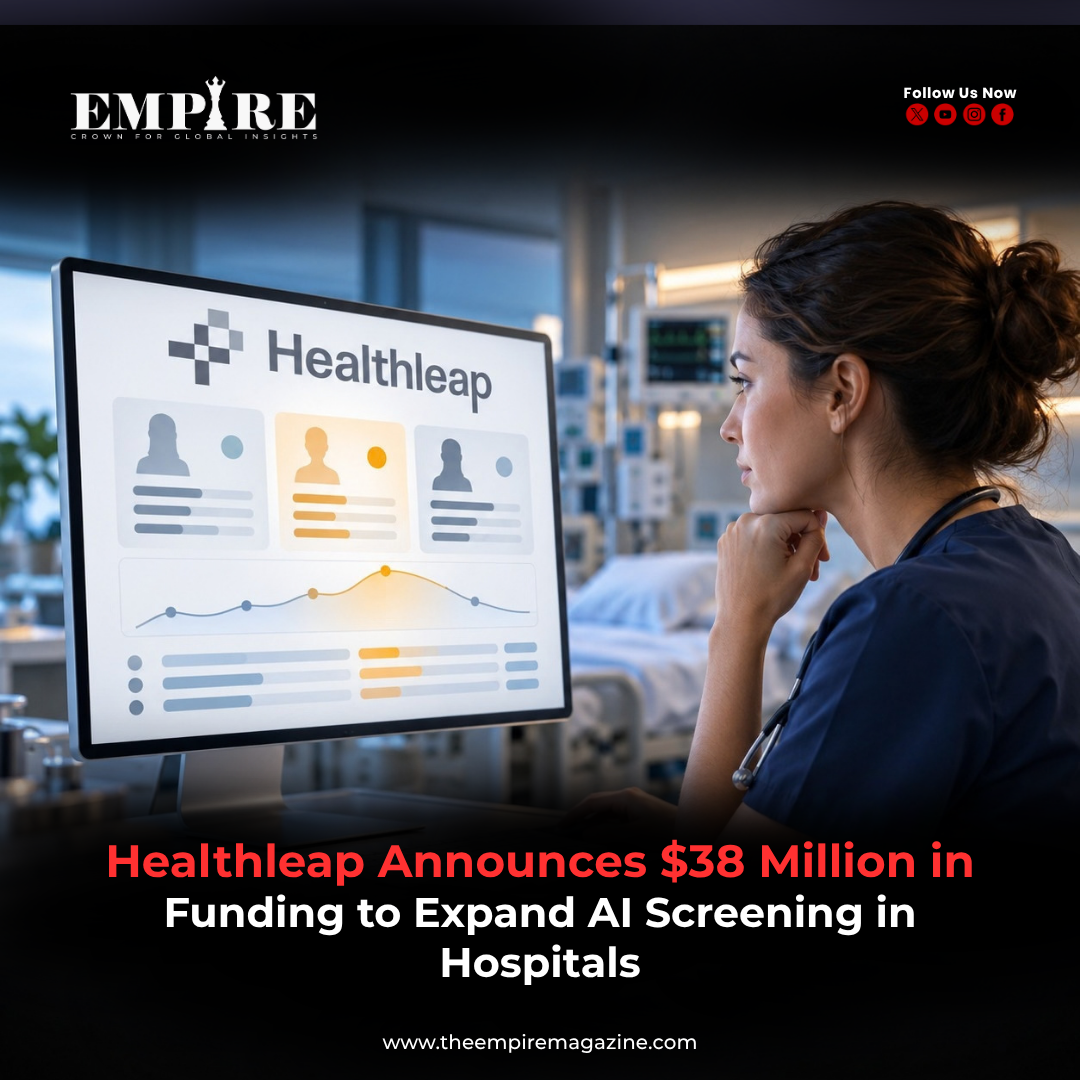
Healthleap has announced $38 million in combined seed and Series A funding to expand its AI screening platform for hospitals. Announced on 7 October 2026, the financing includes backing from Sequoia Capital, First Round Capital and Hummingbird Ventures.
The company’s software reviews electronic health records to identify patients who may need further clinical assessment, initially focusing on malnutrition. Its aim is to help care teams decide where to direct their attention as information accumulates during a hospital stay.
The announcement brings together a startup funding story and a practical question for healthcare technology: can software help clinicians identify overlooked risks without adding another difficult-to-manage layer to their work?
What the Healthleap Funding Will Support
The $38 million covers two financing stages. TechCrunch reported an $8 million seed round and a $30 million Series A.
Healthleap says the capital will support expansion into additional conditions and recruitment across engineering, product, sales and customer success.
Those priorities reflect the work involved in bringing a clinical software product into more hospitals. Building a model is one part of the process; connecting it to local records, supporting users and maintaining a dependable service are also necessary.
For the business, expansion therefore depends on more than signing new customers. Each implementation needs to fit the hospital’s information systems and the way its clinical teams organise their day.
A Company Built From a Dietitian’s Experience
Healthleap was co-founded by siblings Jemima Meyer, a clinical dietitian, and Josiah Meyer, the company’s chief executive.
According to the company, Jemima first developed NutriLeap, a tool intended to help dietitians reach the patients who needed them more quickly. The subsequent venture broadened that work into a platform for identifying risks across hospital records.
This origin helps explain the company’s initial focus on malnutrition. Its starting point was the practical challenge of deciding which patients should receive closer attention from a nutrition team.
The product’s value proposition centres on helping clinicians use information that already exists. A record can contain relevant observations across different notes, measurements and entries; bringing those signals together is the task the software is intended to support.
How Healthleap’s Daily Screening Works
Healthleap describes a process that reviews adult inpatient records each day and places a nutrition-risk score into the hospital’s electronic health record, or EHR, each morning.
Dietitians can use the resulting prioritisation within their existing workflow. The company positions the system before clinical assessment, diagnosis and documentation.
| Stage | Intended role |
|---|---|
| Review available records | Examine information already held in the hospital’s EHR |
| Identify possible risk | Produce signals that help prioritise adult inpatients |
| Support clinical assessment | Give dietitians information to review alongside the patient’s clinical circumstances |
| Continue monitoring | Refresh screening as records change during the hospital stay |
The operational benefit would be a clearer starting point for the clinical team’s day.
For example, a hypothetical patient’s admission record might contain limited information, while later notes document changes relevant to nutrition. Repeated screening could bring those later observations to the team’s attention.
Whether that becomes useful care depends on the quality of the record and the assessment that follows.
What the Published Malnutrition Study Shows
A 2025 study in Applied Clinical Informatics evaluated the approach using records from 166,841 admissions involving 106,449 unique adult patients at Cedars-Sinai.
The retrospective analysis covered approximately 3.75 years. Its model combined a language model that extracted information from clinical notes with a separate machine-learning model that estimated malnutrition risk.
The researchers reported an AUROC of 0.92 on the first hospital day, increasing to 0.95 when using each patient’s highest predicted risk during their stay, measured against discharge-coded malnutrition.
AUROC describes how well a model distinguishes cases from non-cases across different thresholds. A value of 0.95 does not mean 95% of patients were correctly diagnosed.
The study provides evidence about screening performance in the population examined. It used data from one hospital and did not establish that introducing the software caused shorter stays or fewer deaths.
Several authors were Healthleap employees or advisers. Wider testing and prospective evaluation would help establish how the findings translate to other hospitals.
Hospital Adoption and the Financial Case
In his funding announcement, Josiah Meyer said Healthleap had grown from three to more than 50 hospital partners over the preceding year.
The company names organisations including Penn Medicine, Cedars-Sinai, Houston Methodist and Emory Healthcare among its partners.
Healthleap’s published Penn Medicine case study reports $23.8 million in annualised financial impact at the Hospital of the University of Pennsylvania, based on first-quarter results. Its evidence page breaks this into approximately $6.3 million in additional reimbursement and $17.5 million in impact associated with shorter hospital stays.
These are company-published deployment and financial results, separate from the peer-reviewed model-validation study.
An annualised figure expresses results on a yearly basis; it does not mean that an equivalent amount of cash savings has already been realised over a completed year. Additional reimbursement and the financial value of shorter stays also measure different effects.
For prospective customers, the useful questions include how the estimates were calculated, what changed in clinical practice and whether comparable results could be achieved with their own patients and staffing.
Clinicians Remain Responsible for Assessment and Care
The company’s intended-use statement describes Healthleap Nutrition as clinical decision-support software for registered dietitians working with adult hospital patients.
It provides risk information and supporting evidence to help prioritise assessment. It does not diagnose malnutrition or recommend treatment, and its published scope excludes paediatric, outpatient and emergency decision-making.
This defines the role of the nutrition product within the care process. A risk signal gives a clinician a reason to review a patient; the clinical assessment determines what that signal means.
The supporting information is consequently as important as the score itself. A dietitian needs to understand which observations contributed to the result and whether they remain relevant to the patient’s current circumstances.
Useful automation should make that review easier to conduct and document.
Expansion Beyond Malnutrition
In his announcement, Meyer described delirium as Healthleap’s second deployed condition. He identified aspiration pneumonia, acute kidney injury, congestive heart failure and pressure injuries among the next areas of development.
These statements describe the company’s expansion plans and deployment claims. The malnutrition study does not validate performance across those additional conditions.
Each application presents a different clinical and operational question. Detecting a risk of deterioration, identifying an existing condition and estimating the likelihood of readmission involve different outcomes and may require different evidence.
The team receiving the signal may also change. A workflow built around a dietitian’s daily assessment list will not automatically fit another department’s responsibilities or response times.
The funding gives Healthleap resources to develop these applications. Their usefulness will depend on evidence for each condition and how well the tools fit the teams expected to act on them.
What Will Matter in Healthleap’s Next Phase
Healthleap’s next stage will be easier to assess through results from specific hospital implementations and individual screening applications.
Several measures would help establish progress:
- Clinical usefulness: How often a flagged patient needs further assessment or intervention.
- Timeliness: Whether relevant patients are identified earlier in a way that changes care.
- Workload: The time required to review signals, including those that do not lead to a confirmed finding.
- Consistency: Performance across hospitals with different patient populations and records.
- Financial value: Benefits measured alongside software, integration and staffing costs.
These are criteria for evaluating future progress, rather than outcomes established by the funding announcement.
The commercial opportunity is to make existing clinical information easier to act on. Sustained growth will depend on hospitals finding that the software helps their teams reach the right patients, while retaining a clear basis for the decisions they make.
Explore more global business, technology and innovation coverage in The Empire Magazine’s article archive.
Read our related coverage: Microsoft’s experimental Quine system for biology research.
Follow The Empire Magazine:
Facebook | Instagram
The Empire Magazine | Crown For Global Insights