
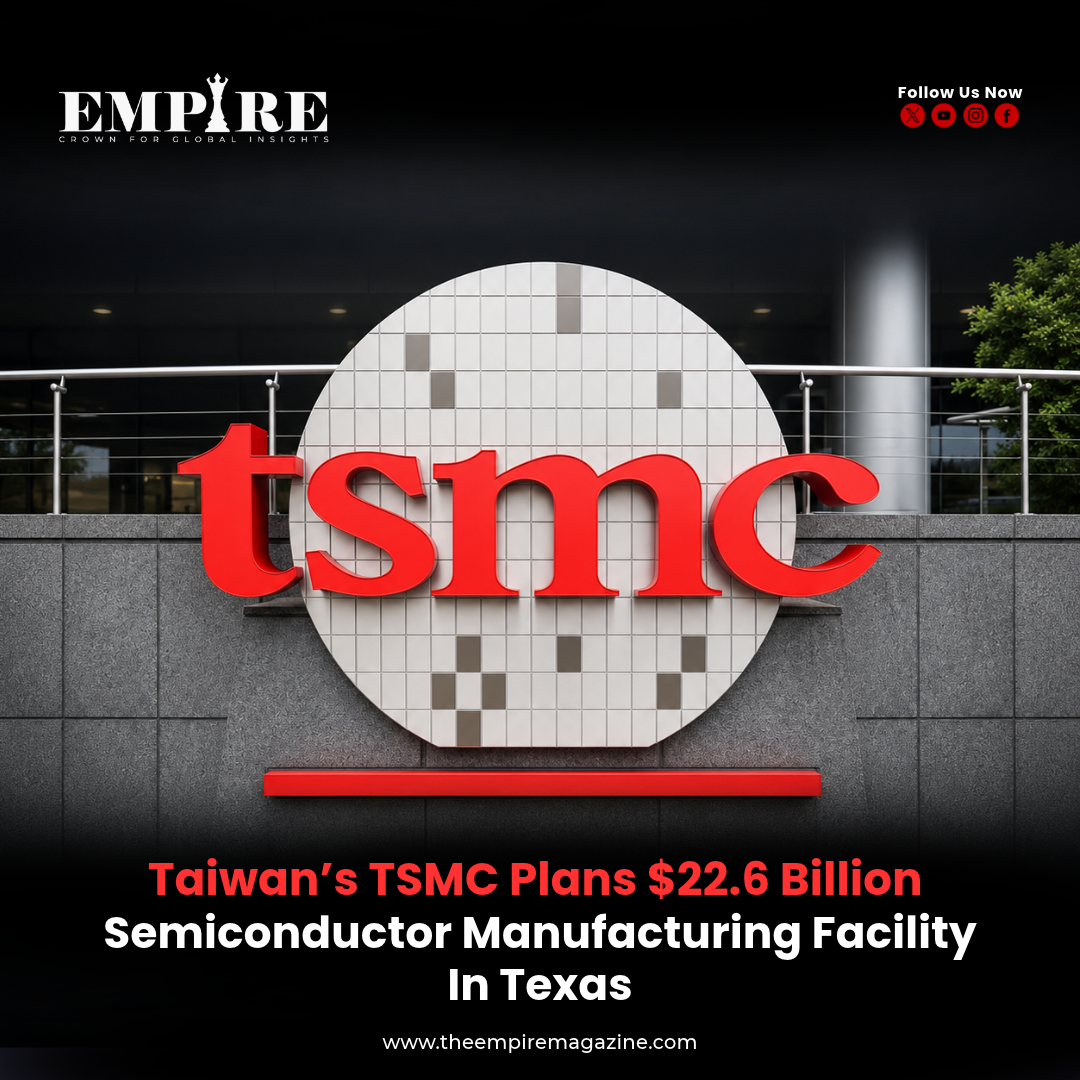
The proposed Brazos County campus would manufacture advanced chips for AI, computing and mobile devices, with tax incentives and final investment approval still pending.
The TSMC Texas chip plant proposal has brought a potential $22.6 billion semiconductor investment into focus, as the Taiwanese company evaluates a manufacturing campus in Brazos County.
TSMC has confirmed its application for a Texas property-tax incentive while emphasising that the investment remains under evaluation. The filing is part of its assessment process, and the company has not announced a final decision to build the facility.
The project has nevertheless advanced through an initial state review. On November 24, local officials announced that the Texas Comptroller had recommended the application for consideration by the governor and College Station Independent School District.
The TSMC Texas Chip Plant Proposal
The proposed development is formally described as the TSMC Texas Advanced Semiconductor Manufacturing Campus. Its application was submitted by TSMC Arizona Corporation through the state’s Jobs, Energy, Technology and Innovation programme, known as JETI.
The site covers approximately 3,232 acres in Brazos County, within College Station’s extraterritorial jurisdiction and the school district’s boundaries. The campus description allows for one or more semiconductor fabrication facilities and supporting infrastructure, while the initial investment proposal centres on a manufacturing facility valued at about $22.6 billion.
That scale makes the proposal significant for the region. Its eventual economic contribution would depend on how much manufacturing capacity is approved, built and brought into sustained operation.
Advanced Chips for AI, Computing and Mobile Devices
The TSMC Texas chip plant would manufacture logic semiconductors using 2-nanometre or more advanced process technology. The intended applications include artificial intelligence, high-performance computing and mobile devices.
TSMC’s N2 technology uses its first generation of nanosheet transistors, with improvements in performance and power efficiency. The company says N2 entered volume production in the fourth quarter of 2025. The Texas proposal would therefore expand access to advanced manufacturing technology through an additional production location.
The reference to “2-nanometre or more advanced” also leaves room for the manufacturing process to evolve before the proposed campus becomes operational. The filing should not be read as a fixed specification for every chip the facility might eventually produce.
Tax Incentives Are Central to the Site Decision
Tax treatment is a major consideration for the TSMC Texas chip plant. The company argues in its application that the requested limitation is a deciding factor in whether the Texas investment can be economically justified.
The proposed arrangement would limit the taxable value of eligible property to 50% for school district maintenance and operations taxes during a ten-year incentive period. School debt-service taxes would continue to apply to the property’s full taxable value.
The comptroller’s 20-year assessment estimates approximately $354.1 million in gross maintenance and operations tax savings associated with the proposed arrangement. This is a projection based on the application and its valuation assumptions.
For local decision-makers, the evaluation involves balancing the proposed tax concession against the project’s expected investment, employment and longer-term contribution to the tax base.
Arizona Remains a Competing Location
The TSMC Texas chip plant is being evaluated alongside alternatives in Arizona, where the company already operates semiconductor manufacturing facilities.
In its filing, TSMC identifies operational efficiencies and lower capital risk associated with the Arizona alternatives. It argues that the requested Texas incentive would help narrow the financial gap between the locations.
This comparison helps explain why an incentive application can be detailed even while the location remains undecided. A company can assess land, infrastructure, financing and public support before committing to construction.
Texas must therefore demonstrate that the proposed campus offers a workable combination of operating conditions, investment economics and long-term capacity.
Construction Timetable and Public Review
The planning schedule for the TSMC Texas chip plant points to construction beginning in 2027 and finishing in 2031, subject to the project proceeding.
The next public milestones and projected development periods are:
| Milestone | Scheduled or projected timing |
|---|---|
| Community town hall | December 7, 2026 |
| School district public hearing | December 10, 2026 |
| Projected construction period | 2027–2031 |
| Proposed ten-year incentive period | 2032–2041 |
Brazos County has announced the town hall, while the school district’s hearing will address the JETI application and proposed reinvestment zone. The construction and incentive dates come from the comptroller’s recommendation packet.
These dates distinguish scheduled public meetings from projected development milestones. Moving from construction to commercial output would also require the operational preparation needed to bring a sophisticated manufacturing facility into reliable production.
Employment and Regional Economic Potential
County officials project that the TSMC Texas chip plant could create at least 2,099 direct jobs, with an estimated average annual salary of approximately $133,000.
Brazos County is coordinating with College Station, Bryan, the school district, Texas A&M University and the Greater Brazos Partnership as the proposal is evaluated.
If the project proceeds, its effects could extend to suppliers, engineering services, construction contractors and other businesses supporting the campus. Those opportunities would depend on procurement decisions and the extent to which local firms can meet the manufacturer’s requirements.
Workforce preparation would also matter. Turning projected employment into lasting regional benefits would require suitable training, recruitment and the infrastructure needed to support a large industrial operation.
How the Proposal Fits TSMC’s US Expansion
The TSMC Texas chip plant would represent a potential additional manufacturing location within the company’s expanding US presence.
In July 2026, the US Department of Commerce announced a further $100 billion investment commitment from TSMC for semiconductor manufacturing and packaging facilities in Arizona, bringing its announced US commitment to $265 billion. The announcement described a planned total of 12 semiconductor and packaging facilities.
The Texas evaluation reflects the broader question of where future manufacturing capacity can be developed most effectively. An additional location could broaden geographic production options, although its value would depend on execution, customer requirements and operating costs.
The Decisions Still Ahead
The JETI agreement requires favourable decisions from the governor and the school district, and TSMC must make its final investment decision. Any county incentive agreement would be considered separately.
The proposed TSMC Texas chip plant is therefore a substantial investment opportunity with a defined review process. Its progress will be measured by completed approvals, an investment commitment and delivery of the planned manufacturing capacity.
Explore more global business, technology and innovation coverage in The Empire Magazine’s article archive.
Read our related coverage: maple-ai-seed-funding-private-chat/
Follow The Empire Magazine:
Facebook | Instagram
The Empire Magazine | Crown For Global Insights