
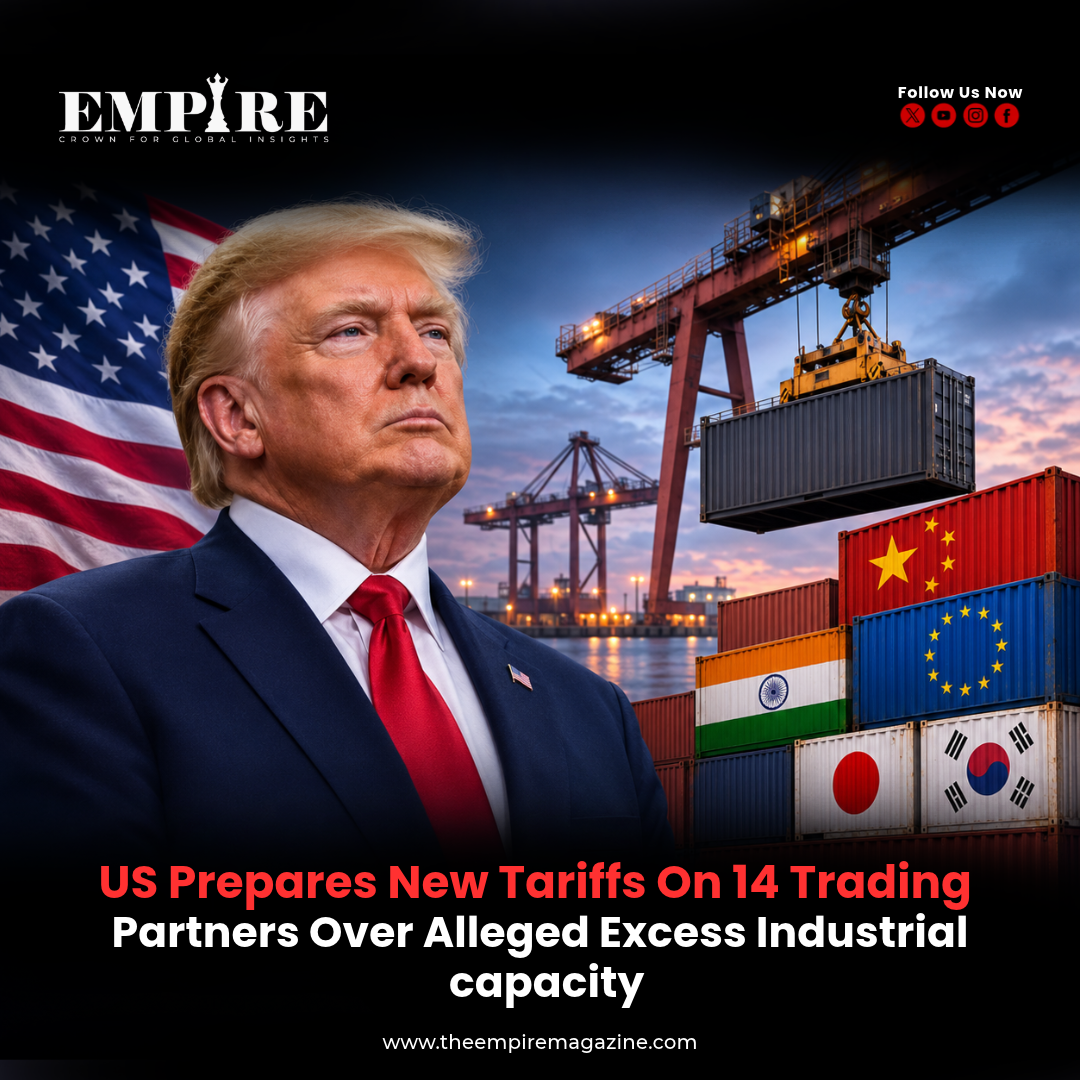
Washington has proposed new import duties following manufacturing investigations, with negotiations, product exemptions and public hearings set to shape the final measures.
The latest US tariff proposals target 14 trading partners over alleged policies that sustain excess industrial capacity. Announced on November 25, 2026, the measures could affect trade with major manufacturing economies, including China, the European Union and Japan.
As of November 26, these proposed duties are not in effect. The announcement opens another stage of consultation and negotiation, with public hearings scheduled for January 2027. Final rates and implementation arrangements remain unsettled.
Scope of the US Tariff Proposals
The Office of the United States Trade Representative, or USTR, issued the findings under Section 301 of the Trade Act of 1974.
The investigations originally covered 16 economies. USTR has not yet made determinations concerning Mexico and Norway; neither has been permanently exempted.
The European Union counts as one trading partner in the current group of 14.
The Industrial Overcapacity Allegations
The US tariff proposals rest on Washington’s contention that government interventions can sustain manufacturing capacity beyond levels supported by market demand.
In its March investigation notice, USTR described structural excess capacity as industrial capacity maintained or expanded through policies that weaken normal market incentives. It argued that persistent overproduction can encourage exports, suppress investment elsewhere and undermine American manufacturing.
Under this reasoning, the concern extends beyond individual shipments. It involves the policies influencing how factories receive support, expand production and compete internationally. These are the US government’s allegations and findings; affected governments can dispute both the analysis and the proposed response.
The 14 Trading Partners and Proposed Rates
The US tariff proposals contain different approaches for different economies. The figures below describe the principal proposals, before applicable offsets, product exclusions and alternative rates.
| Trading partner or group | Principal proposed approach |
|---|---|
| China | Up to 20% on goods outside specified annexes, up to 10% on Annex A products, and exemptions for Annex B products. The notice also contemplates an alternative of up to 40% if engagement proves inadequate. |
| European Union, Japan, South Korea, Switzerland and Taiwan | A 15% benchmark, with adjustments for ordinary most-favoured-nation duties and existing Section 301 tariffs, alongside product exemptions. |
| Bangladesh, Cambodia, Indonesia, Malaysia and Thailand | Up to 18%, net of existing Section 301 tariffs, with exemptions for specified goods. |
| Vietnam | Up to 35%, with a 20% rate contemplated if a responsive trade agreement is reached. |
| India | Up to 25%, with a 17% rate contemplated if a responsive trade agreement is reached. |
| Singapore | Up to 20%, potentially adjusted to 10% following a responsive agreement or other negotiations. |
The grouped rates reflect USTR’s announcement; the China, Vietnam, India and Singapore notices detail the conditional alternatives. Several proposals allow higher rates if negotiations or commitments are judged insufficient. These figures therefore should not be treated as final customs charges or universal ceilings.
How the US Tariff Proposals Interact With Existing Duties
The headline percentages do not all represent identical additions to current import costs.
For China, the proposed 20% rate includes an offset for duties under the separate Section 301 investigation into enforcement of forced-labour import restrictions. That provision does not erase every earlier tariff on Chinese goods.
For the EU, the proposed calculation accounts for ordinary most-favoured-nation tariffs and existing Section 301 duties. Its notice also identifies exemptions involving certain products already covered by Section 232 measures.
Consequently, simply adding every announced percentage together could misstate the duty on a particular shipment. Product classification, origin and the final exclusion lists would determine the applicable treatment.
Public Comments and the January 2027 Hearings
The next formal stage for the US tariff proposals is public consultation.
Written comments and requests to appear at the hearings are due by January 5, 2027. Public hearings are scheduled to begin on January 25, 2027.
The consultation allows interested parties to address proposed rates, product coverage and exemptions. Businesses can explain potential supply problems or the consequences of duties on particular inputs.
The hearing date is a procedural milestone, rather than an automatic date for collecting the proposed tariffs.
China Rejects Washington’s Position
China has challenged the premise behind the US tariff proposals.
At a November 25 press briefing, Foreign Ministry spokesperson Guo Jiakun rejected the industrial overcapacity allegation and argued that it should not become a justification for political pressure.
He called for consultation based on equality, mutual respect and mutual benefit, while urging both governments to implement their leaders’ understandings and maintain stable trade relations. His remarks did not announce retaliatory measures.
Potential Costs for Businesses and Consumers
For businesses, the US tariff proposals create uncertainty around purchasing, pricing and future supply agreements.
Under US customs rules, importers are legally responsible for paying applicable duties. The economic burden can then move through the commercial relationship: suppliers may accept lower prices, importers may absorb costs, or customers may face higher charges. The balance would depend on competition, contracts and the availability of substitutes.
Domestic producers competing with covered imports could gain a pricing advantage. However, American manufacturers that depend on imported components could face higher input costs.
The announcement alone cannot establish how much consumer prices would change. That would require knowing the final duties, affected products and businesses’ responses.
Supply Chains and the Next Trade Decisions
The commercial consequences could extend beyond the immediate price of imports. Firms may reconsider where to source components, how much inventory to hold and whether new production investments remain attractive.
Those decisions involve trade-offs. A replacement supplier may offer lower tariff exposure but require additional testing, longer delivery times or different production standards. Moving production also takes capital and time.
For now, the US tariff proposals leave businesses facing several possible outcomes. Negotiated adjustments, product exemptions and final implementation decisions will determine whether the initiative produces modest changes to existing trade arrangements or substantially raises costs across affected supply chains.
Explore more global business, technology and innovation coverage in The Empire Magazine’s article archive.
Read our related coverage: spacex-data-centres-one-million-satellites/
Follow The Empire Magazine:
Facebook | Instagram
The Empire Magazine | Crown For Global Insights