
By The Empire Magazine | 18 November 2026
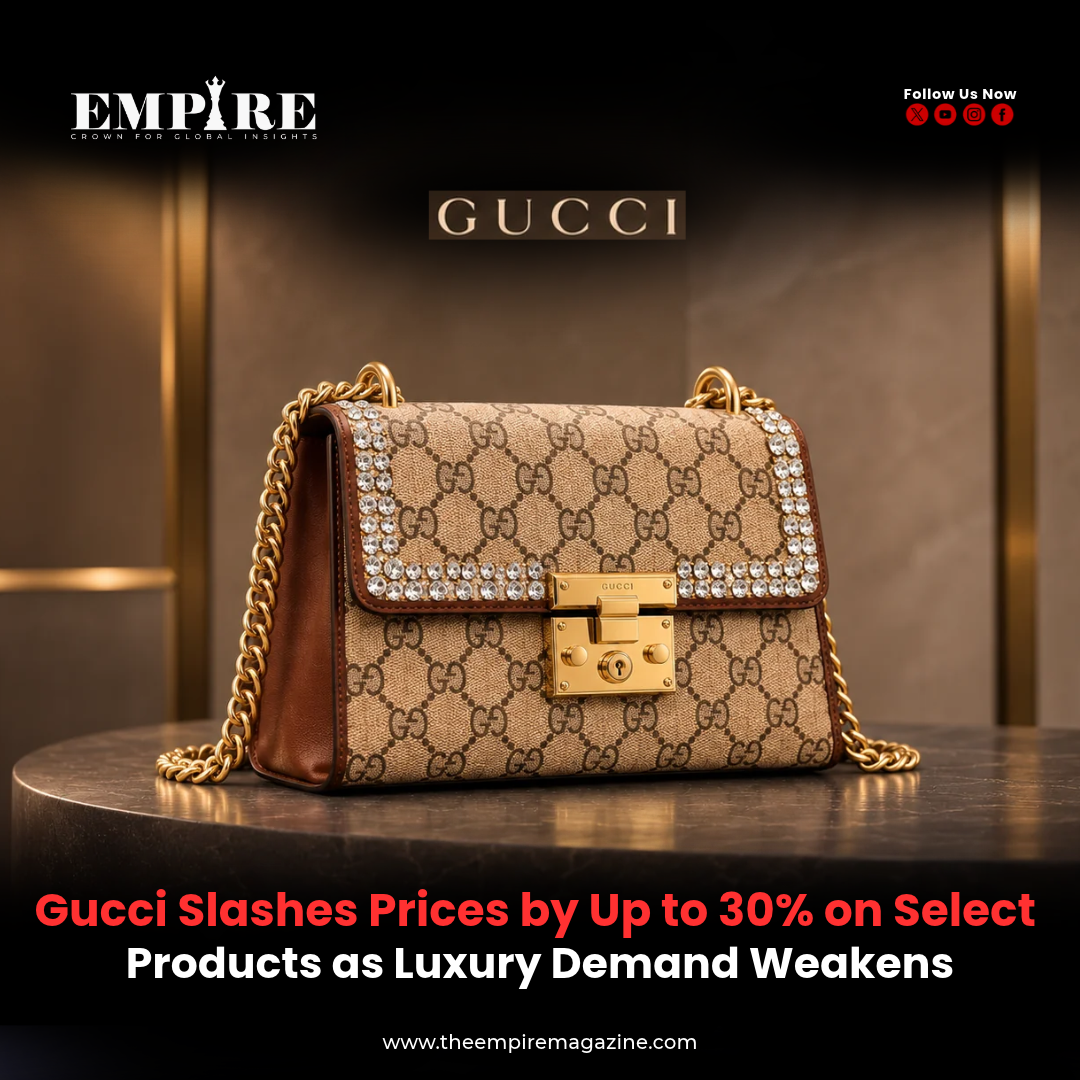
Gucci price cuts are drawing attention as the Italian luxury house adjusts selected products while working to rebuild demand. Recent reporting has identified reductions reaching 30%, including a crystal-embellished Padlock handbag sold in France.
The changes concern particular products and markets. Kering, Gucci’s parent company, has acknowledged limited reductions on seasonal items while maintaining that its broader strategy centres on desirable products, quality and appropriate pricing.
The timing also matters. Reports describe adjustments made over the summer, with renewed attention in November as Gucci continues its turnaround.
Gucci Price Cuts Include a 30% Handbag Reduction
The Wall Street Journal reported on 15 November that Gucci’s small Padlock crystal top-handle bag had fallen from €3,500 in France in July to €2,450, citing a comparison highlighted by Bernstein analyst Luca Solca.
Gucci’s French website also listed a crystal-embellished small Padlock top-handle bag at €2,450 when checked for this article.
| French handbag price comparison | Amount |
|---|---|
| Reported July price | €3,500 |
| Current listed price | €2,450 |
| Difference | €1,050 |
| Reduction from the reported earlier price | 30% |
The percentage describes a specific comparison. Shoppers should check the exact model and local listing before assuming the same reduction applies to another bag, colour or market.
Price Changes Differ Across Markets
Further evidence of Gucci price cuts comes from South Korea. The Korea JoongAng Daily reported on 17 November that the Mercato small tote had fallen by 21.3% to 3.5 million won.
These examples show how selected prices have changed by different amounts. The French Padlock comparison and the Korean Mercato reduction concern different products, currencies and markets.
For readers following the story, the practical distinction is between a lower price on a particular item and a general promotion across a brand’s entire collection. The available evidence supports selective adjustments.
Kering Explains the Limited Scope of the Reductions
Kering addressed Gucci price cuts during its third-quarter earnings call on 22 October.
Chief Financial Officer Armelle Poulou said the reductions involved a limited number of seasonal products associated with earlier creative collections. She described the changes as part of efforts to clear older merchandise and said they had also encouraged some customers to visit stores and purchase newer products.
Poulou emphasised the importance of offering products at appropriate prices while improving customers’ perception of quality. She said Gucci was not undergoing a general repositioning of its prices.
That explanation places the changes within a wider product and inventory strategy. It also helps explain why selected reductions can coexist with new collections offered at different price levels.
Latest Sales Figures Show the Turnaround Challenge
The commercial context for Gucci price cuts is visible in Kering’s latest results.
Gucci generated €1.291 billion in revenue during the third quarter of 2026, down 4% as reported and 6% on a comparable basis from a year earlier.
The comparable measure helps assess performance after adjusting for factors such as currency movements and changes in the reporting perimeter.
Kering identified store traffic as the main constraint. At the same time, it reported improvements in conversion, average selling price and average transaction value as new collections reached customers.
These figures suggest that attracting shoppers remains a central challenge. Better spending among those who buy does not automatically compensate for fewer people visiting or purchasing.
Lower Individual Prices Can Coexist With Higher Averages
Gucci price cuts on selected products do not necessarily mean the average price across all sales falls.
An average depends on the combination of products customers purchase. If more shoppers choose higher-priced bags, or buy additional items, average selling prices and transaction values can rise even while certain older products become cheaper.
This is a general explanation of how sales averages work. Kering has not published enough product-level sales information to isolate the effect of each individual reduction.
The distinction is useful because a 30% change on one handbag cannot be applied to the brand’s entire revenue base or used to calculate its overall profitability.
Pricing Changes Form Part of a Broader Plan
Gucci price cuts sit alongside a wider effort to strengthen the brand’s appeal.
In its April 2026 strategy presentation, Kering outlined plans for clearer creative direction, stronger leather goods, higher quality standards and a more coherent offer across clothing, shoes and jewellery. It also highlighted regional strategies and changes to distribution.
Those objectives address several reasons a customer might choose a luxury product: design, craftsmanship, usefulness, brand identity and the experience of buying it.
The group’s results also show that demand is uneven across brands. Kering reported continued growth at Saint Laurent, Bottega Veneta and Brioni, indicating that Gucci’s challenges need to be understood alongside its own product and brand transition.
The Opportunity and Risk Behind Lower Prices
From a business perspective, Gucci price cuts could bring selected items within reach of shoppers who had postponed a purchase or questioned their value.
A lower price can encourage renewed consideration, especially for customers who buy luxury goods occasionally. Whether that interest produces lasting demand depends on the appeal of the products and the broader shopping experience.
There are also trade-offs. If other conditions remain unchanged, a lower selling price reduces revenue per item. The business would need additional volume, a different sales mix or lower costs to offset that effect.
Customers who recently paid more may also reassess the value of their purchase. These are potential consequences of repricing; the available results do not quantify the reductions’ direct effect on customer loyalty or profit.
What to Watch in Future Updates
The next test for Gucci price cuts will be whether the wider turnaround attracts more customers and supports sustained sales improvement.
Future reporting on store traffic, comparable revenue, customer conversion and profitability will provide a clearer assessment than individual price comparisons alone.
For shoppers, the immediate change is specific: some products are available at lower listed prices in certain markets. Checking the exact item, current local price and availability remains essential before making a purchase.
Explore more global business, technology and innovation coverage in The Empire Magazine’s article archive.
Read our related coverage: apple-outage-icloud-gmail-google-reports/
Follow The Empire Magazine:
Facebook | Instagram
The Empire Magazine | Crown For Global Insights