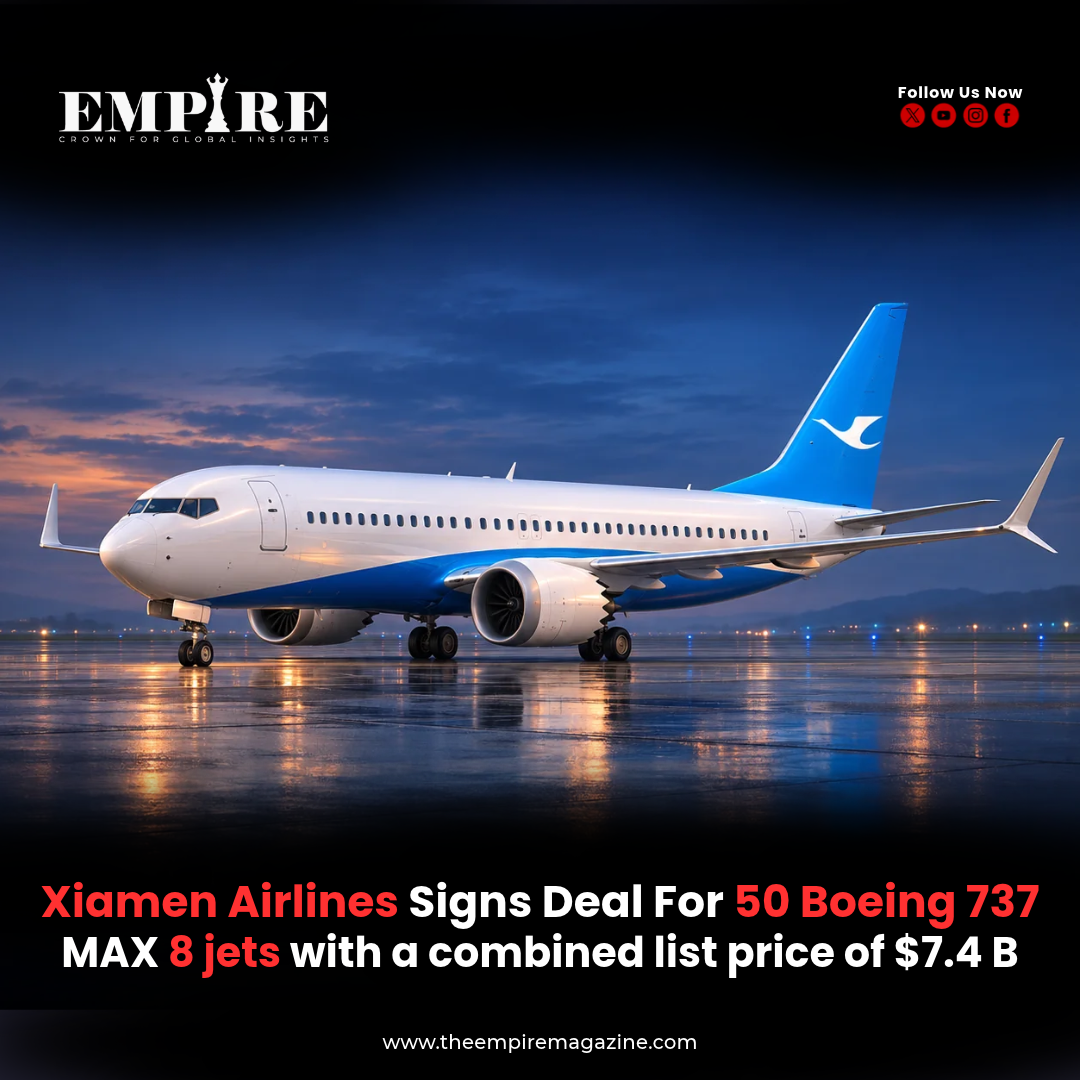
The agreement sets out deliveries for 2031–2034 as the Chinese carrier prepares for its next phase of fleet development.
The Xiamen Airlines Boeing deal covers the purchase of 50 Boeing 737-8 aircraft, commonly known as the 737 MAX 8, with a combined list price of approximately US$7.4 billion. Signed on 24 November 2026, the agreement was disclosed by parent company China Southern Airlines.
The transaction gives the airline a substantial pipeline of aircraft for the next decade. However, the headline valuation is a catalogue figure: the negotiated purchase price is lower, and the acquisition still requires shareholder and government approvals.
Key Terms of the Xiamen Airlines Boeing Deal
China Southern holds a 55% stake in the carrier. The agreement establishes a delivery window extending across four years, with aircraft arriving in batches.
| Deal detail | Announced terms |
|---|---|
| Aircraft | 50 Boeing 737-8 jets |
| Combined list price | Approximately US$7.4 billion, including airframes and engines |
| Actual purchase price | Lower than list price; undisclosed |
| Planned deliveries | 2031–2034 |
| Outstanding approvals | China Southern shareholders and relevant Chinese authorities. aerotime.aero |
The distinction between signing and final approval matters. The agreement sets out the proposed acquisition, while the remaining approval process determines whether it can take effect.
Understanding the $7.4 Billion Valuation
The Xiamen Airlines Boeing deal includes a substantial discount from Boeing. China Southern’s announcement says the price was negotiated between the parties and that the discount was comparable with concessions obtained on previous Boeing purchases.
Neither the final contract value nor the discount percentage has been made public. Consequently, the US$7.4 billion figure cannot be used to calculate the airline’s actual acquisition spending or financing requirement.
Commercially, that leaves an important part of the transaction confidential. Assessing the investment’s eventual financial return would also require information about financing costs, aircraft utilisation, operating expenses and passenger revenue.
Deliveries Extend Into the Next Decade
Aircraft covered by the Xiamen Airlines Boeing deal are scheduled to arrive between 2031 and 2034. That timetable makes this a long-term fleet decision, with several years separating the agreement from the first planned handover.
From a planning perspective, phased deliveries allow the carrier to coordinate aircraft introductions with network development, staffing and maintenance requirements. It also means that the commercial conditions under which the jets eventually operate may differ from today’s market.
The purchase announcement does not allocate individual aircraft to particular routes or specify how many will replace existing jets. The eventual change in fleet size will depend on retirements, replacements and other deliveries during the same period.
Financing and Payment Arrangements
The purchase will be paid for in stages. Xiamen Airlines will make advance payments in instalments and settle the remaining amount for each aircraft when it is delivered. The company identifies operating funds, commercial bank loans and other financing arrangements as funding sources.
This structure creates commitments both before delivery and at handover. The cash-flow implications will therefore depend on the negotiated payment schedule and the financing selected for the aircraft.
China Southern’s board approved the proposal on 24 November. Shareholder consideration and approval by the relevant Chinese authorities remain outstanding.
How the Xiamen Airlines Boeing Deal Supports Hub Development
China Southern links the purchase to the carrier’s planned move to Xiamen Xiang’an International Airport, the development of its Fujian hub network and improvements to its fleet structure.
The airport project provides context for that strategy. Fujian’s provincial government describes its current phase as including a terminal of approximately 550,000 square metres, two runways and 195 aircraft stands. The facilities are designed to accommodate 45 million passengers annually.
These figures describe infrastructure capacity, rather than guaranteed passenger demand. For the airline, the strategic opportunity is to develop a network that can use the new facilities effectively.
The combination of airport infrastructure and future aircraft deliveries could support additional frequencies or new destinations. Those opportunities will still depend on route economics, competition and passenger demand when capacity becomes available.
Boeing Purchase Fits a Broader Fleet Programme
The Xiamen Airlines Boeing deal follows a separate Airbus purchase agreement announced in April 2026. Under that transaction, Xiamen agreed to acquire 35 A320neo-family aircraft, while China Southern agreed to buy 102, bringing the group’s total to 137 jets.
The Airbus aircraft allocated to Xiamen are scheduled for delivery between 2029 and 2032. The overlapping delivery windows indicate that both manufacturers are part of the carrier’s future fleet planning.
From an operational perspective, a mixed fleet can provide choices over aircraft deployment and supplier relationships. It also requires coordinated training, maintenance and spare-parts arrangements. The financial benefits depend on how those choices work across the network.
What the 737 MAX 8 Offers
The aircraft selected for the Xiamen Airlines Boeing deal belongs to Boeing’s single-aisle 737 MAX family. Boeing lists a typical two-class seating capacity of 160–180 passengers and a range of up to 3,500 nautical miles, or approximately 6,480 kilometres.
The model uses CFM International LEAP-1B engines. These published specifications describe the aircraft type; they do not confirm the seating configuration or operating range of Xiamen’s future deliveries.
For fleet planners, the relevant question is how the aircraft’s capacity and performance match the intended routes. Cabin choices, payload, flight conditions and scheduling all affect how published capabilities translate into daily operations.
Significance for Boeing’s China Business
The Xiamen Airlines Boeing deal also arrives against the backdrop of China’s commitment to purchase 200 Boeing aircraft following the May 2026 summit between the US and Chinese presidents.
Reuters reported that the filing did not establish whether these 50 jets form part of that earlier commitment. reuters.com The purchase should therefore be assessed on its disclosed terms, without assuming it represents additional aircraft beyond every previously announced national-level agreement.
For Boeing, securing a named airline customer provides a clearer commercial milestone than broad statements about possible future purchases.
Next Steps for the Agreement
The next milestones for the Xiamen Airlines Boeing deal are the outstanding approvals, followed by execution of the payment and delivery arrangements.
Its longer-term value will depend on how successfully the aircraft support the airline’s network, fleet replacement needs and financial performance. The agreement establishes a sizeable commitment to future capacity; the results will emerge as the jets enter service and the carrier puts its plans into operation.
Explore more global business, technology and innovation coverage in The Empire Magazine’s article archive.
Read our related coverage: bhp-copper-expansion-south-australia/
Follow The Empire Magazine:
Facebook | Instagram
The Empire Magazine | Crown For Global Insights