United States | Space Technology & Energy
Information checked on November 14, 2026
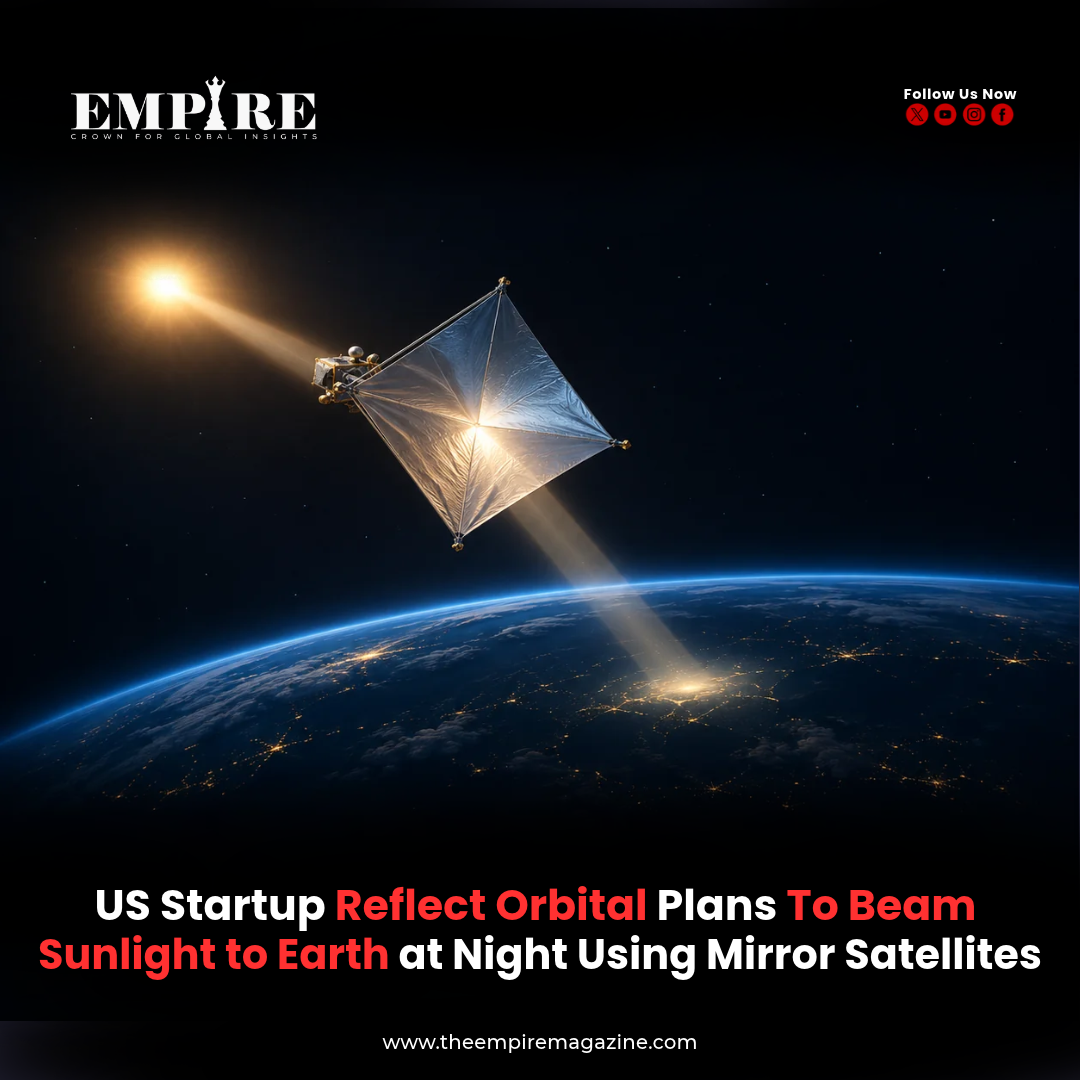
Reflect Orbital is developing satellites equipped with large mirrors to redirect sunlight onto selected locations on Earth after sunset. The US startup sees potential applications in temporary lighting, search-and-rescue operations and extending electricity generation at solar farms.
The Hawthorne, California-based company is led by co-founders Ben Nowack and Tristan Semmelhack. Its concept has attracted investment, launch agreements and scientific scrutiny, but its latest announcements place the first orbital missions in 2027. An operational commercial sunlight service has not yet been demonstrated from orbit.
How Would the Mirror Satellites Work?
The idea relies on a satellite remaining in sunlight while the area below has entered darkness. A steerable reflector would redirect some of that sunlight towards a selected ground location.
Reflect Orbital proposes controlling the illumination by changing the mirror’s orientation. The available lighting window would depend on the satellite’s position and its alignment with both the Sun and the target.
The Eärendil-1 demonstration design has been described as using an approximately 18-by-18-metre reflector, with a ground footprint around five kilometres wide.
Those dimensions help explain the scale of the proposal. The illuminated area would cover a substantial patch of ground, making pointing accuracy and effects beyond the intended site important questions for testing.
Reflect Orbital’s Updated Launch Timeline
The latest development plan separates basic spacecraft testing from the first reflector demonstration.
| Mission | Planned purpose | Latest announced timing |
|---|---|---|
| Eärendil-0 | Test spacecraft control, communications and pointing; it would carry no orbital reflector | No earlier than April 2027, subject to regulatory approval |
| Eärendil-1 | Test reflector deployment and performance in low Earth orbit | Targeted for the second quarter of 2027 |
The company filed its application for the first mission on October 30, 2026. Its November 10 funding announcement provided the updated timing for the subsequent demonstration.
These are planned milestones. Launching a spacecraft, deploying a reflector and operating a dependable commercial service are separate stages that each require evidence.
What Would the First Mirror Demonstration Show?
Reflect Orbital has described a demonstration involving light roughly comparable to a full moon, lasting up to five minutes within two hours after local sunset.
That description concerns a limited test. It does not establish that the initial spacecraft could provide the brightness or duration needed for commercially significant solar-electricity production.
A useful demonstration would measure how accurately the reflector can be deployed and pointed, how much light reaches the target, and how illumination changes during a pass.
Measurements outside the intended footprint would also help assess whether the company’s proposed controls perform as expected.
Could the Technology Help Solar Farms?
Reflect Orbital’s longer-term energy proposal is to direct additional sunlight onto existing solar installations after sunset, allowing them to generate electricity beyond their normal daylight operating period.
The commercial question is how much usable electricity such illumination could produce relative to the cost of delivering it.
An assessment would need to consider reflector size, brightness, duration, weather conditions, spacecraft availability, launch costs and operating expenses. A successful lighting test would be one input into that assessment, rather than proof of competitive electricity prices.
The company also identifies temporary illumination for rescue teams and remote work sites as potential markets. Those applications may have different requirements for brightness, duration and reliability from electricity generation.
New Funding and Launch Agreements
On November 10, 2026, Reflect Orbital announced $73.5 million in new funding, bringing its total funding to more than $100 million.
The company said the investment would support initial launches, development of the reflector technology and commercial partnerships. Participating investors included Sequoia Capital, Lux Capital and Starship Ventures, alongside additional backers.
Separately, an October announcement disclosed the purchase of two dedicated launches from India’s Skyroot Aerospace. The agreement covers the Vikram-1 and the in-development Vikram-1U launch vehicles.
Why Astronomers and Environmental Groups Are Concerned
Reflect Orbital faces objections from organisations concerned about changes to the natural night sky.
The American Astronomical Society has warned about possible effects on astronomical observations, sensitive instruments and the nighttime environment. It has also questioned whether the regulatory process adequately addresses the consequences of operating solar reflectors.
DarkSky International highlights light spill, wildlife, orbital debris and community consent. A customer requesting illumination may not represent everyone living near a target area or affected by scattered light.
In August 2026, DarkSky and allied organisations requested a review of the FCC Space Bureau’s approval of the demonstration satellite.
These concerns are especially relevant to any future expansion. The consequences of a large constellation would require assessment beyond the results of a single brief test.
What Approval Has Been Granted?
The FCC authorised deployment and radio operations for the Eärendil-1 demonstration satellite in July 2026.
That authorisation concerns a single spacecraft. It should not be described as approval for an entire commercial constellation or as proof that the proposed energy service is economically viable.
The scientific and environmental debate also extends beyond radio communications. How reflected light interacts with the atmosphere, observatories and surrounding communities remains central to evaluating the project.
How the Company Proposes to Address Concerns
Reflect Orbital says its planned safeguards include steerable mirrors, limited illumination periods, advance sharing of satellite positions and avoiding sensitive locations such as observatories.
Its public materials also say illumination would require a request and approval from the appropriate local authorities.
These are proposed operating measures whose effectiveness needs to be demonstrated. Useful evidence would include independent brightness measurements, accurate maps of illuminated areas and clear procedures for stopping an illumination event.
Engagement with affected communities would also need to address people outside the paying customer’s site.
What Happens Next?
For Reflect Orbital, the next major tests involve spacecraft control and communications, followed by reflector deployment and measured illumination from orbit.
The questions are practical: can the system reliably deliver the intended light, for the intended duration, while controlling unintended effects? Can the resulting service provide enough value to justify its costs?
The planned missions may help answer those questions. Their results will be more informative than promotional demonstrations alone when assessing the prospects for sunlight delivered from space.
Explore more global business, technology and innovation coverage in The Empire Magazine’s article archive.
Read our related coverage: microsoft-365-outage-outlook-teams/
Follow The Empire Magazine:
Facebook | Instagram
The Empire Magazine | Crown For Global Insights