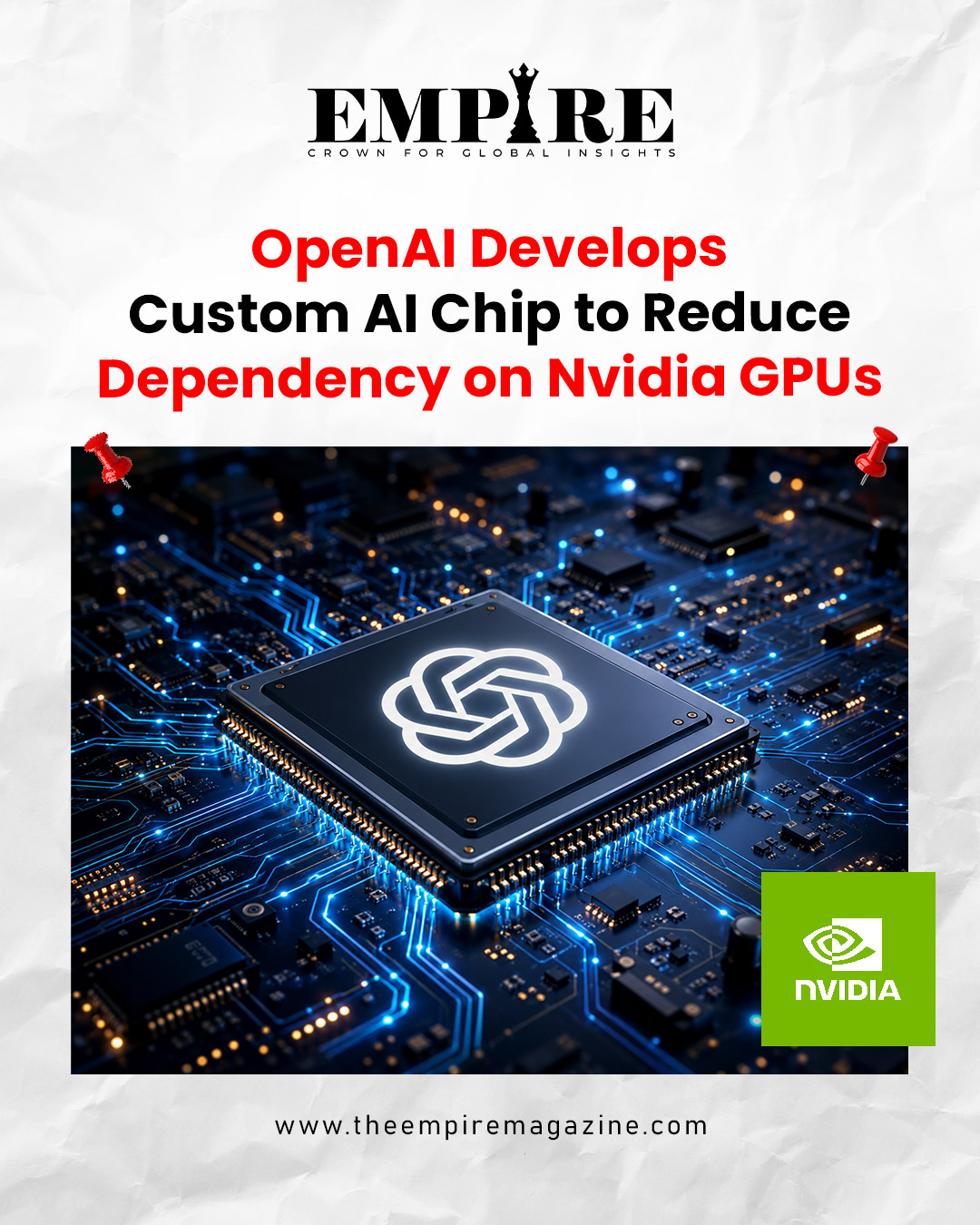
OpenAI is developing a custom AI chip to reduce reliance on Nvidia GPUs, optimize AI workloads, lower infrastructure costs, and strengthen its long-term AI strategy. By developing its own AI chips, OpenAI aims to optimize hardware specifically for its workloads, potentially improving efficiency while reducing operational expenses. Rather than designing general-purpose processors, OpenAI is expected to focus on chips tailored for AI inference and possibly future model training tasks.
OpenAI Develops Custom AI Chip to Reduce Dependency on Nvidia GPUs
The artificial intelligence industry is entering a new era where software innovation alone is no longer enough. As AI models continue to grow in size and complexity, the demand for powerful computing hardware has become one of the biggest challenges facing technology companies worldwide. In this rapidly evolving landscape, OpenAI Custom AI Chip development has emerged as one of the most significant strategic moves in the AI ecosystem. Reports indicate that OpenAI is accelerating efforts to design its own AI chips, reducing its heavy dependence on Nvidia GPUs while gaining greater control over computing infrastructure.
The move reflects a broader transformation occurring across Silicon Valley. Leading technology giants including Google, Amazon, Microsoft, Meta, and Apple have invested billions of dollars in designing proprietary chips optimized for artificial intelligence workloads. OpenAI now appears ready to join this elite group by building specialized hardware capable of supporting next-generation AI models more efficiently.
As generative AI adoption continues to explode across industries, custom silicon has become more than just a technical upgrade it has become a competitive necessity. OpenAI’s chip ambitions could reshape how AI models are trained, deployed, and scaled over the coming decade.
OpenAI Custom AI Chip Signals a New Strategy for AI Infrastructure
The development of the OpenAI Custom AI Chip represents a strategic shift from relying exclusively on third-party hardware suppliers toward owning a larger portion of the AI technology stack.
Currently, Nvidia dominates the AI accelerator market through its highly successful H100 and Blackwell GPU platforms, which power the majority of advanced AI models worldwide. These GPUs have become the backbone of generative AI because of their exceptional parallel computing capabilities.
However, increasing global demand has created supply shortages, rising procurement costs, and fierce competition among technology companies seeking access to Nvidia hardware. For organizations building frontier AI models, limited GPU availability can directly affect product development timelines and infrastructure expansion.
By developing its own AI chips, OpenAI aims to optimize hardware specifically for its workloads, potentially improving efficiency while reducing operational expenses. Rather than designing general-purpose processors, OpenAI is expected to focus on chips tailored for AI inference and possibly future model training tasks.
This strategy mirrors the path taken by companies like Google with Tensor Processing Units (TPUs), Amazon with Trainium and Inferentia chips, and Meta’s in-house AI accelerators. Custom silicon allows organizations to align hardware architecture directly with software requirements, unlocking significant performance gains.
Why Reducing Nvidia GPU Dependency Matters for OpenAI’s Growth
One of the biggest motivations behind the OpenAI Custom AI Chip initiative is reducing dependence on Nvidia’s increasingly expensive GPU ecosystem.
Training advanced language models requires tens of thousands of GPUs operating simultaneously across massive data centers. These infrastructure investments can cost billions of dollars annually.
As OpenAI expands ChatGPT, enterprise AI services, API offerings, and future multimodal systems, computing demand continues to rise dramatically. Every new AI model requires more processing power, greater memory bandwidth, and increasingly sophisticated networking capabilities.
Owning custom AI hardware offers several advantages:
- Lower long-term infrastructure costs
- Better optimization for OpenAI workloads
- Reduced exposure to supply chain constraints
- Improved energy efficiency
- Greater flexibility for future AI architectures
- Enhanced control over product roadmaps
Industry analysts believe that reducing reliance on external suppliers could strengthen OpenAI’s long-term competitiveness while supporting more sustainable AI scaling strategies.
Although Nvidia will likely remain an important hardware partner for years, proprietary AI chips provide strategic flexibility as OpenAI continues expanding globally.
The Global Race for AI Hardware Intensifies Beyond Nvidia GPUs
The OpenAI Custom AI Chip initiative reflects a much larger industry trend where hardware innovation is becoming just as important as software breakthroughs.
Google has spent years refining its Tensor Processing Units for internal AI services and cloud customers. Amazon has introduced Trainium chips for AI training and Inferentia processors for inference workloads through AWS. Microsoft continues investing heavily in Azure AI infrastructure while also developing custom silicon initiatives. Meta has significantly increased investment in proprietary AI accelerators supporting recommendation engines and generative AI applications.
Even startups specializing in AI infrastructure are attracting billions in funding to develop next-generation AI processors capable of competing with traditional GPU architectures.
The rapid growth of generative AI has fundamentally changed semiconductor priorities. Instead of optimizing chips primarily for graphics rendering, companies now design processors capable of handling trillions of AI calculations efficiently.
This competitive landscape demonstrates that future leadership in artificial intelligence will increasingly depend on controlling both software intelligence and the hardware powering it.
How OpenAI Custom AI Chip Could Improve Performance and Efficiency
Beyond reducing costs, the OpenAI Custom AI Chip could significantly improve AI performance through workload-specific optimization.
Unlike general-purpose GPUs that must support diverse computing tasks, custom AI accelerators can be engineered specifically for neural network operations. This specialization enables faster inference speeds, reduced latency, improved energy consumption, and more efficient memory utilization.
For millions of ChatGPT users worldwide, these improvements could eventually translate into:
- Faster responses
- Lower service costs
- Improved reliability
- Better scalability during peak demand
- Enhanced support for multimodal AI
- More efficient enterprise deployments
Inference the process of generating responses after a model has been trained—is becoming increasingly important as AI adoption accelerates globally. Since inference represents the majority of production AI workloads, specialized inference chips can deliver substantial efficiency improvements.
As AI systems become integrated into healthcare, finance, manufacturing, education, customer service, and scientific research, infrastructure optimization will become essential for maintaining affordability and performance.
What the OpenAI Custom AI Chip Means for the Future of Artificial Intelligence
The development of the OpenAI Custom AI Chip signals an important evolution in the artificial intelligence industry. Rather than viewing AI solely as a software challenge, leading companies now recognize that future innovation depends equally on advanced semiconductor engineering.
OpenAI’s hardware ambitions could eventually support increasingly sophisticated AI systems capable of reasoning, multimodal understanding, scientific discovery, robotics, and autonomous decision-making. Custom chips may also enable more sustainable AI infrastructure by improving performance per watt and reducing energy consumption across massive data centers.
For Nvidia, OpenAI’s move does not necessarily represent an immediate competitive threat. Demand for Nvidia GPUs remains extraordinarily strong, and the company continues leading the AI accelerator market through rapid product innovation. However, the broader trend toward proprietary silicon suggests that hyperscale AI companies want greater independence over their computing ecosystems.
The coming years are likely to witness intense competition among AI chip developers, cloud providers, semiconductor manufacturers, and AI model creators. This competition will ultimately benefit businesses and consumers through faster innovation, improved efficiency, and lower deployment costs.
As artificial intelligence becomes foundational to the global digital economy, custom AI hardware will play a defining role in determining which organizations lead the next generation of technological advancement. OpenAI’s investment in proprietary chips is therefore not simply about reducing dependency on Nvidia—it is about building the infrastructure needed to power the future of AI itself.
OpenAI Custom AI Chip Could Redefine AI Infrastructure
The emergence of the OpenAI Custom AI Chip marks a pivotal chapter in the evolution of artificial intelligence infrastructure. While Nvidia GPUs remain indispensable for training and deploying today’s most advanced AI models, OpenAI’s decision to invest in proprietary silicon reflects a long-term strategy focused on efficiency, scalability, and technological independence.
As the AI race intensifies, owning both the software and the underlying hardware will become a critical competitive advantage. Whether for powering ChatGPT, supporting enterprise AI services, or enabling future generations of intelligent systems, custom chips have the potential to transform performance while lowering operational costs.
For the global AI industry, this development highlights a broader reality: the future of artificial intelligence will be shaped not only by smarter algorithms but also by smarter hardware. OpenAI’s custom chip initiative may therefore become one of the most influential milestones in the next phase of AI innovation.
For more business and retail insights, read more on The Empire Magazine
Previous article: https://theempiremagazine.com/lime-micromobility/
Magazine Feautures | Podcasts: Empire Global Talks
Follow The Empire Magazine on Facebook | Instagram | LinkedIn | YouTube
The Empire Magazine | Crown for Global Insights